• Fri frakt över 249 kr
  • •
  • Snabba leveranser
  • •
  • Billiga böcker
Kundservice

Du är på sajten för privatpersoner.

Företag, bibliotek eller offentlig verksamhet?

Du handlar på classic.bokus.com, där alla dina funktioner finns intakta.
Till classic.bokus.com
Bokus logotyp. Gå till startsidan.
  • Erbjudanden
  • Nyheter
  • Student
  • Topplistor
  • Barn & ungdom
  • Bokus Play
  • E-böcker
  • Pocketböcker
  • Spel & pussel

10% studentrabatt med kod TERM26

Sidfot

Mina sidor

    Hjälp

    • Kundservice
    • Vanliga frågor och svar
    • Frakt och leverans
    • Retur vid ångerrätt
    • Reklamera vara
    • Betalning
    • Köpvillkor
    • Allmänna villkor
    • Information om webbplatsens tillgänglighet

    Om Bokus

    • Om oss
    • Pressrum
    • För studenter
    • För företag
    • För bibliotek och offentlig verksamhet
    • För leverantörer
    • Hållbarhet

    Populärt

    • Aktuella erbjudanden
    • Presentkort
    • Studentlitteratur
    • Nya böcker
    • Topplistor
    • Signerade böcker
    • Engelska böcker

    Inspiration

    • Boktips
    • BookTok
    • Populära bokserier
    • Barnbokskaraktärer
    • Populära författare
    Logotyp för Bokus
    Följ oss på Facebook (extern länk)Följ oss på Instagram (extern länk)Följ oss på YouTube (extern länk)Följ oss på TikTok (extern länk)
    bokus @ CookiesAnpassa cookiesIntegritetspolicyKöpvillkor
    Till Citymail hemsida (extern länk)Till Budbee hemsida (extern länk)Till Postnord hemsida (extern länk)Till Schenker hemsida (extern länk)Till Early Bird hemsida (extern länk)Till Walleys hemsida (extern länk)
    1. Psykologi och pedagogik
    2. Pedagogik
    3. Högskola och universitet

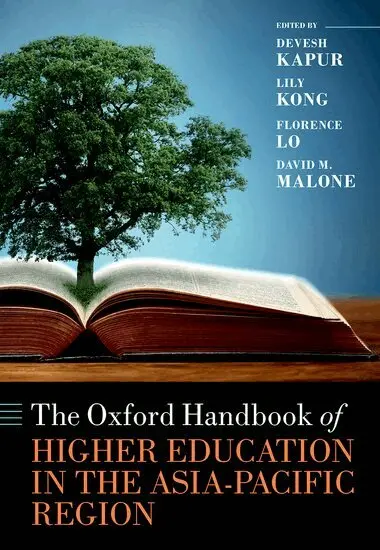
    The Oxford Handbook of Higher Education in the Asia-Pacific Region

    AvDevesh Kapur,Lily Kong

    Inbunden, Engelska, 2023

    Del i serien Oxford Handbooks

    2 652 kr

    Beställningsvara. Skickas inom 7-10 vardagar. Fri frakt över 249 kr.

    Beskrivning

    Since the turn of the millennium it has become clear that the Asia-Pacific Region is, economically, the fastest growing continent in the world, and is likely to remain so for some time despite the setbacks of the COVID-19 pandemic. Asia-Pacific's share of the world's Gross Domestic Product (GDP) doubled from 15 per cent to 30 per cent between 1970 and 2017 and is projected to account for half of global GDP by 2050. With South East and South Asia also growing rapidly, with over half the world's population and three of the world's five largest economies, Asia is soon poised to home half of the world's middle class - a class that is both the driver and the product of higher education.The quality of a country's system of higher education may be seen both as a gauge of its current level of national development as well as of its future economic prospects. It is therefore natural that the putative "Asian Century" should generate interest in the region's higher education systems which, on the one hand, share common characteristics-a fixation with credentials and engineering, high technology (especially among male students), and business degrees-while at the same time are also highly differentiated, not only across countries but also within. As such, a better understanding of higher education achievements, failings, potential, and structural limitations in the Asia-Pacific Region is imperative.This handbook presents a number of significant country case-studies and documents cross-cutting trends relating to, among other things: the trilemma faced by governments juggling competing claims of access, accessible cost, and quality; the balance between teaching and research; the links between labour markets (demand) and higher education (supply); preferred fields of study and their consequences; the rise of the research university in Asia; the lure of institutions of international reputation within the region; new education technologies and their effects; and, trends in government policy within the wider region and sub-regions.

    Produktinformation

    • Utgivningsdatum:2023-01-26
    • Mått:183 x 253 x 59 mm
    • Vikt:1 838 g
    • Format:Inbunden
    • Språk:Engelska
    • Serie:Oxford Handbooks
    • Antal sidor:976
    • Förlag:OUP OXFORD
    • ISBN:9780192845986

    Utforska kategorier

    • Högskola och universitet inom Psykologi och pedagogik
    • Utbildningsstrategier och utbildningspolitik inom Psykologi och pedagogik
    • Affärsstrategi inom Ekonomi och Ledarskap

    Mer om författaren

    Devesh Kapur is Starr Foundation South Asia Studies Professor at the Paul H. Nitze School of Advanced International Studies (SAIS) at Johns Hopkins University. His recent books include Navigating the Labyrinth: Perspectives on India's Higher Education and The Other One Percent: Indians in America.Lily Kong is President of the Singapore Management University and Lee Kong Chian Chair Professor of Social Sciences. Her research focuses on social and cultural change in Asian cities and she has published widely on topics such as religion, cultural policy, creative industries, smart cities, urban heritage, and education.Florence Lo is the Legal Specialist at the United Nations University (UNU). Prior to joining UNU, she worked as a legal practitioner in Southeast Asia providing legal and regulatory advice across a broad range of practice areas including project financing, banking and security, land and property, and labour and employment law.David Malone is UN Under-Secretary General, Rector of the United Nations University (UNU). Prior to joining UNU he served as President of Canada's International Development Research Centre (2008-2013) and as Canada's High Commissioner to India and non-resident Ambassador to Bhutan and Nepal (2006-2008).

    Innehållsförteckning

    • Devesh Kapur, Lily Kong, Florence Lo, and David M. Malone: Introduction I. History 1: Deane Neubauer: History of Higher Education in Asia-Pacific II. Goals, Growth, and Massification 2: Malcolm Tight: From Elite Higher Education to Massification: The Asia-Pacific Experience 3: Roslyn Cameron and John Burgess: Employment and Labour Markets 4: Arnoud De Meyer: Productive Workers or Better Citizens? III. Who Learns? 5: Prompilai Buasuwan and Arisara Leksansern: Access 6: Elizabeth M. King: Gender in Higher Education in The Asia-Pacific Region: Vertical Progress, Horizontal Segregation, and a Leaky Pipeline IV. What: Content and Learning in Higher Education 7: Johanna Waters: The Relationship Between Credentials and Learning: A Focus on International Educational Value and Distinction 8: Mikiko Nishimura: Liberal Arts and Sciences Education for the 21st Century in Asia 9: Aki Yamada: STEM Field Demand and Educational Reform in Asia-Pacific Countries 10: William Yat Wai Lo and Ryan M. Allen: The Rankings Game 11: Sheng-Ju Chan and Hua-Chi Chou: Professional Education: Models and Issues V. How and Who? 12: Angela Yung Chi Hou, I-Jung Grace Lu, Karen Hui Jung Chen, and Chao Yu Guo: Quality Regulation in Higher Education in Asia-Pacific: Roles of Quality Assurance and National Qualification Frameworks 13: K.C. Ho, Ravinder Sidhu, and Brenda S.A. Yeoh: Internationalisation and Education-Related Mobility in Asia-Pacific Universities 14: Christopher S. Collins and Alexander H. Jones: Internationalization and Mobility: Providers, Academic Collaborators and Recognition of Qualifications 15: Kris Olds: Education Hubs in the Asia-Pacific 16: Melinda dela Peña Bandalaria and Alexandra Ivanovic: Open University Systems 17: Helen Farley: MOOCs in Asia: Promise Unfulfilled or Promise Realised? VI. Costs: Who Pays? 18: Xi Wang and W. James Jacob: Public Financing 19: Swee-Sum Lam: Private Philanthropy in Higher Education in Asia 20: Adrian Ziderman: Student Loans in Practice: Benefits and Pitfalls of Loans Schemes in Asia VII. Consequences and Challenges 21: Rennie J. Moon: Returning Talent 22: Youngsuk Chi and John Van Orden: Asia as a Producer of Knowledge 23: Jack T. Lee: Asian Higher Education as Soft Power? 24: Christopher D. Hammond: Higher Education and Nationalism in the Asia-Pacific 25: Hongxia Shan and Zheng Ren: Lifelong Learning as a Globally Diffused Policy Discourse in Asia VIII. Country Studies 26: Wenqin Shen and Wanhua Ma: China: Historical and Contemporary Development of Higher Education 27: Lan Xue, Zhen Yu, and Zhou Zhong: Elite Universities in China 28: Niraja Gopal Jayal: India: History and Thrust of Overall Higher Education and Research Patterns 29: Pratap Bhanu Mehta: Private Universities in India: New Dawn or False Dawn? 30: Akiyoshi Yonezawa: Japan: The Changing Role of Higher Education for Nation-Building 31: Miki Sugimura and Shinobu Yume Yamaguchi: Japan: Challenges in Internationalization of its Higher Education Sector 32: Jang Wan Ko: Higher Education in the Republic of Korea 33: S. Gopinathan and Michael H. Lee: Singapore: The Making of Higher Education in an Asian Education Hub 34: Jin Jiang: Higher Education in Hong Kong: Recent Developments and Challenges 35: Anthony Welch: Australia: History Versus Geography in an Evolving National System 36: Kathryn A. Sutherland and Stephen J. Marshall: Education for All? Higher Education at a Crossroads in Aotearoa New Zealand 37: Chiara Logli and Hermin Indah Wahyuni: Indonesia: The Politics of Equity and Quality in Higher Education 38: Chang Da Wan: Higher Education in Malaysia 39: Prachayani Praphamontripong Kanwar and Florence Lo: Privatized Higher Education in Thailand: In Pursuit of Legitimacy and Profitability 40: Marie Lall, Camille Kandiko Howson, and Aye Aye Tun: Higher Education in Myanmar 41: Maria Cynthia Rose Bautista, Vicente Paqueo, and Aniceto Orbeta Jr: Philippine Higher Education: A Case for Public-Private Complementarity in the Next Normal