• Fri frakt över 249 kr
  • •
  • Snabba leveranser
  • •
  • Billiga böcker
Kundservice

Du är på sajten för privatpersoner.

Företag, bibliotek eller offentlig verksamhet?

Du handlar på classic.bokus.com, där alla dina funktioner finns intakta.
Till classic.bokus.com
Bokus logotyp. Gå till startsidan.
  • Erbjudanden
  • Nyheter
  • Student
  • Topplistor
  • Barn & ungdom
  • Bokus Play
  • E-böcker
  • Pocketböcker
  • Spel & pussel

10% rabatt på allt med kod: NYSTART10 →

Sidfot

Mina sidor

    Hjälp

    • Kundservice
    • Vanliga frågor och svar
    • Frakt och leverans
    • Retur vid ångerrätt
    • Reklamera vara
    • Betalning
    • Köpvillkor
    • Allmänna villkor
    • Information om webbplatsens tillgänglighet

    Om Bokus

    • Om oss
    • Pressrum
    • För studenter
    • För företag
    • För bibliotek och offentlig verksamhet
    • För leverantörer
    • Hållbarhet

    Populärt

    • Aktuella erbjudanden
    • Presentkort
    • Studentlitteratur
    • Nya böcker
    • Topplistor
    • Signerade böcker
    • Engelska böcker

    Inspiration

    • Boktips
    • BookTok
    • Populära bokserier
    • Barnbokskaraktärer
    • Populära författare
    Logotyp för Bokus
    Följ oss på Facebook (extern länk)Följ oss på Instagram (extern länk)Följ oss på YouTube (extern länk)Följ oss på TikTok (extern länk)
    bokus @ CookiesAnpassa cookiesIntegritetspolicyKöpvillkor
    Till Citymail hemsida (extern länk)Till Budbee hemsida (extern länk)Till Postnord hemsida (extern länk)Till Schenker hemsida (extern länk)Till Early Bird hemsida (extern länk)Till Walleys hemsida (extern länk)
    1. Psykologi och pedagogik
    2. Psykologi
    3. Kognitiv psykologi

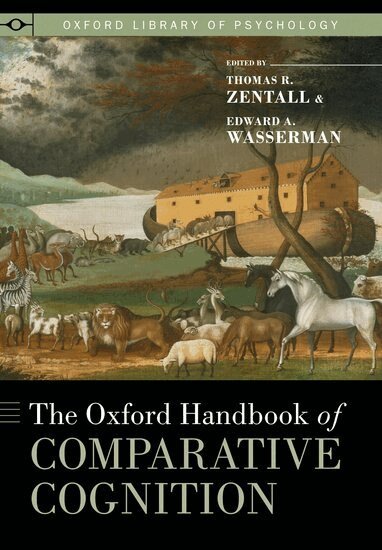
    The Oxford Handbook of Comparative Cognition

    AvEdward A. Wasserman,Thomas R. Zentall

    Inbunden, Engelska, 2012

    Del i serien Oxford Library of Psychology

    3 507 kr

    Beställningsvara. Skickas inom 5-8 vardagar. Fri frakt över 249 kr.

    Beskrivning

    In the past decade, the field of comparative cognition has grown and thrived. No less rigorous than purely behavioristic investigations, examinations of animal intelligence are useful for scientists and psychologists alike in their quest to understand the nature and mechanisms of intelligence. Extensive field research of various species has yielded exciting new areas of research, integrating findings from psychology, behavioral ecology, and ethology in a unique and wide-ranging synthesis of theory and research on animal cognition. This updated edition of The Oxford Handbook of Comparative Cognition contains sections on perception and illusion, attention and search, memory processes, spatial cognition, conceptualization and categorization, problem solving and behavioral flexibility, and social cognition processes. The authors have incorporated new findings and new theoretical approaches that reflect the current state of the field, including findings in primate tool usage, pattern learning, and counting. This comprehensive volume will be a must-read for students and scientists who are curious about the state the modern science of comparative cognition.

    Produktinformation

    • Utgivningsdatum:2012-04-19
    • Mått:183 x 257 x 53 mm
    • Vikt:1 814 g
    • Format:Inbunden
    • Språk:Engelska
    • Serie:Oxford Library of Psychology
    • Antal sidor:960
    • Upplaga:2
    • Förlag:OUP USA
    • ISBN:9780195392661

    Utforska kategorier

    • Kognitiv psykologi inom Psykologi och pedagogik
    • Arbetspsykologi inom Psykologi och pedagogik

    Mer om författaren

    Edward A. Wasserman, Ph.D., is Stuit Professor of Experimental Psychology, Department of Psychology, Iowa Center for Developmental and Learning Sciences, The University of Iowa. Thomas Zentall, Ph.D., is DiSilvestro Professor of Arts and Sciences and Professor of Psychology, University of Kentucky.

    Recensioner i media

    Those who study comparative cognition find themselves in a particularly prosperous time . . . A diversity of available species to study, opportunities for increased national and international collaboration, and technological advances offer us a greater opportunity for data collection and dissemination than at any time in history. The present book attests to how these opportunities can produce compelling research programs that serve as excellent models for the future of comparative cognition.

    Innehållsförteckning

    • Contents ; 1. Introduction to the Oxford Handbook of Comparative Cognition ; Edward A. Wasserman and Thomas R. Zentall ; I. Perception and Illusion ; 2. Grouping and Segmentation in human and nonhuman primates ; Joel Fagot, Isabelle Barbet, and Carole Parron ; 3. Seeing What Is Not There: Illusion, Completion, and Spatiotemporal Boundary Formation in Comparative Perspective ; Kazuo Fujita ; 4. The Cognitive Chicken: Visual and Spatial Cognition in a Nonmammalian Brain ; Giorgio Vallortigara ; 5. New Perspectives on Absolute Pitch in Birds and Mammals ; Ronald G. Weisman, Douglas J. K. Mewhort, Marisa Hoeschele, and Christopher B. Sturdy ; II. Attention and Search ; 6. Reaction-time Explorations of Visual Perception, Attention, and Decision in Pigeons ; Donald S. Blough ; 7. The Competition for Attention in Humans and Other Animals ; David A. Washburn and Lauren A. Taglialatela ; 8. Establishing frames of reference for finding hidden goals: The use of multiple spatial cues by nonhuman animals and people ; Brett Gibson ; III. Learning and Causation ; 9. Contemporary thought on the environmental cues that affect causal attribution ; Michael E. Young ; 10. Associative Accounts of Causality Judgments ; Martha Escobar and Ralph R. Miller ; 11. Rational Rats: Causal Inference and Representation ; Aaron P. Blaisdell and Michael R. Waldmann ; 12. Contrast: A More Parsimonious Account of Cognitive Dissonance Effects ; Thomas R. Zentall, Rebecca A. Singer, Tricia S. Clement, Andrea M. Friedrich, and Jerome Alessandri ; IV. Memory Processes ; 13. Methodological Issues in Comparative Memory Research ; Thomas R. Zentall ; 14. Memory Processing ; Anthony A. Wright ; 15. The Questions of Temporal and Spatial Displacement in Animal Cognition ; William A. Roberts ; 16. Animal Metacognition ; J. David Smith, Michael J. Beran, and Justin J. Couchman ; 17. A comparative analysis of episodic memory: Cognitive mechanisms and neural substrates ; H. Eichenbaum, Magdalena Sauvage, Norbert Fortin, Jonathan Robitsek, and Robert Komorowski ; 18. Spatial, Temporal, and Associative Behavioral Functions Associated with Different Subregions of the Hippocampus ; Raymond P. Kesner, Andrea M. Morris, and Christy S.S. Weeden ; V. Spatial Cognition ; 19. Arthropod Navigation: Ants, Bees, Crabs, Spiders Finding Their Way ; Ken Cheng ; 20. Comparative Spatial Cognition: Encoding of Geometric Information from Surfaces and Landmark Arrays. ; Debbie M. Kelly and Marcia L. Spetch ; 21. Corvid Caching: The Role of Cognition ; S. R. De Kort, N. J. Emery, and N. S. Clayton ; VI. Timing and Counting ; 22. Behavioristic, Cognitive, Biological, and Quantitative Explanations of Timing ; Russell M. Church ; 23. Sensitivity to Time: Implications for the Representation of Time ; Jonathon D. Crystal ; 24. Comparative cognition of number representation ; Dustin J. Merritt, Nicholas K. DeWind, and Elizabeth M. Brannon ; 25. Similarities Between Temporal and Numerosity Discriminations ; J. Gregor Fetterman ; VII. Categorization and Concept Learning ; 26. A modified feature theory as an account of pigeon visual categorization ; Ludwig Huber and Ulrike Aust ; 27. Artificial Categories and Prototype Effects in Animals ; Masako Jitsumori ; 28. Relational Discrimination Learning in Pigeons ; Robert G. Cook and Edward A. Wasserman ; 29. Similarity and Difference in the Conceptual Systems of Primates: The Unobservability Hypothesis ; Jennifer Vonk and Daniel J. Povinelli ; VIII. Pattern Learning ; 30. Spatial Patterns: Behavioral Control and Cognitive Representation ; Michael F. Brown ; 31. The Organization of Sequential Behavior: Conditioning, Memory, and Abstraction ; Stephen B. Fountain, James D. Rowan, Melissa D. Muller, Shannon M. A. Kundey, Laura R. G. Pickens, and Karen E. Doyle ; 32. The Comparative Psychology of Ordinal Knowledge ; Herbert Terrace ; 33. Truly Random Operant Responding: Results and Reasons ; Greg Jensen, Claire Miller, and Allen Neuringer ; 34. From Momentary Maximizing to Serial Response Times and Artificial Grammar Learning ; Charles P. Shimp, Walter Herbranson, and Thane Fremouw ; IX. Problem Solving, Behavioral Flexibility, and Tool Use ; 35. Intelligences and Brains: An Evolutionary Bird's Eye View ; Juan D. Delius and Julia A. M. Delius ; 36. Transitive inference in nonhuman animals ; Olga F. Lazareva ; 37. Dolphin Problem Solving ; Stan A. Kuczaj II and Rachel T. Walker ; 38. <"What>" and <"Where>" Analysis and Flexibility in Avian Visual Cognition ; Shigeru Watanabe ; X. Social Cognition Processes ; 39. Social Learning in Rats: Historical Context and Experimental Findings ; Bennett G. Galef ; 40. What Is Challenging About Tool Use? The Capuchin's Perspective ; Elisabetta Visalberghi and Dorothy Fragaszy ; 41. Inter-species social learning in dogs: The inextricable roles of phylogeny and ontogeny ; Monique A. R. Udell, Nicole R. Dorey, Clive D. L. Wynne ; 42. Social learning: strategies, mechanisms and models ; Kevin N. Laland, Lewis Dean, Will Hoppitt, Luke Rendell & Mike M. Webster ; 43. Chimpanzee Social Cognition in Early Life: Comparative-Developmental Perspective ; Masaki Tomonaga, Masako Myowa-Yamakoshi, Yuu Mizuno, Sanae Okamoto, Masami K. Yamaguchi, Daisuke Kosugi, Kim A. Bard, Masayuki Tanaka, Tetsuro Matsuzawa ; 44. Social Learning and Culture in Primates: Evidence from Free-Ranging and Captive Populations ; Elizabeth E. Price and Andrew Whiten ; Epilogue: ; 45. Postscript: An Essay on the Study of Cognition in Animals ; Stewart H. Hulse ; Index