• Fri frakt över 249 kr
  • •
  • Snabba leveranser
  • •
  • Billiga böcker
Kundservice

Du är på sajten för privatpersoner.

Företag, bibliotek eller offentlig verksamhet?

Du handlar på classic.bokus.com, där alla dina funktioner finns intakta.
Till classic.bokus.com
Bokus logotyp. Gå till startsidan.
  • Erbjudanden
  • Nyheter
  • Student
  • Topplistor
  • Barn & ungdom
  • Bokus Play
  • E-böcker
  • Pocketböcker
  • Spel & pussel

10% studentrabatt med kod TERM26

Sidfot

Mina sidor

    Hjälp

    • Kundservice
    • Vanliga frågor och svar
    • Frakt och leverans
    • Retur vid ångerrätt
    • Reklamera vara
    • Betalning
    • Köpvillkor
    • Allmänna villkor
    • Information om webbplatsens tillgänglighet

    Om Bokus

    • Om oss
    • Pressrum
    • För studenter
    • För företag
    • För bibliotek och offentlig verksamhet
    • För leverantörer
    • Hållbarhet

    Populärt

    • Aktuella erbjudanden
    • Presentkort
    • Studentlitteratur
    • Nya böcker
    • Topplistor
    • Signerade böcker
    • Engelska böcker

    Inspiration

    • Boktips
    • BookTok
    • Populära bokserier
    • Barnbokskaraktärer
    • Populära författare
    Logotyp för Bokus
    Följ oss på Facebook (extern länk)Följ oss på Instagram (extern länk)Följ oss på YouTube (extern länk)Följ oss på TikTok (extern länk)
    bokus @ CookiesAnpassa cookiesIntegritetspolicyKöpvillkor
    Till Citymail hemsida (extern länk)Till Budbee hemsida (extern länk)Till Postnord hemsida (extern länk)Till Schenker hemsida (extern länk)Till Early Bird hemsida (extern länk)Till Walleys hemsida (extern länk)
    1. Samhälle och politik
    2. Samhälle och kultur
    3. Sociala och etiska frågor

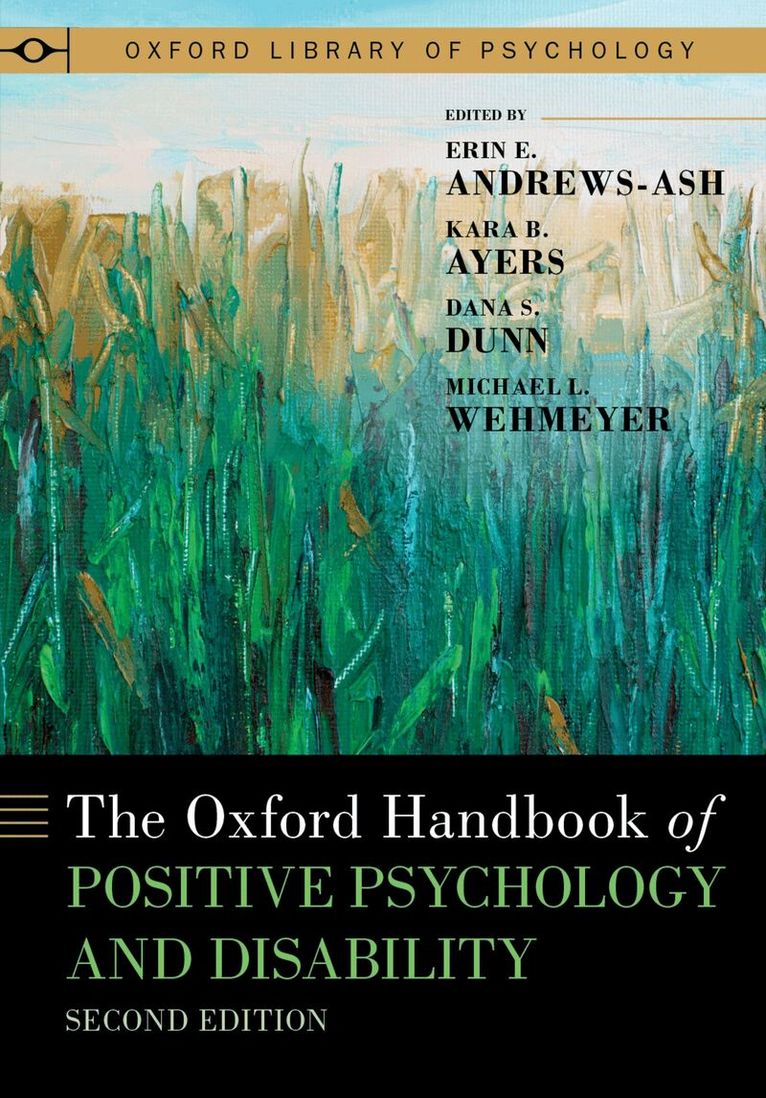
    The Oxford Handbook of Positive Psychology and Disability

    AvErin E. Andrews-Ash,Kara B. Ayers

    Inbunden, Engelska, 2026

    Del i serien Oxford Library of Psychology

    2 079 kr

    Beställningsvara. Skickas inom 5-8 vardagar. Fri frakt över 249 kr.

    Beskrivning

    Roughly 61 million people with disabilities live in the United States, and there are many more millions of people with disabilities around the world. Not surprisingly, differences among and between people with disabilities are often as notable as differences between people with and without disabilities. And, while the lack of homogeneity among people with disabilities makes creating a valid taxonomy under this term difficult, if not impossible, there is commonality among and between people with disabilities that justifies an authoritative resource on positive psychology and disability. That is, they have experienced discrimination and marginalization as a function of their disability.This expanded and updated volume assembles chapters by leading scholars in the fields of disability and positive psychology to provide a comprehensive synthesis of the state of the combined field of positive psychology and disability. Chapters are organized into thematic sections, beginning with an introductory section providing information on overarching themes in positive psychology and disability. The second section focuses on specific positive psychological constructs that have relevance to disability, including optimism, hope, social well-being, resilience, and positive education. The following section examines systems that take strengths-based approaches to treatment and intervention, while the fourth section looks at the application of positive psychological principles in specific disciplines such as rehabilitation sciences and disability studies. The final section focuses on topics that merit consideration in positive psychology and disability such as disability ethics, adaptation, and toxic positivity.Disability has always been associated with "differentness" and, consequently, people with disabilities have, throughout time, been treated as such. By examining disability from a strengths-based perspective, this volume provides a catalyst to accelerate the application of positive psychology with regard to how disability is understood.

    Produktinformation

    • Utgivningsdatum:2026-04-06
    • Mått:182 x 253 x 37 mm
    • Vikt:1 012 g
    • Format:Inbunden
    • Språk:Engelska
    • Serie:Oxford Library of Psychology
    • Antal sidor:516
    • Upplaga:2
    • Förlag:OUP USA
    • ISBN:9780197749760

    Utforska kategorier

    • Sociala och etiska frågor inom Samhälle och politik
    • Socialpsykologi och gruppsykologi inom Psykologi och pedagogik
    • Folkhälsa och hälsopedagogik inom Medicin

    Mer om författaren

    Erin E. Andrews, PsyD, ABPP, is an affiliate faculty member in the Department of Psychiatry and Behavioral Sciences at Dell Medical School, the University of Texas at Austin, and the Chief of Psychology for the Veterans Health Administration VISN 17 Mental Health Clinical Resource Hub. Kara B. Ayers, PhD, is an Associate Professor of Pediatrics in the College of Medicine at the University of Cincinnati and the Associate Director of the University of Cincinnati Center for Excellence.Dana S. Dunn, PhD, is Professor of Psychology and Director of Academic Assessment at Moravian University in Bethlehem, PA. Michael L. Wehmeyer, PhD, is the Ross and Marianna Beach Distinguished Professor in Special Education and Senior Scientist and Director, Beach Center on Disability at the University of Kansas.

    Innehållsförteckning

    • Part I: Introduction to Positive Psychology and Disability Chapter 1: Embracing Disability Identity: A Positive Psychology PerspectiveErin E. Andrews and Jaylene M. Lee Chapter 2: A Brief History of Positive Psychology and Its Application to DisabilityDana S. Dunn and Michael L. Wehmeyer Chapter 3: Conceptualizing Disability: Positive Psychology and the ICF ModelsMichael L. Wehmeyer and Dana S. Dunn Chapter 4: Positive Deviance: Character Strength Development at the Intersectionality of DisabilityDan Tomasulo Chapter 5: Cultural Diversity, Equity, and Inclusion in Positive Psychology and DisabilityChandra Donnell Carey and Tyra A Bernard-Watts Part II: Application of Positive Psychological Constructs to Disability Chapter 6: Optimism Within the Context of DisabilityKevin L. Rand and Naheeda Ahamadeen Chapter 7: Disability and Hope: The Neurodevelopmental Disorder PerspectiveMalka Margalit and Michal Al-Yagon Chapter 8: Coping and Disability: A Positive Psychology PerspectiveElla McNeil, Abigail Wang, Kaitlin Gelman, Jack Holloway, Gissette Noriega, and Michele M. Tugade Chapter 9: Social Well-Being and FriendshipCarli Friedman Chapter 10: Self-Determination and Self-Determined LearningSheida K. Raley, Michael L. Wehmeyer, and Todd D. Little Chapter 11: Resilience, Problem Solving, and the Experience of Disability: A Positive Psychological PerspectiveDana S. Dunn and Kara B. Ayers Chapter 12: Interpersonal Decision Making in Individuals With Intellectual and Developmental DisabilitiesIshita Khemka Chapter 13: Character StrengthsRyan M. Niemiec Chapter 14: Mindfulness and DisabilityNirbhay N. Singh, Giulio E. Lancioni, Rachel E. Myers, Yoon-Suk Hwang, and Oleg N. Medvedev Chapter 15: Disability and Sexual Positivity: The Right to Sexual CitizenshipRoxanna Nasseri Pebdani, Rachel Cuesta, Gabrielle Ficchi, Jolie Chantharath, Margaret McGrath Chapter 16: Disability and the Virtues of InterdependencyShane Clifton and Jemma Clifton Chapter 17: A Social Identity Approach to Positive Education: Toward New Sources of Life Satisfaction for Students with DisabilitiesJeffrey G. Noel, Thomas P. Dirth, and Michelle R. Nario-Redmond Chapter 18: Understanding and Increasing Well-Being in People With Disabilities and/or Chronic IllnessBarry Nierenberg and D'anna Sydow Part III. Strengths-based Processes, Approaches, and Systems Chapter 19: Supports and Support NeedsVirginia Walker, Megan E. Carpenter, Yuwadee Viriyangkura, and James R. Thompson Chapter 20: Positive Psychology Measurement and Assessment Lauren A. Stutts and Erin E. Andrews Chapter 21: Micro, Meso, and Macro Actions for an Inclusive and Sustainable Career FutureLaura Nota, Maria Cristina Ginevra, Sara Santilli, Denise Zucchini, and Salvatore Soresi Chapter 22: Powering up Family Systems Using Systems-Informed Positive Psychology: Parent-Peer Workers as Levers for ChangeSylvana Mahmic, Margaret L. Kern, Annick Janson, Danielle Tracey, and Christine Johnston Chapter 23: Aging With DisabilityTamar Heller, Lieke van Heumen, and Abby Schindler Chapter 24: Social Support and DisabilityKathleen R. Bogart, Brooke A Bryson, and Amanda Hemmesch Part IV. Positive Psychology and Disability Disciplines Chapter 25: Positive Rehabilitation Psychology: Prospects, Progress, and PotentialDana S. Dunn and Timothy R. Elliott Chapter 26: Disability Studies Brenda Jo Brueggemann and Jessica Gallagher Chapter 27: Positive Psychological Mechanisms and Interventions in Chronic PainJennifer G. Pearston and Dawn M. Ehde Chapter 28: Positive Psychology and Brain Injury SystemsJed N. McGiffin, Whitney Morean, and David Sheppard Part V. Considerations in Positive Psychology and Disability Chapter 29: Positive Psychology and Disability Ethics: Foundations and PrinciplesEmily M. Lund Chapter 30: Adaptation and Disability IdentityToni Saia, Joseph Stramondo, Abraham Graber, and Kathleen Green Chapter 31: Toxic Positivity: The Pitfalls of Positivity in the Context of DisabilityCarrie R. Pilarski and Miso Kwak Chapter 32: Conclusions and Future DirectionsErin Andrews, Kara Ayers, Dana S. Dunn, and Michael L. Wehmeyer