• Fri frakt över 249 kr
  • •
  • Snabba leveranser
  • •
  • Billiga böcker
Kundservice

Du är på sajten för privatpersoner.

Företag, bibliotek eller offentlig verksamhet?

Du handlar på classic.bokus.com, där alla dina funktioner finns intakta.
Till classic.bokus.com
Bokus logotyp. Gå till startsidan.
  • Erbjudanden
  • Nyheter
  • Student
  • Topplistor
  • Barn & ungdom
  • Bokus Play
  • E-böcker
  • Pocketböcker
  • Spel & pussel

10% rabatt på allt med kod: NYSTART10 →

Sidfot

Mina sidor

    Hjälp

    • Kundservice
    • Vanliga frågor och svar
    • Frakt och leverans
    • Retur vid ångerrätt
    • Reklamera vara
    • Betalning
    • Köpvillkor
    • Allmänna villkor
    • Information om webbplatsens tillgänglighet

    Om Bokus

    • Om oss
    • Pressrum
    • För studenter
    • För företag
    • För bibliotek och offentlig verksamhet
    • För leverantörer
    • Hållbarhet

    Populärt

    • Aktuella erbjudanden
    • Presentkort
    • Studentlitteratur
    • Nya böcker
    • Topplistor
    • Signerade böcker
    • Engelska böcker

    Inspiration

    • Boktips
    • BookTok
    • Populära bokserier
    • Barnbokskaraktärer
    • Populära författare
    Logotyp för Bokus
    Följ oss på Facebook (extern länk)Följ oss på Instagram (extern länk)Följ oss på YouTube (extern länk)Följ oss på TikTok (extern länk)
    bokus @ CookiesAnpassa cookiesIntegritetspolicyKöpvillkor
    Till Citymail hemsida (extern länk)Till Budbee hemsida (extern länk)Till Postnord hemsida (extern länk)Till Schenker hemsida (extern länk)Till Early Bird hemsida (extern länk)Till Walleys hemsida (extern länk)
    1. Naturvetenskap och teknik
    2. Matematik och naturvetenskap
    3. Biologi
    4. Biovetenskap

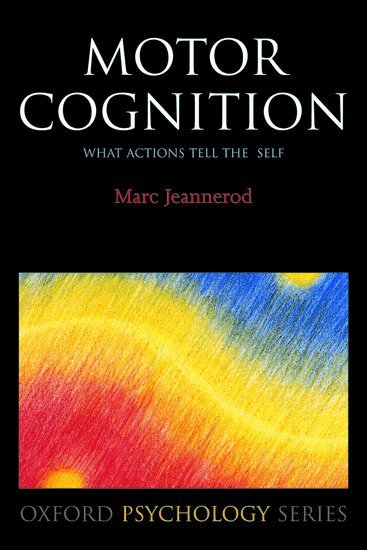
    Motor Cognition

    What actions tell the self

    AvMarc Jeannerod

    Häftad, Engelska, 2006

    Del 42 i serien Oxford Psychology Series

    1 581 kr

    Beställningsvara. Skickas inom 5-8 vardagar. Fri frakt över 249 kr.

    Fler format och utgåvor

    Inbunden

    1 754 kr

    Beskrivning

    Our ability to acknowledge and recognise our own identity - our 'self' - is a characteristic doubtless unique to humans. Where does this feeling come from? How does the combination of neurophysiological processes coupled with our interaction with the outside world construct this coherent identity? We know that our social interactions contribute via the eyes, ears etc. However, our self is not only influenced by our senses. It is also influenced by the actions we perform and those we see others perform. Our brain anticipates the effects of our own actions and simulates the actions of others. In this way, we become able to understand ourselves and to understand the actions and emotions of others. This book is the first to describe the new field of 'Motor Cognition' - one to which the author's contribution has been seminal. Though motor actions have long been studied by neuroscientists and physiologists, it is only recently that scientists have considered the role of actions in building the self. How consciousness of action is part of self-consciousness, how one's own actions determine the sense of being an agent, how actions performed by others impact on ourselves for understanding others, differentiating ourselves from them and learning from them: these questions are raised and discussed throughout the book, drawing on experimental, clinical, and theoretical bases.The advent of new neuroscience techniques, like neuroimaging and direct electrical brain stimulation, together with a renewal of behavioral methods in cognitive psychology, provide new insights into this area. Mental imagery of action, self-recognition, consciousness of actions, imitation can be objectively studied using these new tools. The results of these investigations shed light on clinical disorders in neurology, psychiatry and in neuro-development.This is a major new work that will lay down the foundations for the field of motor cognition.

    Produktinformation

    • Utgivningsdatum:2006-06-29
    • Mått:157 x 233 x 12 mm
    • Vikt:349 g
    • Format:Häftad
    • Språk:Engelska
    • Serie:Oxford Psychology Series
    • Antal sidor:220
    • Förlag:OUP OXFORD
    • ISBN:9780198569657
    • Utmärkelser:Commended in the Neurology category - BMA Medical Book Awards 2007

    Utforska kategorier

    • Biovetenskap inom Naturvetenskap och teknik
    • Kognitiv psykologi inom Psykologi och pedagogik
    • Arbetspsykologi inom Psykologi och pedagogik

    Mer om författaren

    Marc Jeannerod, born in Lyon, France. Doctor in Medicine (1965), Thesis in Lyon, on sleep mechanisms. Post-doc at the Brain Research Institute, UCLA, Los Angeles (California). Professor in Physiology at the University Claude Bernard, Lyon. Runs his own lab on sensory-motor coordination, until 1997. 1997-2005: Founder and Director of the Institut des Sciences Cognitives, Lyon. In this Institute, works on the mechanisms of the generation of actionsMember, Académie des Sciences.

    Recensioner i media

    This book is a tour de force covering encompassing neuropsychology, neurophysiology, philosophy, neuoimaging, comparative neurobiology and clinical studies to support a thought provoking perspective on motor functioning. I would recommend this book to those interested in the study of neural production of movements...

    Innehållsförteckning

    • 1. Representations for actions ; 1.1 Definitions ; 1.2 Neural models of action representations ; 1.3 Functional models of action representation ; 2. Imagined actions as a prototypical form of action representation ; 2.1 The kinematic content of motor images ; 2.2 Dynamic changes in physiological parameters during motor imagery ; 2.3 The functional anatomy of motor images ; 2.4 The consequences of the embodiment of action representations ; 3. Consciousness of self-produced actions and intentions ; 3.1 Consciousness of actions ; 3.2 Consciousness of intentions ; 4. The sense of agency and the self/other distinction ; 4.1 Sense of ownership and sense of agency in self-identification ; 4.2 The nature of the mechanism for self-identification ; 4.3 The problem of the self/other distinction ; 4.4 Failure of self-recognition/attribution mechanisms in pathological states ; 5. How do we perceive and understand the actions of others ; 5.1 The perception of faces and bodies ; 5.2 The perception of biological motion ; 5.3 The understanding of others' actions ; 5.4 Functional implications of the mirror system in motor cognition ; 5.5 The role of the mirror system in action imitation ; 6. The simulation hypothesis of motor cognition ; 6.1 Motor simulation: a hypothesis for explaining action representations ; 6.2 Motor cognition and social cognition ; 6.3 Motor simulation and language understanding ; Conclusion