• Fri frakt över 249 kr
  • •
  • Snabba leveranser
  • •
  • Billiga böcker
Kundservice

Du är på sajten för privatpersoner.

Företag, bibliotek eller offentlig verksamhet?

Du handlar på classic.bokus.com, där alla dina funktioner finns intakta.
Till classic.bokus.com
Bokus logotyp. Gå till startsidan.
  • Erbjudanden
  • Nyheter
  • Student
  • Topplistor
  • Barn & ungdom
  • Bokus Play
  • E-böcker
  • Pocketböcker
  • Spel & pussel

10% studentrabatt med kod TERM26

Sidfot

Mina sidor

    Hjälp

    • Kundservice
    • Vanliga frågor och svar
    • Frakt och leverans
    • Retur vid ångerrätt
    • Reklamera vara
    • Betalning
    • Köpvillkor
    • Allmänna villkor
    • Information om webbplatsens tillgänglighet

    Om Bokus

    • Om oss
    • Pressrum
    • För studenter
    • För företag
    • För bibliotek och offentlig verksamhet
    • För leverantörer
    • Hållbarhet

    Populärt

    • Aktuella erbjudanden
    • Presentkort
    • Studentlitteratur
    • Nya böcker
    • Topplistor
    • Signerade böcker
    • Engelska böcker

    Inspiration

    • Boktips
    • BookTok
    • Populära bokserier
    • Barnbokskaraktärer
    • Populära författare
    Logotyp för Bokus
    Följ oss på Facebook (extern länk)Följ oss på Instagram (extern länk)Följ oss på YouTube (extern länk)Följ oss på TikTok (extern länk)
    bokus @ CookiesAnpassa cookiesIntegritetspolicyKöpvillkor
    Till Citymail hemsida (extern länk)Till Budbee hemsida (extern länk)Till Postnord hemsida (extern länk)Till Schenker hemsida (extern länk)Till Early Bird hemsida (extern länk)Till Walleys hemsida (extern länk)
    1. Psykologi och pedagogik
    2. Psykologi
    3. Barnpsykologi och utvecklingspsykologi

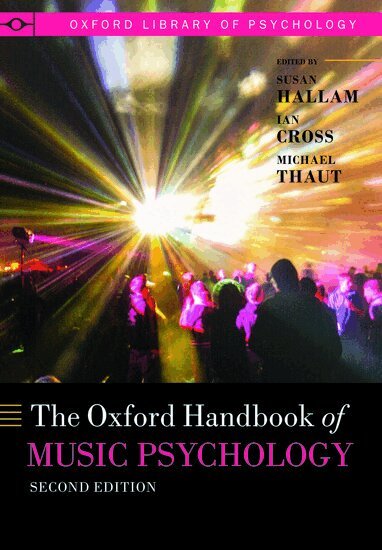
    The Oxford Handbook of Music Psychology

    AvSusan Hallam,Ian Cross

    Häftad, Engelska, 2017

    Del i serien Oxford Library of Psychology

    758 kr

    Skickas . Fri frakt över 249 kr.

    Beskrivning

    The second edition of The Oxford Handbook of Music Psychology updates the original landmark text and provides a comprehensive review of the latest developments in this fast-growing area of research. Covering both experimental and theoretical perspectives, each of the 11 sections is edited by an internationally recognised authority in the area.The first ten parts present chapters that focus on specific areas of music psychology: the origins and functions of music; music perception, responses to music; music and the brain; musical development; learning musical skills; musical performance; composition and improvisation; the role of music in everyday life; and music therapy. In each part authors critically review the literature, highlight current issues and explore possibilities for the future.The final part examines how, in recent years, the study of music psychology has broadened to include a range of other disciplines. It considers the way that research has developed in relation to technological advances, and points the direction for further development in the field. With contributions from internationally recognised experts across 55 chapters, it is an essential resource for students and researchers in psychology and musicology.

    Produktinformation

    • Utgivningsdatum:2017-12-07
    • Mått:172 x 247 x 50 mm
    • Vikt:1 686 g
    • Format:Häftad
    • Språk:Engelska
    • Serie:Oxford Library of Psychology
    • Antal sidor:976
    • Upplaga:2
    • Förlag:OUP OXFORD
    • ISBN:9780198818830

    Utforska kategorier

    • Barnpsykologi och utvecklingspsykologi inom Psykologi och pedagogik
    • Musikvetenskap inom Kultur
    • Socialpsykologi och gruppsykologi inom Psykologi och pedagogik

    Recensioner i media

    The Oxford Handbook of Music Psychology presents an extraordinarily comprehensive view of the many elements that constitute the psychology of music. In essence, it is a treasure trove of information and research findings about the role music plays in our lives.

    Innehållsförteckning

    • Part 1: The origins and functions of music 1: Ian Cross: The nature of music and its evolution 2: Catherine J. Stevens and Tim Bryon: Universals in music processing: Entrainment, acquiring expectations and learning 3: Ian Cross and Elizabeth Tolbert: Music and meaning 4: Martin Clayton: The social and personal functions of music in cross-cultural perspective Part 2: Music perception 5: Thomas Stainsby & Ian Cross: The perception of pitch 6: Psyche Loui: Absolute pitch 7: Emmanuel Bigand and Bénédicte Poulin-Charronnat: Tonal cognition 8: Stephen McAdams and Bruno L. Giordano: The perception of musical timbre 9: Mari Riess Jones: Musical time 10: Mark A. Schmuckler: Tonality and contour in melodic processing 11: Bob Snyder: Memory for music Part 3: Responses to music 12: Donald A. Hodges: Bodily Responses to Music 13: Patrik N. Juslin: Emotional reactions to music 14: Alf Gabrielsson: The relationship between musical structure and perceived expression 15: David Huron: Aesthetics 16: Donald A. Hodges: The neuroaesthetics of music 17: Alika Greasley and Alexandra Lamont: Musical preferences Part 4: Music and the Brain 18: Laurel J. Trainor and Robert J. Zatorre: The neurobiology of musical expectations from perception to emotion 19: Psyche Loui: Disorders of music cognition 20: Simone Dalla Bella: Music and brain plasticity 21: Sebastian Jentschke: The relationship between music and language 22: Daniel J. Cameron and Jessica A. Grahn: The neuroscience of rhythm Part 5: Musical development 23: Richard Parncutt: Prenatal development and the phylogeny and ontogeny of musical behaviour 24: Sandra E. Trehub: Infant musicality 25: Alexandra Lamont: Music development from the early years onwards 26: E. Glenn Schellenberg: Music training and nonmusical abilities Part 6: Learning musical skills 27: Gary McPherson and Susan Hallam: Musical potential 28: Harald Jørgensen and Susan Hallam: Practicing 29: Helena Gaunt and Susan Hallam: Individuality in the learning of musical skills 30: Susan Hallam: Motivation to learn 31: Andrea Creech: The role of the family in supporting learning 32: Graham Welch and Adam Ockelford: The role of the institution and teachers in supporting learning Part 7: Musical performance 33: Eckart Altenmüller & Shinichi Furuya: Planning and performance 34: Andreas Lehmann and Reinhardt Kopiez: Sight reading 35: Roger Chaffin, Alexander P. Demos and Topher Logan: Performing from memory 36: Jane W. Davidson and Mary C. Broughton: Bodily Mediated Coordination, Collaboration, and Communication in Music Performance 37: Patrik N. Juslin and Erik Lindstrom: Emotion in music performance 38: Erica Bisesi and W. Luke Windsor: Expression and communication of structure in music performance: measurements and models 39: Dianna Theadora Kenny and Bronwen J. Ackermann: Optimizing physical and psychological health in performing musicians Part 8: Composition and improvisation 40: Jonathan Impett: Making a mark: The psychology of composition 41: Richard Ashley: Musical Improvisation 42: Peter R. Webster: Pathways to the Study of Music Composition by Preschool to Precollege Students Part 9: The role of music in our everyday lives 43: Alexandra Lamont, Alika Greasley and John Sloboda: Choosing to hear music: motivation, process, and effect 44: Annabel J. Cohen: Music in performance arts: Film, theatre and dance 45: Alf Gabrielsson, John Whaley and John Sloboda: Peak experiences with music 46: David J. Hargreaves, Raymond MacDonald and Dorothy Miell: Musical identities 47: Susan Hallam and Raymond MacDonald: The effects of music in community and education settings 48: Adrian C. North, David J. Hargreaves and Amanda E. Krause: Music and consumer behavior Part 10: Music Therapy 49: Shannon De l'Etoile: Processes of music therapy: Clinical and Scientific Rationales and Models 50: Corene Hurt-Thaut: Clinical Practice in music therapy 51: Barabara L. Wheeler: Research in music therapy 52: Stefan Mainka, Ralph K. W. Spintge and Michael Thaut: Music Therapy in Medical and Neurological Rehabilitation Settings Part 11: Conceptual frameworks, research methods and future directions 53: Adam Ockelford: Beyond Music Psychology 54: Michael Thaut: History and research 55: Susan Hallam, Ian Cross and Michael Thaut: Where now?