• Fri frakt över 249 kr
  • •
  • Snabba leveranser
  • •
  • Billiga böcker
Kundservice

Du är på sajten för privatpersoner.

Företag, bibliotek eller offentlig verksamhet?

Du handlar på classic.bokus.com, där alla dina funktioner finns intakta.
Till classic.bokus.com
Bokus logotyp. Gå till startsidan.
  • Erbjudanden
  • Nyheter
  • Student
  • Topplistor
  • Barn & ungdom
  • Bokus Play
  • E-böcker
  • Pocketböcker
  • Spel & pussel

Må bättre, för mindre! Upp till 50% rabatt på hälsoböcker

Sidfot

Mina sidor

    Hjälp

    • Kundservice
    • Vanliga frågor och svar
    • Frakt och leverans
    • Retur vid ångerrätt
    • Reklamera vara
    • Betalning
    • Köpvillkor
    • Allmänna villkor
    • Information om webbplatsens tillgänglighet

    Om Bokus

    • Om oss
    • Pressrum
    • För studenter
    • För företag
    • För bibliotek och offentlig verksamhet
    • För leverantörer
    • Hållbarhet

    Populärt

    • Aktuella erbjudanden
    • Presentkort
    • Studentlitteratur
    • Nya böcker
    • Topplistor
    • Signerade böcker
    • Engelska böcker

    Inspiration

    • Boktips
    • BookTok
    • Populära bokserier
    • Barnbokskaraktärer
    • Populära författare
    Logotyp för Bokus
    Följ oss på Facebook (extern länk)Följ oss på Instagram (extern länk)Följ oss på YouTube (extern länk)Följ oss på TikTok (extern länk)
    bokus @ CookiesAnpassa cookiesIntegritetspolicyKöpvillkor
    Till Citymail hemsida (extern länk)Till Budbee hemsida (extern länk)Till Postnord hemsida (extern länk)Till Schenker hemsida (extern länk)Till Early Bird hemsida (extern länk)Till Walleys hemsida (extern länk)
    1. Språk och ordböcker
    2. Språkvetenskap och lingvistik

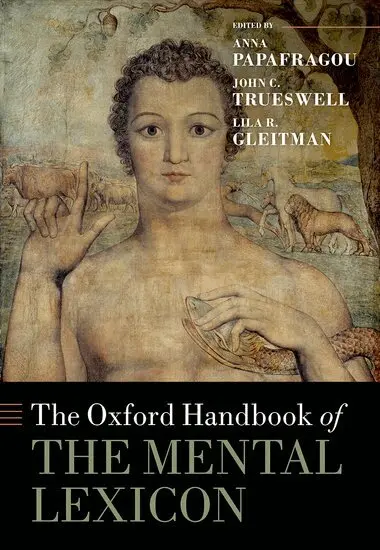
    The Oxford Handbook of the Mental Lexicon

    AvAnna Papafragou,John C. Trueswell

    Inbunden, Engelska, 2022

    Del i serien Oxford Handbooks

    2 729 kr

    Beställningsvara. Skickas inom 5-8 vardagar. Fri frakt över 249 kr.

    Beskrivning

    This volume brings together the latest research from leading scholars on the mental lexicon - the representation of language in the mind/brain at the level of individual words and meaningful sub-word units. In recent years, the study of words as mental objects has grown rapidly across several fields, including linguistics, psychology, philosophy, neuroscience, education, and cognitive science. This comprehensive collection spans multiple disciplines, topics, theories, and methods to highlight important advances in the study of the mental lexicon, identify areas of debate, and inspire innovation in the field from present and future generations of scholars.The book is divided into three parts. Part I presents modern linguistic and cognitive theories of how the mind/brain represents words at the phonological, morphological, syntactic, semantic, and pragmatic levels. This part also discusses broad architectural issues pertaining to the internal organization of the lexicon, the relation between words and concepts, and the role of compositionality. Part II examines how children learn the form and meaning of words in their native language, bridging learner- and environment-driven contributions and taking into account variability across both individual learners and communities. Chapters in the final part explore how the mental lexicon contributes to language use during listening, speaking, and conversation, and includes perspectives from bilingualism, sign languages, and disorders of lexical access and production.

    Produktinformation

    • Utgivningsdatum:2022-01-14
    • Mått:175 x 252 x 52 mm
    • Vikt:1 576 g
    • Format:Inbunden
    • Språk:Engelska
    • Serie:Oxford Handbooks
    • Antal sidor:816
    • Förlag:OUP OXFORD
    • ISBN:9780198845003

    Utforska kategorier

    • Språkvetenskap och lingvistik inom Språk och ordböcker
    • Biovetenskap inom Naturvetenskap och teknik
    • Kognitiv psykologi inom Psykologi och pedagogik

    Mer om författaren

    Anna Papafragou is a Professor in the Department of Linguistics at the University of Pennsylvania and the director of the University's interdisciplinary graduate program in Language and Communication Sciences. Her research focuses on how children acquire meaning in language, how language is used and understood, and how language interfaces with human perception and cognition. She is an elected Fellow of the Association for Psychological Science and serves on the Governing Board of the Cognitive Science Society.John C. Trueswell is a Professor in the Department of Psychology at the University of Pennsylvania and the co-director of the University's MindCORE initiative in Integrative Language Science and Technology. His research focuses on understanding how children develop the ability to process language in real-time, and how this ability interacts with the acquisition of language. He is an elected fellow of the Association for Psychological Science, the American Association for the Advancement of Science, and the Cognitive Science Society.Lila R. Gleitman is a Professor Emerita of Psychology and (by secondary appointment) Linguistics at the University of Pennsylvania. She has conducted foundational work on language acquisition, and the relationship between language and other cognitive systems. She is an elected member of the National Academy of Sciences, an elected fellow of the American Association for the Advancement of Science, a Fyssen Foundation Laureate, and a winner of the Rumelhart Prize from the Cognitive Science Society.

    Innehållsförteckning

    • 1: Anna Papafragou, John C. Trueswell, and Lila R. Gleitman: Introduction Part I: Representing the Mental Lexicon Part Ia: Form 2: Eric Bakovic, Jeffrey Heinz, and Jonathan Rawski: Phonological abstraction in the mental lexicon 3: Ruaridh Purse, Meredith Tamminga, and Yosiane White: Phonological variation and lexical form 4: David Poeppel and Yue Su: Neural encoding of speech and word forms Part Ib: Meaning 5: David Embick, Ava Creemers, and Amy J. Goodwin Davies: Morphology and the mental lexicon: Three questions about decomposition 6: Artemis Alexiadou: Syntax and the lexicon 7: Ray Jackendoff: Lexical semantics 8: Valentine Hacquard: Logic and the lexicon: Insights from modality Part Ic: Interfaces and Boundaries 9: Florian Schwarz and Jérémy Zehr: Pragmatics and the lexicon 10: Kyle Mahowald, Isabelle Dautriche, Mika Braginsky, and Edward Gibson: Efficient communication and the organization of the lexicon 11: Gala Stojnic and Ernie Lepore: Compositionality of concepts 12: Barbara Landau: Language and thought: The lexicon and beyond Part II: Acquiring the Mental Lexicon Part IIa: Form 13: Daniel Swingley: Infants' learning of speech sounds and word forms 14: Sarah C. Creel: Learning words amidst speech sound variability Part IIb: Meaning 15: Katherine Demuth: How learners move from sound to morphology 16: Charles Yang: Systematicity and arbitrariness in language: Saussurean rhapsody 17: Jeffrey Lidz: Children's use of syntax in word learning 18: Lila R. Gleitman and John C. Trueswell: Easy words: Reference resolution in a malevolent referent world 19: Stephen Crain: Early logic and language Part IIc: Interfaces and Boundaries 20: Myrto Grigoroglou and Anna Papafragou: Contributions of pragmatics to word learning and interpretation 21: Christine E. Potter and Casey Lew-Williams: Differences in vocabulary growth across groups and individuals Part III: Accessing the Mental Lexicon Part IIIa: Via Form 22: James S. Magnuson and Anne Marie Crinnion: Spoken word recognition 23: Jennifer Rodd: Word meaning access: The one-to-many mapping from form to meaning 24: Rebecca Treiman and Brett Kessler: Learning and using written word forms Part IIIb: Via Meaning 25: Oriana Kilbourn-Ceron and Matthew Goldrick: The dynamics of word production 26: Nazbanou Nozari: The neural basis of word production Part IIIc: Interfaces and Boundaries 27: Maria Mercedes Piñango: The structure of the lexical item and sentence-meaning composition 28: Judith Kroll, Kinsey Bice, Mona Roxana Botezatu, and Megan Zirnstein: On the dynamics of lexical access in two or more languages 29: Rachel I. Mayberry and Beatrijs Wille: Lexical representation and access in sign languages 30: Daniel Mirman and Erica L. Middleton: Disorders of lexical access and production