• Fri frakt över 249 kr
  • •
  • Snabba leveranser
  • •
  • Billiga böcker
Kundservice

Du är på sajten för privatpersoner.

Företag, bibliotek eller offentlig verksamhet?

Du handlar på classic.bokus.com, där alla dina funktioner finns intakta.
Till classic.bokus.com
Bokus logotyp. Gå till startsidan.
  • Erbjudanden
  • Nyheter
  • Student
  • Topplistor
  • Barn & ungdom
  • Bokus Play
  • E-böcker
  • Pocketböcker
  • Spel & pussel

10% rabatt på allt med kod: NYSTART10 →

Sidfot

Mina sidor

    Hjälp

    • Kundservice
    • Vanliga frågor och svar
    • Frakt och leverans
    • Retur vid ångerrätt
    • Reklamera vara
    • Betalning
    • Köpvillkor
    • Allmänna villkor
    • Information om webbplatsens tillgänglighet

    Om Bokus

    • Om oss
    • Pressrum
    • För studenter
    • För företag
    • För bibliotek och offentlig verksamhet
    • För leverantörer
    • Hållbarhet

    Populärt

    • Aktuella erbjudanden
    • Presentkort
    • Studentlitteratur
    • Nya böcker
    • Topplistor
    • Signerade böcker
    • Engelska böcker

    Inspiration

    • Boktips
    • BookTok
    • Populära bokserier
    • Barnbokskaraktärer
    • Populära författare
    Logotyp för Bokus
    Följ oss på Facebook (extern länk)Följ oss på Instagram (extern länk)Följ oss på YouTube (extern länk)Följ oss på TikTok (extern länk)
    bokus @ CookiesAnpassa cookiesIntegritetspolicyKöpvillkor
    Till Citymail hemsida (extern länk)Till Budbee hemsida (extern länk)Till Postnord hemsida (extern länk)Till Schenker hemsida (extern länk)Till Early Bird hemsida (extern länk)Till Walleys hemsida (extern länk)
    1. Samhälle och politik
    2. Samhälle och kultur
    3. Sociala grupper och identitet

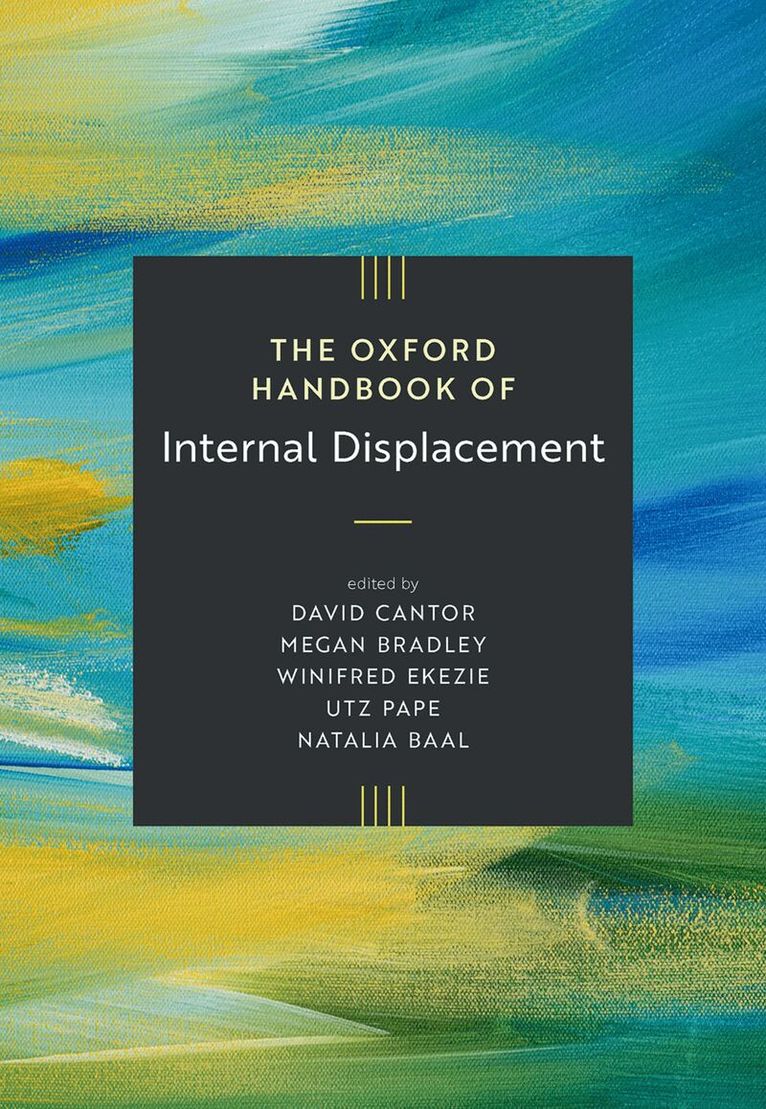
    The Oxford Handbook of Internal Displacement

    AvDavid Cantor,Megan Bradley

    Inbunden, Engelska, 2026

    Del i serien Oxford Handbooks

    2 184 kr

    Beställningsvara. Skickas inom 5-8 vardagar. Fri frakt över 249 kr.

    Beskrivning

    The displacement of people within their own countries due to crises such as conflicts, disasters, and the effects of climate change is a major contemporary challenge, eliciting global concern about how to protect the displaced. The vast scale of this 'internal displacement' poses far-reaching questions for key debates around humanitarian aid, development, migration, sovereignty, rights, citizenship, identity, and social change. Yet knowledge of the issue is fragmented and highly dispersed across a range of academic and policy domains. Bringing together 45 contributions by leading researchers and practitioners, the Oxford Handbook of Internal Displacement provides an essential point of reference for advancing these debates and raising the profile of internal displacement as a vital concern for research and policy agendas. The Handbook addresses eight major areas of debate in this field of research and practice. Part I presents different conceptual understandings of internal displacement from a range of the most relevant disciplinary perspectives, including philosophy and political theory, history, law, geography, and forced migration studies. Part II of the Handbook explores the different drivers of internal displacement, embedding them in their broader social, political, and historical context. Part III addresses major internal displacement dynamics and population trends in different regions of the world. Part IV highlights the material, social and economic consequences of displacement, in terms of poverty, health, education, and housing land for the displaced. Part V addresses lived experiences of internal displacement, underscoring the agency of displaced persons in making sense of and dealing with internal displacement. Part VI of the Handbook addresses key aspects of IDP assistance and protection, including legal and policy frameworks, institutional responses, and policy and operational issues arising in this response. Part VII addresses the 'end' of internal displacement and so-called 'durable solutions' for internally displaced persons, offering compelling insights into how long-term solutions have been handled and hindered in practice. Finally, Part VIII outlines the crucial role of data in understanding and responding to internal displacement.

    Produktinformation

    • Utgivningsdatum:2026-04-23
    • Mått:178 x 253 x 37 mm
    • Vikt:1 203 g
    • Format:Inbunden
    • Språk:Engelska
    • Serie:Oxford Handbooks
    • Antal sidor:608
    • Förlag:OUP OXFORD
    • ISBN:9780198928775

    Utforska kategorier

    • Sociala grupper och identitet inom Samhälle och politik
    • Folkrätt inom Juridik

    Mer om författaren

    Professor David Cantor is the founding Director of the Refugee Law Initiative and its Internal Displacement Research Programme, at the School of Advanced Study, University of London. He brings 25 years of working on refugee and displacement issues in contexts of armed conflict, crime and disasters, especially in the Americas. David publishes widely on internal displacement, established the Researching Internal Displacement platform and convenes several networks of researchers and practitioners. He was formerly a Legal Officer at the Refugee Legal Centre and a principal advisor to UNHCR. His work won the Times Higher Education Research of the Year award.Professor Megan Bradley is Professor and William Dawson Scholar in Political Science and International Development Studies at McGill University in Montreal, where her work focuses on the global governance of forced migration, humanitarianism and transitional justice. She served from 2012-2014 as a Fellow with the Brookings-LSE Project on Internal Displacement. She has conducted fieldwork on internal displacement in conflict and disaster situations, including in Haiti, the United States, Philippines and Sri Lanka. Her work spans international relations, political theory and historical approaches. She currently serves as co-editor-in-chief of the Journal of Refugee Studies.Dr Winifred Ekezie is a Lecturer in Public Health at Aston University and a core member of the Health and Internal Displacement Network. With expertise in epidemiology, she researches the health of marginalised groups, including migrants and ethnic minorities. She has conducted research on IDPs in Nigeria and has published extensively, including on IDP health financing, primary health service availability, health management, and community involvement. She brings expertise in monitoring and evaluation, health advocacy, and policy analysis. She directs the Centre for Health and Society at Aston University and is the Evidence Synthesis Coordinator for the Avoidable Death Network.Dr Utz Pape is Lead Economist in the World Bank. He works with governments to inform policies towards poverty reduction and shared prosperity, while improving national statistical systems. His work experience in post-conflict countries contributes to his research around policy, development and public health. His award-winning research is published in top-ranking peer-reviewed journals, including British Medical Journal, Canadian Medical Association Journal, Journal of Development Economics, The Lancet, Nature and Science Advances. In 2020, he co-edited a book on Data Collection in Fragile States: Innovations from Africa. He holds a Ph.D. in Economics and a Ph.D. in Sciences.Natalia Krynsky Baal brings over a decade of practitioner experience working with governments and across the humanitarian/development sector to improve data and knowledge on internal displacement. She is Head of the Secretariat for the Expert Group on Refugee, IDP and Statelessness Statistics and previously was a Senior Strategy and Policy Officer at the World Bank-UNHCR Joint Data Center. Before that she was Coordinator of the Joint IDP Profiling Service. She has worked across countries including Afghanistan, Colombia, Ukraine, Somalia, Mali, Kosovo and Central African Republic, and has authored several publications on this topic.Dr Melissa Weihmayer supported the editorial team throughout the development of this Handbook, bringing in networks of early career researchers. Her extensive work on migration and displacement spans the legal, policy, academic and humanitarian sectors. She managed large-scale data collection projects on internal displacement in Central America, Eastern Europe and the Middle East with the Joint IDP Profiling Service. She has also published in top-ranking peer-reviewed journals on the governance of forced migration, including how local governments respond to situations of urban internal displacement. She holds a Ph.D. in Regional and Urban Planning Studies from the London School of Economics.

    Recensioner i media

    This Handbook makes an invaluable contribution by examining the normative, policy, and operational dimensions of internal displacement across diverse contexts. Its chapters offer rigorous analyses, comparative insights, and lessons from the field, highlighting what works-and what still needs to change. Above all, it exemplifies the collaboration between scholars and practitioners, that is essential to addressing the complexities of internal displacement today. Readers - whether policy makers, researchers or field practitioners- will find in these pages not only evidence and analyses, but also inspiration to continue to improve the lives of those internally displaced and the communities that host them.

    Innehållsförteckning

    • 1: David Cantor, Megan Bradley, Winifred Ekezie, Natalia Krynsky Baal, and Utz Pape: Introduction: Internal Displacement as a Field of Research and Practice 2: Jamie Draper: Philosophy and Internal Displacement 3: Laura Madokoro: Historical Approaches to 'Internal' Displacement 4: Bríd Ní Ghráinne: Legal and Policy Approaches to Internal Displacement 5: Ali Ali: Geographical Perspectives on Internal Displacement 6: Roger Zetter: Internal Displacement, Refugees, and Forced Migration Studies 7: Adam Lichtenheld: Armed Conflict and Internal Displacement 8: Victorie Knox: Internal Displacement Caused by Other Forms of Violence Outside Conflict 9: Ana Mosneaga: Internal Displacement in the Context of Disasters and Climate Change 10: Asmita Kabra and Budhaditya Das: Development-Induced Displacement and Resettlement 11: Sanjula Weerasinghe: Intersections Between the Drivers of Internal Displacement 12: Nicholas Maple and Enguday Meskele Ashine: Internal Displacement in Africa 13: Beatriz Eugenia Sánchez-Mojica: Internal Displacement in the Americas 14: Nassim Majidi, Jerome Elie, and Daniel Provost: Internal Displacement in Asia and the Pacific 15: Lidia Kuzemska: Internal Displacement in Europe and Central Asia 16: Tamirace Fakhoury: Internal Displacement in the Middle East 17: Paolo Verme: The Impact of Internal Displacement on Poverty 18: Isis Nuñez-Ferrera: The Impact of Internal Displacement on Food Security 19: Winifred Ekezie and Bayard Roberts: The Health Impacts of Internal Displacement 20: Mary Mendenhall: Internal Displacement and Education 21: Vishnu Prasad and Jim Robinson: Housing, Land, and Property and Internal Displacement 22: Patrik Johansson: The Impacts of Internal Displacement on Politics, Participation, and Conflict 23: Patricia García Amado, Ileana Nicolau, and Jennifer Welsh: Agency and Internal Displacement 24: Rabia Salihi and Megan Bradley: Internal Displacement, Ethnicity, and Marginalization 25: Valeria Lazarenko: Belonging, Identity, and Home 26: Alexander Burlin and Ali Bhagat: Intersectionality and Internal Displacement 27: Carolien Jacobs: Citizenship and Internal Displacement 28: Walter Kälin: Global Standards and Frameworks on Internal Displacement 29: Chaloka Beyani and Aderomola Adeola: Regional Frameworks and Standards on Internal Displacement 30: David Cantor: National Frameworks on Internal Displacement 31: Phil Orchard: Global Institutional Responses to Internal Displacement 32: Allehone Abebe and Deborah Casalin: Regional Institutional Responses to Internal Displacement 33: Martina Caterina: National and Subnational Institutional Responses to Internal Displacement 34: Caitlin Sturridge, Leen Fouad, and Kerrie Holloway: Practicalities of Humanitarian Action in Contexts of Internal Displacement 35: Greta Zeender and Mark Yarnell: Framing 'Nexus' Issues in the Response to Internal Displacement 36: Christopher Ward and Lucy Earle: Internally Displaced Persons Camps, Self-Settlement, and Everything in Between 37: Josep Zapater: Self-Protection Strategies of Displacement-Affected Communities 38: Laura Kivelä and Natalia Krynsky Baal: Durable Solutions and the 'End of Displacement' 39: Elizabeth Ferris: Local Integration 40: Ben Hudson and Jasmine Ketabchi: Return as a Solution to Internal Displacement 41: Liam Moore: Settlement Elsewhere as a Solution for IDPs 42: Paula Gaviria Betancur and Nadine Walicki: Peace Processes and Transitional Justice in Contexts of Internal Displacement 43: Domenico Tabasso and Joe Costanzo: Overview of Internally Displaced Person Data: Availability, Sources, Gaps, and Frameworks 44: Gabriel Cardona-Fox: The Politics of Internally Displaced Persons Data 45: Melissa Weihmayer and Nassim Majidi: Research Methodologies and Challenges in Internally Displaced Persons Contexts