• Fri frakt över 249 kr
  • •
  • Snabba leveranser
  • •
  • Billiga böcker
Kundservice

Du är på sajten för privatpersoner.

Företag, bibliotek eller offentlig verksamhet?

Du handlar på classic.bokus.com, där alla dina funktioner finns intakta.
Till classic.bokus.com
Bokus logotyp. Gå till startsidan.
  • Erbjudanden
  • Student
  • Topplistor
  • Barn & ungdom
  • Bokus Play
  • E-böcker
  • Ljudböcker
  • Pocketböcker
  • Spel och pussel

Pocketfynda! Hundratals böcker för 49 kr/st →

Sidfot

Mina sidor

    Hjälp

    • Kundservice
    • Vanliga frågor och svar
    • Frakt och leverans
    • Retur vid ångerrätt
    • Reklamera vara
    • Betalning
    • Köpvillkor
    • Allmänna villkor
    • Information om webbplatsens tillgänglighet

    Om Bokus

    • Om oss
    • Pressrum
    • För studenter
    • För företag
    • För bibliotek och offentlig verksamhet
    • För leverantörer
    • Hållbarhet

    Populärt

    • Aktuella erbjudanden
    • Presentkort
    • Studentlitteratur
    • Nya böcker
    • Topplistor
    • Signerade böcker
    • Engelska böcker

    Inspiration

    • Boktips
    • BookTok
    • Barnbokskaraktärer
    • Populära författare
    Logotyp för Bokus
    Följ oss på Facebook (extern länk)Följ oss på Instagram (extern länk)Följ oss på YouTube (extern länk)Följ oss på TikTok (extern länk)
    bokus @ CookiesAnpassa cookiesIntegritetspolicyKöpvillkor
    Till Citymail hemsida (extern länk)Till Budbee hemsida (extern länk)Till Postnord hemsida (extern länk)Till Schenker hemsida (extern länk)Till Early Bird hemsida (extern länk)Till Walleys hemsida (extern länk)
    1. Ekonomi och Ledarskap
    2. Industrier och branscher
    3. Servicesektorn

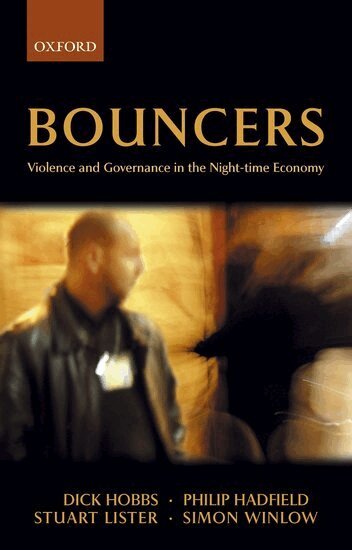
    Bouncers

    Violence and Governance in the Night-Time Economy

    AvDick Hobbs,Philip Hadfield

    Häftad, Engelska, 2005

    Del i serien Clarendon Studies in Criminology

    438 kr

    Beställningsvara. Skickas inom 5-8 vardagar. Fri frakt över 249 kr.

    Fler format och utgåvor

    Inbunden

    831 kr

    Beskrivning

    In recent years, the expansion of night-time leisure has emerged as a key indicator of post-industrial urban prosperity, attracting investment, creating employment and re-generating the built environment. These leisure economies are youth-dominated, focusing upon the sale and consumption of alcohol. Unprecedented numbers of young people now flock to town centres that are crammed with bars, pubs and clubs, and the resulting violent disorder has over run police resources that remain geared to the drinking patterns and alcohol cultures of previous generations. Post-industrial re-structuring has spawned an increasingly complex mass of night-time leisure options through which numerous licit and illicit commercial opportunities flow. Yet, regardless of the fashionable and romantic notions of many contemporary urban theorists, it is alcohol, mass intoxication and profit rather than 'cultural regeneration,' which lies at the heart of this rapidly expanding dimension of post-industrial urbanism. Private security in the bulky form of bouncers fills the void left by the public police. These men (only 7% are women), whose activities are barely regulated by the State, are dominated by a powerful subculture rooted in routine violence and intimidation. Using ethnography, participant observation and extensive interviews with all the main players, this controversial book charts the emergence of the bouncer as one of the most graphic symbols in the iconography of post industrial Britain.

    Produktinformation

    • Utgivningsdatum:2005-06-30
    • Mått:139 x 215 x 19 mm
    • Vikt:424 g
    • Format:Häftad
    • Språk:Engelska
    • Serie:Clarendon Studies in Criminology
    • Antal sidor:336
    • Förlag:OUP OXFORD
    • ISBN:9780199288007
    • Utmärkelser:2003 Radzinowicz Prize

    Utforska kategorier

    • Servicesektorn inom Ekonomi och Ledarskap
    • Våld och övergrepp inom Samhälle och politik
    • Brottslighet och kriminologi inom Samhälle och politik

    Mer om författaren

    Dick Hobbs is Professor of Sociology at the University of Durham. He has published widely on various aspects of criminal cultures, policing, research methods, professional and organised crime, and the night-time economy. He has published edited collections of papers on ethnographic research, and professional crime, and his two single authored books (both published with OUP) are Doing the Business (1988) which won the Abrams Prize, and Bad Business (1995). He was, with Steve Hall, the co-grant holder for the ESRC "Bouncers" projectPhilip Hadfield is currently an ESRC funded postgraduate student at the University of Durham. He recently graduated from the Universities of Keele and Cambridge, has published widely on regulatory and licensing aspects of the night-time economy and works part time as a DJ.Stuart Lister is a Research Fellow at the University of Leeds. He is a member of the Home office Alcohol and Crime Steering Group, and has published on various aspects of the night-time economy with particular reference to policing, regulation, and training.Simon Winlow is Senior Lecturer in Criminology at the University of Teesside. He gained his Ph.D. from Durham University in 1999 and has published on crime, masculinities, research methods and various aspects of the night-time economy. His first book, Badfellas,(Berg 2001)an ethnography based upon his Ph.D

    Recensioner i media

    Review from previous edition Hobbs is without doubt Britain's most insightful and penetrating criminological ethnographer, and he uses his skill to provide an extremely useful service...my advice to all interested academics and students is to get a copy, read it, and keep it as a principal guide book to take with you on your theoretical excursions into the subject of professional crime.

    Innehållsförteckning

    • 1. Let the Good Times Roll: Liminality and the Night-Time Economy ; 2. After-Dark 'Fun' and its Control in the Industrial City ; 3. Post-Industrial Manchester: From Cotton to Carlsberg ; 4. Tommy Smith's Story: Four Decades on the Door ; 5. A Word at the Door: Bouncers On Their Work ; 6. Manners Maketh the Man: Licensing 'Door Supervisors' and the Discourses of Professionalism and Safety ; 7. Market Force: Class, Violence, and Liminal Buiness on the Night-Time Frontier ; 8. Night Futures: The Marketization of License and Control ; 9. Big People, Dirty Work; A Conclusion