• Fri frakt över 249 kr
  • •
  • Snabba leveranser
  • •
  • Billiga böcker
Kundservice

Du är på sajten för privatpersoner.

Företag, bibliotek eller offentlig verksamhet?

Du handlar på classic.bokus.com, där alla dina funktioner finns intakta.
Till classic.bokus.com
Bokus logotyp. Gå till startsidan.
  • Erbjudanden
  • Nyheter
  • Student
  • Topplistor
  • Barn & ungdom
  • Bokus Play
  • E-böcker
  • Pocketböcker
  • Spel & pussel

10% rabatt på allt med kod: NYSTART10 →

Sidfot

Mina sidor

    Hjälp

    • Kundservice
    • Vanliga frågor och svar
    • Frakt och leverans
    • Retur vid ångerrätt
    • Reklamera vara
    • Betalning
    • Köpvillkor
    • Allmänna villkor
    • Information om webbplatsens tillgänglighet

    Om Bokus

    • Om oss
    • Pressrum
    • För studenter
    • För företag
    • För bibliotek och offentlig verksamhet
    • För leverantörer
    • Hållbarhet

    Populärt

    • Aktuella erbjudanden
    • Presentkort
    • Studentlitteratur
    • Nya böcker
    • Topplistor
    • Signerade böcker
    • Engelska böcker

    Inspiration

    • Boktips
    • BookTok
    • Populära bokserier
    • Barnbokskaraktärer
    • Populära författare
    Logotyp för Bokus
    Följ oss på Facebook (extern länk)Följ oss på Instagram (extern länk)Följ oss på YouTube (extern länk)Följ oss på TikTok (extern länk)
    bokus @ CookiesAnpassa cookiesIntegritetspolicyKöpvillkor
    Till Citymail hemsida (extern länk)Till Budbee hemsida (extern länk)Till Postnord hemsida (extern länk)Till Schenker hemsida (extern länk)Till Early Bird hemsida (extern länk)Till Walleys hemsida (extern länk)
    1. Psykologi och pedagogik
    2. Psykologi
    3. Kognitiv psykologi

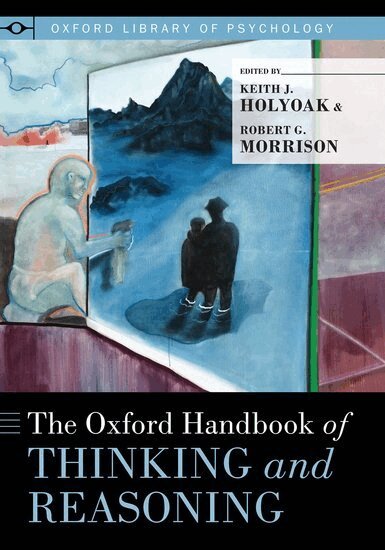
    The Oxford Handbook of Thinking and Reasoning

    AvKeith J. Holyoak,Robert G. Morrison

    Häftad, Engelska, 2013

    Del i serien Oxford Library of Psychology

    1 446 kr

    Beställningsvara. Skickas inom 5-8 vardagar. Fri frakt över 249 kr.

    Beskrivning

    Thinking and reasoning, long the academic province of philosophy, have over the past century emerged as core topics of empirical investigation and theoretical analysis in the modern fields of cognitive psychology, cognitive science, and cognitive neuroscience. Formerly seen as too complicated and amorphous to be included in early textbooks on the science of cognition, the study of thinking and reasoning has since taken off, brancing off in a distinct direction from the field from which it originated.The Oxford Handbook of Thinking and Reasoning is a comprehensive and authoritative handbook covering all the core topics of the field of thinking and reasoning. Written by the foremost experts from cognitive psychology, cognitive science, and cognitive neuroscience, individual chapters summarize basic concepts and findings for a major topic, sketch its history, and give a sense of the directions in which research is currently heading. Chapters include introductions to foundational issues and methods of study in the field, as well as treatment of specific types of thinking and reasoning and their application in a broad range of fields including business, education, law, medicine, music, and science. The volume will be of interest to scholars and students working in developmental, social and clinical psychology, philosophy, economics, artificial intelligence, education, and linguistics.

    Produktinformation

    • Utgivningsdatum:2013-05-23
    • Mått:178 x 251 x 40 mm
    • Vikt:1 538 g
    • Format:Häftad
    • Språk:Engelska
    • Serie:Oxford Library of Psychology
    • Antal sidor:864
    • Förlag:OUP USA
    • ISBN:9780199313792

    Utforska kategorier

    • Kognitiv psykologi inom Psykologi och pedagogik

    Mer om författaren

    Keith J. Holyoak, Ph.D., Distinguished Professor of Psychology at the University of California, Los Angeles, is a leading researcher in human thinking and reasoning. Robert G. Morrison, Ph.D., Assistant Professor of Psychology and Neuroscience at Loyola University Chicago, seeks to understand how memory and reasoning develop throughout the lifespan.

    Recensioner i media

    "This rich and complex book tackles the vagaries of the mind in a neuroscientific framework, but it is not a survey or introductory manual to be read casually. It requires an intense passion for studying this area and in-depth understanding of the concepts to truly reap its rewards." -- DOODY'S"This is an excellent volume on the growing field of thinking and reasoning, now a part of high-level human cognition which includes creative thinking, decision making and problem solving. These have of late become increasingly important areas of inquiry and scientific research. The better we understand ourselves and others, the happier are the lives we can lead. The editors and contributors therefore deserve to be applauded for this monumental work which contributes immensely to understanding ourselves and our thoughts." -- BizIndia"This comprehensive treatment of human thinking should be of value to anyone who is interested in human cognition and the many ways in which it can be conceptualized, modeled, and studied. Holyoak and Morrison in the Oxford Handbook also provide suggestions for organizing the chapters in the book for use as a text for advanced undergraduates (very advanced, I'd add) and graduate students. All of these potential readers should find many issues worth thinking about in the 836 pages of this book." -- PsycCRITIQUES

    Innehållsförteckning

    • 1. Thinking and Reasoning: A Reader's Guide ; Keith J. Holyoak and Robert G. Morrison ; Part One: General Approaches to Thinking and Reasoning ; 2. Normative Systems: Logic, Probability, and Rational Choice ; Nick Chater and Mike Oaksford ; 3. Bayesian Inference ; Tom Griffiths, Josh Tenenbaum, and Charles Kemp ; 4. Knowledge Representation ; Arthur B. Markman ; 5. Computational Modeling of Higher Cognition ; Leonidas A. A. Doumas and John E. Hummel ; 6. Neurocognitive Methods in Higher Cognition ; Robert G. Morrison and Barbara Knowlton ; 7. Mental Function as Genetic Expression: Emerging Insights from Cognitive Neurogenetics ; Adam E. Green and Kevin N. Dunbar ; Part Two: Deductive, Inductive, and Abductive Reasoning ; 8. Dual-process Theories of Reasoning: Facts and Fallacies ; Jonathan St. B. T. Evans ; 9. Inference in Mental Models ; P. N. Johnson-Laird ; 10. Similarity ; Robert L. Goldstone and Ji Yun Son ; 11. Concepts and Categories: Memory, Meaning, and Metaphysics ; Lance J. Rips, Edward E. Smith, and Douglas L. Medin ; 12. Causal Learning and Inference ; Marc Buehner and Patricia W. Cheng ; 13. Analogy and Relational Reasoning ; Keith J. Holyoak ; 14. Explanation and Abductive Inference ; Tania Lombrozo ; 15. Rational Argument ; Ulrike Hahn and Mike Oaksford ; Part Three: Judgment and Decision Making ; 16. Decision Making ; Robyn A. LeBoeuf and Eldar Shafir ; 17. Judgment Heuristics ; Dale Griffin ; 18. Cognitive Hierarchies and Emotions in Behavioral Game Theory ; Colin Camerer and Alec Smith ; 19. Moral Judgment ; Michael Waldmann, Jonas Nagel, and Alex Wiegmann ; 20. Motivated Thinking ; Daniel C. Molden and E. Tory Higgins ; Part Four: Problem Solving, Intelligence, and Creative Thinking ; 21. Problem Solving ; Miriam Bassok and Laura R. Novick ; 22. On the Distinction between Rationality and Intelligence: Implications for Understanding Individual Differences in Reasoning ; Keith E. Stanovich ; 23. Cognition and the Creation of Ideas ; Steve M. Smith and Tom B. Ward ; 24. Insight ; J. Jason van Steenburgh, Jessica I. Fleck, Mark Beeman, and John Kounios ; 25. Genius ; Dean Keith Simonton ; Part Five: Ontogeny, Phylogeny, Language, and Culture ; 26. Development of Thinking in Children ; Susan A. Gelman and Brandy N. Frazier ; 27. The Human Enigma ; Derek Penn and Dan Povinelli ; 28. Language and Thought ; Lila Gleitman and Anna Papafragou ; 29. Thinking in Society and Culture ; Tage Rai ; Part Six: Modes of Thinking ; 30. Development of Quantitative Thinking ; John Opfer and Robert Siegler ; 31. Visuospatial Thinking ; Mary Hegarty and Andrew T. Stull ; 32. Gesture in Thought ; Susan Goldin-Meadow and Susan Wagner Cook ; 33. Impact of Aging on Thinking ; Shannon McGillivray, Michael C. Friedman, and Alan D. Castel ; 34. The Cognitive Neuroscience of Thought Disorder in Schizophrenia ; Peter Bachman and Tyrone D. Cannon ; Part Seven: Thinking in Practice ; 35. Scientific Thinking and Reasoning ; Kevin N. Dunbar and David Klahr ; 36. Legal Reasoning ; Barbara A. Spellman and Fred Schauer ; 37. Medical Reasoning and Thinking ; Vimla L. Patel, Jose F. Arocha, and Jiajie Zhang ; 38. Thinking in Business ; Jeffrey Lowenstein ; 39. Musical Thought ; William Forde Thompson and Paolo Ammirante ; 40. Learning to Think: Cognitive Mechanisms of Knowledge Transfer ; Ken Koedinger and Ido Roll