• Fri frakt över 249 kr
  • •
  • Snabba leveranser
  • •
  • Billiga böcker
Kundservice

Du är på sajten för privatpersoner.

Företag, bibliotek eller offentlig verksamhet?

Du handlar på classic.bokus.com, där alla dina funktioner finns intakta.
Till classic.bokus.com
Bokus logotyp. Gå till startsidan.
  • Erbjudanden
  • Nyheter
  • Student
  • Topplistor
  • Barn & ungdom
  • Bokus Play
  • E-böcker
  • Pocketböcker
  • Spel & pussel

10% rabatt på allt med kod: NYSTART10 →

Sidfot

Mina sidor

    Hjälp

    • Kundservice
    • Vanliga frågor och svar
    • Frakt och leverans
    • Retur vid ångerrätt
    • Reklamera vara
    • Betalning
    • Köpvillkor
    • Allmänna villkor
    • Information om webbplatsens tillgänglighet

    Om Bokus

    • Om oss
    • Pressrum
    • För studenter
    • För företag
    • För bibliotek och offentlig verksamhet
    • För leverantörer
    • Hållbarhet

    Populärt

    • Aktuella erbjudanden
    • Presentkort
    • Studentlitteratur
    • Nya böcker
    • Topplistor
    • Signerade böcker
    • Engelska böcker

    Inspiration

    • Boktips
    • BookTok
    • Populära bokserier
    • Barnbokskaraktärer
    • Populära författare
    Logotyp för Bokus
    Följ oss på Facebook (extern länk)Följ oss på Instagram (extern länk)Följ oss på YouTube (extern länk)Följ oss på TikTok (extern länk)
    bokus @ CookiesAnpassa cookiesIntegritetspolicyKöpvillkor
    Till Citymail hemsida (extern länk)Till Budbee hemsida (extern länk)Till Postnord hemsida (extern länk)Till Schenker hemsida (extern länk)Till Early Bird hemsida (extern länk)Till Walleys hemsida (extern länk)
    1. Samhälle och politik
    2. Samhälle och kultur
    3. Kultur och medier
    4. Kulturvetenskap

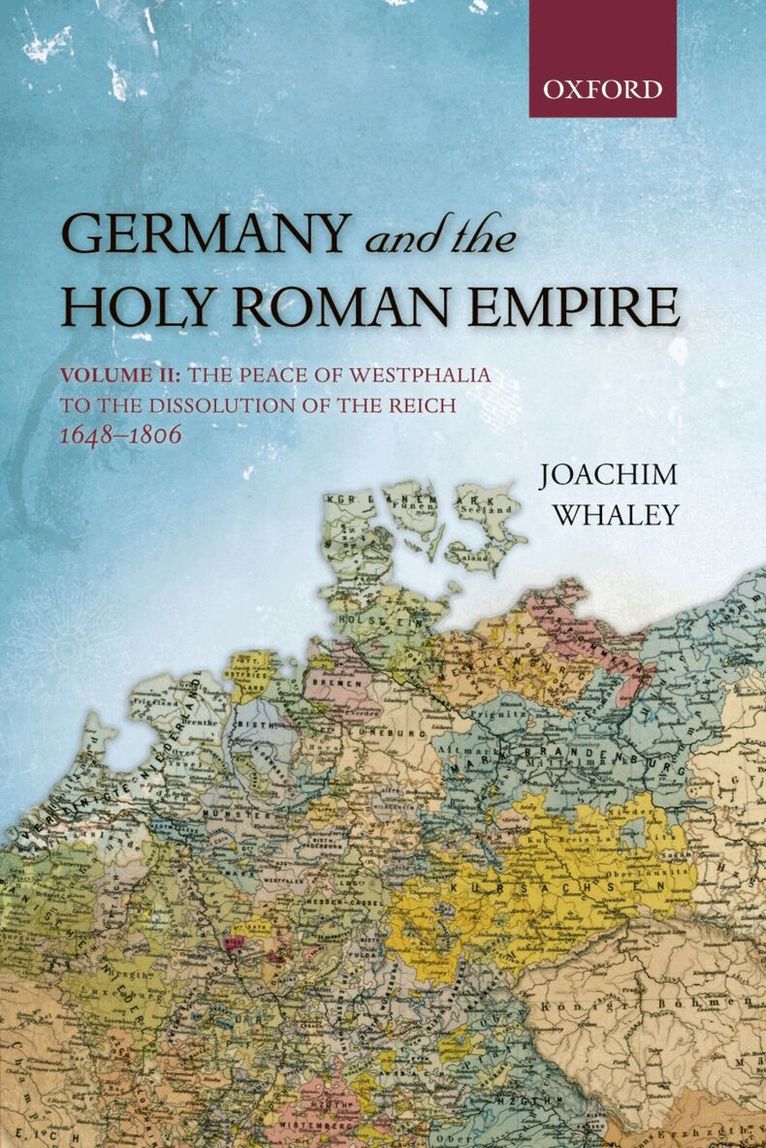
    Germany and the Holy Roman Empire

    Volume II: The Peace of Westphalia to the Dissolution of the Reich, 1648-1806

    AvJoachim Whaley

    Häftad, Engelska, 2013

    Del i serien Oxford History of Early Modern Europe

    1 094 kr

    Beställningsvara. Skickas inom 5-8 vardagar. Fri frakt över 249 kr.

    Fler format och utgåvor

    E-bok

    786 kr

    E-bok

    793 kr

    E-bok

    658 kr

    Inbunden

    3 635 kr

    Häftad

    1 149 kr

    Inbunden

    3 306 kr

    Beskrivning

    Germany and the Holy Roman Empire offers a striking new interpretation of a crucial era in German and European history, from the great reforms of 1495-1500 to the dissolution of the Reich in 1806. Over two volumes, Joachim Whaley rejects the notion that this was a long period of decline, and shows instead how imperial institutions developed in response to the crises of the sixteenth and seventeenth centuries, notably the Reformation and Thirty Years War. The impact of international developments on the Reich is also examined.Volume II begins with the Peace of Westphalia and concludes with the dissolution of the Reich. Whaley analyses the remarkable resurgence of the Reich after the Thirty Years War, which saw the Habsburg emperors achieve a new position of power and influence and which enabled the Reich to withstand the military threats posed by France and the Turks in the later seventeenth century. He gives a rich account of topics such as Pietism and baroque Catholicism, the German enlightenment, and the impact on the Empire and its territories of the French Revolution and Napolean. Whaley emphasizes the continuing viability of the Reich's institutions to the end, and the vitality of a political culture of freedom that has been routinely underestimated by historians of modern Germany.

    Produktinformation

    • Utgivningsdatum:2013-10-10
    • Mått:155 x 236 x 42 mm
    • Vikt:1 145 g
    • Format:Häftad
    • Språk:Engelska
    • Serie:Oxford History of Early Modern Europe
    • Antal sidor:784
    • Förlag:OUP OXFORD
    • ISBN:9780199688838

    Utforska kategorier

    • Kulturvetenskap inom Samhälle och politik
    • Europas historia inom Historia och arkeologi
    • Ekonomisk historia inom Ekonomi och Ledarskap

    Mer om författaren

    Joachim Whaley read History at Christ's College Cambridge. He held Fellowships in History at Christ's College and Robinson College before becoming a Lecturer in German in the Faculty of Modern and Medieval Languages at Cambridge, where he teaches German history, thought, and language. He is the author of Religious Toleration and Social Change in Hamburg 1529-1819 and of numerous articles on early modern and modern German history. He was elected a Fellow of the Royal Historical Society in 1984, and Fellow of the British Academy in 2015.

    Recensioner i media

    Review from previous edition: Whaley sees the Reich as a continually reforming, diverse but legally ordered polity, rather than some kind of bizarre monstrosity or collective fiction. His two volumes are exceptionally well written and highly nuanced and reflect the latest scholarship. Indeed, they represent a huge personal achievementthey will provide a standard of scholarship against which all future works will be measured

    Innehållsförteckning

    • Preface to Volume II ; I. RECONSTRUCTION AND RESURGENCE 1648-1705: THE REICH UNDER FERDINAND III AND LEOPOLD I ; 1. Historians and the Reich after the Thirty Years War ; 2. The Last Years of Ferdinand III: Western Leagues and Northern Wars ; 3. From Ferdinand III to Leopold I ; 4. Leopold I and his Foreign Enemies ; 5. A New Turkish Threat ; 6. Renewed Conflict with France ; 7. The Emperor, the Perpetual Reichstag, the Kreise, and Imperial Justice ; 8. Imperial Networks: the Reichskirche and the Imperial Cities ; 9. The Imperial Court at Vienna and Dynastic Elevations in the Reich ; 10. The Nature of the Reich: Projects and Culture ; 11. Interpretations of the Leopoldine Reic ; II. CONSOLIDATION AND CRISIS 1705-1740: THE REICH UNDER JOSEPH I AND CHARLES VI ; 12. Two Wars and Three Emperors ; 13. Leopold I, Joseph I, and the War of Spanish Succession ; 14. Joseph I and the Government of the Reich ; 15. Charles VI: Fruition or Decline? ; 16. Conflicting Priorities: c.1714 - c.1730 ; 17. Charles VI and the Government of the Reich ; 18. The Return of Confessional Politics? ; 19. The Problem of the Austrian Succession ; 20. The Ebb of Imperial Power 1733-1740? ; 21. The Reich in Print ; III. THE GERMAN TERRITORIES, C. 1648-C.1740 ; 22. An Age of Absolutism? ; 23. Contemporary Perceptions: From Reconstruction to Early Enlightenment ; 24. The Smaller Territories ; 25. Austria and Brandenburg-Prussia ; 26. The Revival of the Court and the Development of Territorial Government ; 27. The Court: its Culture, its Functions, and its Critics ; 28. The Development of Military Power ; 29. Princes and Estates ; 30. An Oppressed Peasantry? ; 31. Government and Society ; 32. Government and Economic Development ; 33. Public and Private Enterprise ; 34. Christian Polities: Baroque Catholicism ; 35. Christian Polities: the Territories of the Reichskirche ; 36. Christian Polities: Protestant Orthodoxy and Renewal ; 37. From Coexistence to Toleration? ; 38. Enlightenment and Patriotism ; IV. DECLINE OR MATURITY? THE REICH FROM CHARLES VII TO LEOPOLD II, C. 1740-1792 ; 39. Three Emperors and a King ; 40. Silesian Wars, 1740-1763 ; 41. Managing the Reich without the Habsburgs: Charles VII (1742-45) ; 42. The Return of the Habsburgs: Francis I (1745-1765) ; 43. The Reich without Enemies? Germany and Europe 1763-1792 ; 44. Renewal: Joseph II 1765-c.1776 ; 45. The Great Reform Debate: Joseph II c. 1778-1790 ; 46. Restoration: Leopold II 1790-92 ; 47. Central and Intermediate Institutions of the Reich ; 48. The Reich, the Public Sphere, and the Nation ; V. THE GERMAN TERRITORIES AFTER C. 1760 ; 49. Enlightenment and the Problem of Reform ; 50. Crisis and Opportunity ; 51. The Challenge of the Enlightenment and the Public Sphere ; 52. Protestant, Catholic and Jewish Aufklarung ; 53. Aufklarung and Government ; 54. Cameralism, Physiocracy, and the Provisioning of Society ; 55. Economic Policy: Manufactures, Guilds, Welfare, and Taxation ; 56. Administration, Law, and Justice ; 57. Education and Toleration ; 58. Courts and Culture ; 59. The Impact of Reform: Immunity against Revolution? ; VI. WAR AND DISSOLUTION: THE REICH 1792-1806 ; 60. Ruptures and Continuities ; 61. The Reich in the Revolutionary Wars ; 62. Reverberations of the French Revolution: Unrest and Uprisings ; 63. Reverberations of the French Revolution: Intellectuals ; 64. Schemes for the Reform of the Reich in the 1790s ; 65. The Peace of Luneville (1801) and the Reichsdeputationshauptschluss (1803) ; 66. The Transformation of the Reich 1803-05 ; 67. Final Attempts at Reform and the Dissolution of the Reich 1806 ; Conclusion ; Glossary ; Bibliography ; Index