• Fri frakt över 249 kr
  • •
  • Snabba leveranser
  • •
  • Billiga böcker
Kundservice

Du är på sajten för privatpersoner.

Företag, bibliotek eller offentlig verksamhet?

Du handlar på classic.bokus.com, där alla dina funktioner finns intakta.
Till classic.bokus.com
Bokus logotyp. Gå till startsidan.
  • Erbjudanden
  • Nyheter
  • Student
  • Topplistor
  • Barn & ungdom
  • Bokus Play
  • E-böcker
  • Pocketböcker
  • Spel & pussel

10% rabatt på allt med kod: NYSTART10 →

Sidfot

Mina sidor

    Hjälp

    • Kundservice
    • Vanliga frågor och svar
    • Frakt och leverans
    • Retur vid ångerrätt
    • Reklamera vara
    • Betalning
    • Köpvillkor
    • Allmänna villkor
    • Information om webbplatsens tillgänglighet

    Om Bokus

    • Om oss
    • Pressrum
    • För studenter
    • För företag
    • För bibliotek och offentlig verksamhet
    • För leverantörer
    • Hållbarhet

    Populärt

    • Aktuella erbjudanden
    • Presentkort
    • Studentlitteratur
    • Nya böcker
    • Topplistor
    • Signerade böcker
    • Engelska böcker

    Inspiration

    • Boktips
    • BookTok
    • Populära bokserier
    • Barnbokskaraktärer
    • Populära författare
    Logotyp för Bokus
    Följ oss på Facebook (extern länk)Följ oss på Instagram (extern länk)Följ oss på YouTube (extern länk)Följ oss på TikTok (extern länk)
    bokus @ CookiesAnpassa cookiesIntegritetspolicyKöpvillkor
    Till Citymail hemsida (extern länk)Till Budbee hemsida (extern länk)Till Postnord hemsida (extern länk)Till Schenker hemsida (extern länk)Till Early Bird hemsida (extern länk)Till Walleys hemsida (extern länk)
    1. Samhälle och politik
    2. Politik och statsskick
    3. Politiska ideologier och rörelser
    4. Högerradikalism och högerextremism

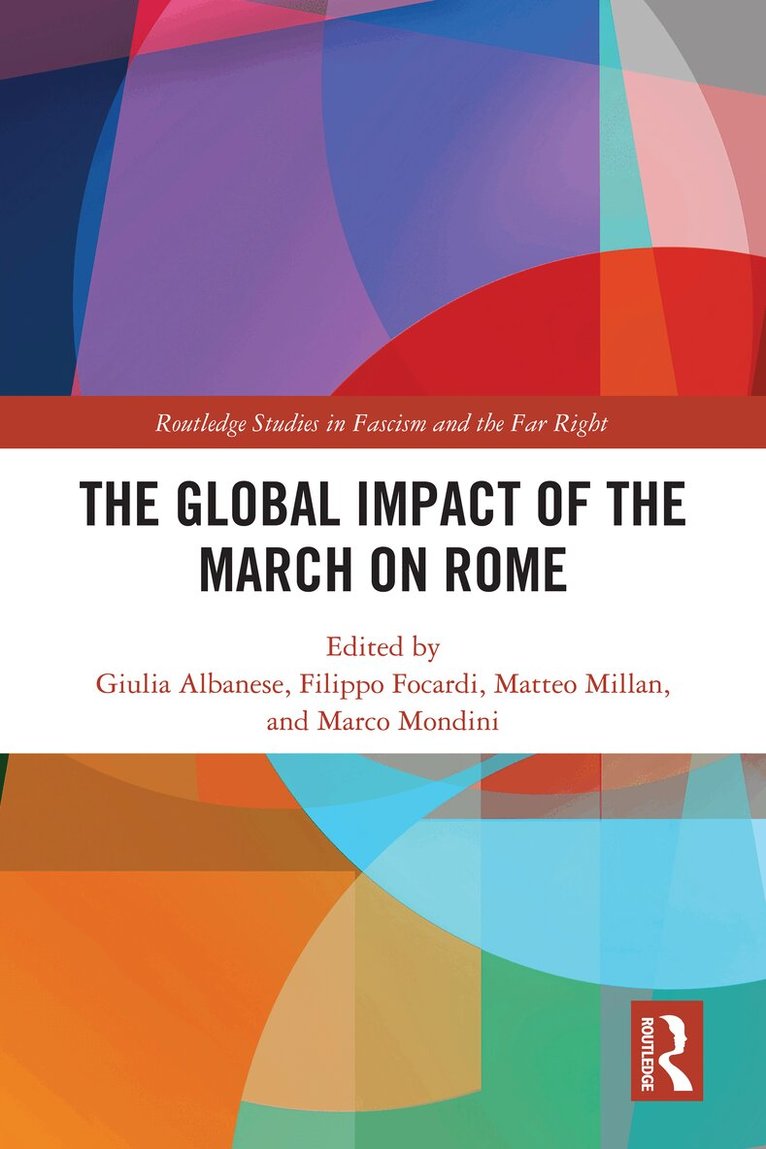
    Global Impact of the March on Rome

    AvGiulia Albanese,Filippo Focardi

    Inbunden, Engelska, 2026

    Del i serien Routledge Studies in Fascism and the Far Right

    2 493 kr

    Beställningsvara. Skickas inom 10-15 vardagar. Fri frakt över 249 kr.

    Beskrivning

    This comprehensive collection of chapters provides a nuanced and multifaceted analysis of the global impact of the March on Rome, offering valuable insights into the spread and adaptation of Fascist ideologies in different cultural and political contexts beyond Italy in the 1920s and 1930s.The chapters seek to contextualise the transformation of political cultures in 1920s Europe and provide a better understanding of the reasons for Fascism's success in the interwar world. By exploring these diverse perspectives and experiences, the book sheds light on the complex processes of ideological transfer, adaptation, and resistance that characterised the global reception of Fascism in the wake of the March on Rome. It underscores the importance of considering local contexts, transnational networks, and individual actors in tracing the trajectory of Fascist influence across Western and Eastern Europe, Latin America and the United States.This book will appeal to an academic and scholarly audience at many levels, particularly in undergraduate and postgraduate courses on Italian and European history. Its accessible engagement of the broader issue of fascism and its transnational spread will also be of interest to a general readership interested in the history of Europe during the interwar period.

    Produktinformation

    • Utgivningsdatum:2026-04-08
    • Mått:156 x 234 x 21 mm
    • Vikt:810 g
    • Format:Inbunden
    • Språk:Engelska
    • Serie:Routledge Studies in Fascism and the Far Right
    • Antal sidor:342
    • Förlag:Taylor & Francis Ltd
    • ISBN:9781032831374

    Utforska kategorier

    • Högerradikalism och högerextremism inom Samhälle och politik
    • Modern militärhistoria inom Historia och arkeologi
    • Andra världskriget inom Historia och arkeologi

    Mer om författaren

    Giulia Albanese is Professor of Contemporary History at the University of Padua. Her research interests have focused primarily on fascism and authoritarian cultures. Among her works are The March on Rome: Violence and the Rise of Italian Fascism (2019) and Rethinking the History of Italian Fascism (2022).Filippo Focardi is Professor of Contemporary History at the University of Padua. His research interests include the memory of Fascism and the Second World War in Italy and the politics of the memory of the European Union. Among his recent publications is The Bad German and the Good Italian: Removing the Guilt of the Second World War (2023).Matteo Millan is Professor of Contemporary History at the University of Padua. His research interests include the history of Fascist squadrismo, armed associations, gun control, and gun cultures in modern Europe. His recent publications include The Blackshirts' Dictatorship: Armed Squads, Political Violence, and the Consolidation of Mussolini’s Regime (2022) and the article “Belle Époque in Arms?” (2021).Marco Mondini is Associate Professor of History of Conflicts at the University of Padua and Co-Director of the Centre International de Recherche sur la Guerre in Péronne. Among his recent publications are The Generalissimo: Luigi Cadorna and the Italian Army (2025) and Il ritorno della guerra (2024).

    Innehållsförteckning

    • Introduction: The March on Rome a Century Later: New Research Perspectives in Europe and Beyond Part 1: Rethinking the March on Rome in Italy and Beyond 1. The March on Rome: Multiple Perceptions in Italy and Beyond 2. War after the War: Fascism between Patriotic Remobilization and Militarization of the Italian Society 3. Not Only Paramilitarism: Civic Militias, Strikebreaking Groups, and the Long-Term Origins of Bourgeois Armed Mobilization in Europe (ca. 1900s–1923) 4. Colonial and Transnational Perspectives on Paramilitarism and Fascism Part 2: The Western European Impact of the March on Rome 5. “Blue-blooded exuberance” or Fascists? The Impact of the March on Rome on the Radical Right in Britain (1922–1926) 6. The Reception of Italian Fascism in France: Representations, Political Relations, Transnational Dynamics 7. From the Putsch to the March: The “March on Rome” as a Performative Model and the Transfer of Fascist Practices across German-Speaking Interwar Europe 8. The Impact of the March on Rome on the Early Nazi Movement, 1922–1925 9. Ramifications of the “March on Rome” in the Weimar Republic: From the Media-Political Reception to the Brokering of Fascism 10. “Wilsonian Disappointment” and Anti-Liberalism in Spain: The Aftermath of the First World War, Fascism, and the Coup d’eìtat of Primo de Rivera (1917–1923) 11. The March on Rome in Greece: Short-Term Reception and Long-Term Impact 12. The Impact of the March on Rome in the Nordic Countries: The Ideological Dilemma between “Black” and “Red” Revolutions Part 3: The Reception of the March on Rome in Central and Eastern Europe 13. Hungary and the March on Rome, an Event That Actually Changed Nothing 14. Fascism Goes East Central Europe: Reactions to Rome’s March and the Evolution of Political Culture in Interwar Poland (1922–1931) 15. Disciples of Italian Authoritarianism: Anti-Democratic Romanian Great War Veterans and Their Transnational Influences in the Interwar Era Part 4: The Impact of the March beyond Europe 16. Threat or Resource? The Impact of the March on Rome among the Italian Population in Tunisia: Perceptions, Reactions and Instrumentalizations in a Peripheral Context 17. The March on Rome Seen from the United States 18. Echoes of Fascism in Brazil under Getúlio Vargas (1930–1945)