• Fri frakt över 249 kr
  • •
  • Snabba leveranser
  • •
  • Billiga böcker
Kundservice

Du är på sajten för privatpersoner.

Företag, bibliotek eller offentlig verksamhet?

Du handlar på classic.bokus.com, där alla dina funktioner finns intakta.
Till classic.bokus.com
Bokus logotyp. Gå till startsidan.
  • Erbjudanden
  • Nyheter
  • Student
  • Topplistor
  • Barn & ungdom
  • Bokus Play
  • E-böcker
  • Pocketböcker
  • Spel & pussel

10% rabatt på allt med kod: NYSTART10 →

Sidfot

Mina sidor

    Hjälp

    • Kundservice
    • Vanliga frågor och svar
    • Frakt och leverans
    • Retur vid ångerrätt
    • Reklamera vara
    • Betalning
    • Köpvillkor
    • Allmänna villkor
    • Information om webbplatsens tillgänglighet

    Om Bokus

    • Om oss
    • Pressrum
    • För studenter
    • För företag
    • För bibliotek och offentlig verksamhet
    • För leverantörer
    • Hållbarhet

    Populärt

    • Aktuella erbjudanden
    • Presentkort
    • Studentlitteratur
    • Nya böcker
    • Topplistor
    • Signerade böcker
    • Engelska böcker

    Inspiration

    • Boktips
    • BookTok
    • Populära bokserier
    • Barnbokskaraktärer
    • Populära författare
    Logotyp för Bokus
    Följ oss på Facebook (extern länk)Följ oss på Instagram (extern länk)Följ oss på YouTube (extern länk)Följ oss på TikTok (extern länk)
    bokus @ CookiesAnpassa cookiesIntegritetspolicyKöpvillkor
    Till Citymail hemsida (extern länk)Till Budbee hemsida (extern länk)Till Postnord hemsida (extern länk)Till Schenker hemsida (extern länk)Till Early Bird hemsida (extern länk)Till Walleys hemsida (extern länk)
    1. Samhälle och politik
    2. Samhälle och kultur
    3. Kultur och medier
    4. Referensverk och tvärvetenskap

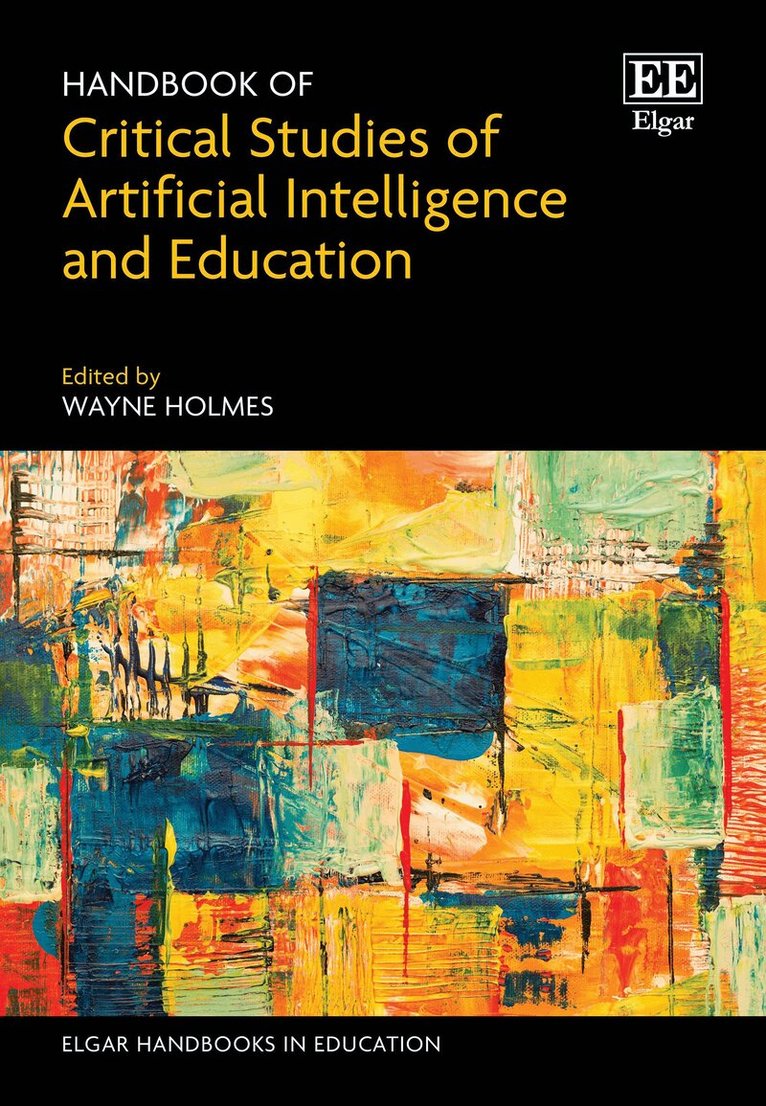
    Handbook of Critical Studies of Artificial Intelligence and Education

    AvWayne Holmes

    Inbunden, Engelska, 2026

    Del i serien Elgar Handbooks in Education

    4 097 kr

    Beställningsvara. Skickas inom 5-8 vardagar. Fri frakt över 249 kr.

    Beskrivning

    This timely Handbook explores, from a critical studies perspective, the ethical, sociocultural and political implications of Artificial Intelligence for education. Questioning techno-optimistic narratives surrounding AI, leading international scholars from a range of disciplines address the challenges that AI technologies pose to educators, administrators and policymakers.The Handbook initiates a necessary conversation regarding the implications of AI for human rights, social justice and equity in education. Chapters offer unique, interdisciplinary perspectives, challenging common assumptions and dominant narratives, and providing frameworks for understanding AI’s influence on teaching, learning and governance. Drawing on in-depth reviews and empirical data, the Handbook advocates for critical engagement with the connections between AI and education and for decisive policy and regulation to control its growing impact on educational environments and beyond.The Handbook is a vital resource for graduate students and academics working in education, educational technologies and AI in education, particularly those open to exploring critical approaches to the field. It is also an essential read for educators and higher education administrators and professionals grappling with the impact of AI on their institutions, as well as policymakers developing AI policy and regulations for education.

    Produktinformation

    • Utgivningsdatum:2026-05-29
    • Mått:169 x 244 x undefined mm
    • Format:Inbunden
    • Språk:Engelska
    • Serie:Elgar Handbooks in Education
    • Förlag:Edward Elgar Publishing Ltd
    • ISBN:9781035335862

    Utforska kategorier

    • Referensverk och tvärvetenskap inom Samhälle och politik
    • Utbildningsstrategier och utbildningspolitik inom Psykologi och pedagogik
    • Material och digital teknik i undervisningen inom Psykologi och pedagogik

    Mer om författaren

    Edited by Wayne Holmes, Professor of Critical Studies of Artificial Intelligence and Education, University College London, UK and UNESCO Chair in the Ethics of Artificial Intelligence and Education, International Research Centre on Artificial Intelligence (IRCAI) under the auspices of UNESCO, Slovenia

    Innehållsförteckning

    • ContentsForeword by Audrey Watters xviWhat do you mean by critical AI? by Ilkka Tuomi xixIntroduction to the Handbook of Critical Studies of Artificial Intelligence andEducation 1Wayne HolmesPART I CRITICAL PERSPECTIVES ON AI AND EDUCATION1 Teaching in the age of its technical reproducibility: a critical perspectiveon sociotechnical transformations of education 13Valeria Cesaroni2 Neither the helm nor the wheel: charting the landscape of agency in highlyautomated education 30Ana Mouta and Emanuele Bardone3 The new spirit of education and the techno-politics of AI 50Ron Salaj4 Whose goals? Challenging the role of AI in education and the need forstudent voices 70Velislava Hillman and Sam Illingworth5 An Islamically inspired critical pedagogy in the AI era: a multiplexframework for fostering wisdom 87Junaid Qadir and Recep Senturk6 The democratic risks of AI in education: an epistemic perspective 101Tiina Räisä, Leonardo Espinosa-Leal and Matteo StocchettiPART II EDUCATIONAL FRAMEWORKS AND AI LITERACY7 Sociocultural reimagining of AI Literacy for educators 115Karen Moran Jackson and Rosemary Papa8 Pedagogy of AIED 130Patricia Gibson9 Modelling critical AI literacies from a posthumanist perspective: acognitive assemblage for Human–Technology–World relations 145Marcelo El Khouri Buzato and Priscila Gonsales10 Between hype and fear: AI Literacy for the development of criticaleducational imaginaries 161Àlex Valverde-Valencia11 AI and assessment in education: imagining practices in utopian terms 177Luis Medina-Gual and Rafael Garcia Campos12 Towards a taxonomy of AI learning 198Jeremy Knox and David LundiePART III SOCIOCULTURAL AND ETHICAL IMPLICATIONS OF AI INEDUCATION13 Coded crisis and situated algorithms: a decolonial intersectional feministperspective on the ethics of AI in education 213Xinman Liu14 Discourse before doctrine: the category error in AI ethics education 233Lucas J. Wiese and Daniel S. Schiff15 A vernacularised taxonomy of harms for AI in education 247Wm. Matthew Kennedy and Daniel Vargas Campos16 Critical data and Artificial Intelligence literacies in academic practice 265Javiera Atenas, Federica Picasso, Chrissi Nerantzi, Leo Havemann,Anna Serbati, Daniele Agostini and Nicholas Caldwell17 Artificial Intelligence in education from the perspective of informationethics: the case of Plan Ceibal in Uruguay 284Maximiliano Rodríguez-Fleitas and Sofia Ache18 Posthuman and postgender education: embodying AI subjectivities 295Manuel López-Pereyra and Diego de Santiago DelfínPART IV PRACTICAL APPLICATIONS AND CASE STUDIES OF AI INEDUCATION19 Tales of temptation: staff and student reflections on AI and dishonesty inthe neoliberal academy 310Hakan Ergül and Nicole Brown20 Ludic perspectives on AI 326Diane Carr and Bruno de Paula21 Authentic learning in a GenAI writing classroom? The reality and itsparadox 335Bernice Yeo22 Learning, agency, and Generative AI: a grassroots perspective 350Ignas Kalpokas and Julija Kalpokienė23 Imaginaries of responsible Generative AI in secondary education 364Jen Ross, Esther Priyadharshini, Harry Dyer, Ayça Atabey, ColtonBotta, Cara Wilson and Judy Robertson24 AI in the classroom: using problem-based learning to enhance reflexivityand build critical thinking skills 384Judith E. Rosenbaum and Sheridan Kelley AdamsPART V POLICY AND GOVERNANCE OF AI IN EDUCATION25 After AI: a research agenda for investigating policy and the future ofschooling 403Kalervo N. Gulson26 Groundhog AI: power and pedagogy in the face of discourses of disruptionin university policies and position statements 416Louise Drumm27 AI and the future of academic labour organising 431Robert Ovetz and Lindsay Weinberg28 EdTech policies in South Korea between 2007 and 2023: teachers,students, and machines 446Kyungmee Lee29 Artificial Intelligence and data colonialism in education: implications foreducation governance in the Global South 468Mauro Jarquín-Ramírez and Enrique-Javier Díez-Gutiérrez30 Addressing inequalities in the uses of Artificial Intelligence in HigherEducation in Latin America: the AI controversy, a comparison of Ecuadorand Colombia 483María Belén Albornoz, Ángel Gutiérrez and Cheryl Martens