• Fri frakt över 249 kr
  • •
  • Snabba leveranser
  • •
  • Billiga böcker
Kundservice

Du är på sajten för privatpersoner.

Företag, bibliotek eller offentlig verksamhet?

Du handlar på classic.bokus.com, där alla dina funktioner finns intakta.
Till classic.bokus.com
Bokus logotyp. Gå till startsidan.
  • Erbjudanden
  • Student
  • Topplistor
  • Barn & ungdom
  • Bokus Play
  • E-böcker
  • Ljudböcker
  • Pocketböcker
  • Spel & pussel

10% rabatt på allt med kod NYSTART10 →

Sidfot

Mina sidor

    Hjälp

    • Kundservice
    • Vanliga frågor och svar
    • Frakt och leverans
    • Retur vid ångerrätt
    • Reklamera vara
    • Betalning
    • Köpvillkor
    • Allmänna villkor
    • Information om webbplatsens tillgänglighet

    Om Bokus

    • Om oss
    • Pressrum
    • För studenter
    • För företag
    • För bibliotek och offentlig verksamhet
    • För leverantörer
    • Hållbarhet

    Populärt

    • Aktuella erbjudanden
    • Presentkort
    • Studentlitteratur
    • Nya böcker
    • Topplistor
    • Signerade böcker
    • Engelska böcker

    Inspiration

    • Boktips
    • BookTok
    • Populära bokserier
    • Barnbokskaraktärer
    • Populära författare
    Logotyp för Bokus
    Följ oss på Facebook (extern länk)Följ oss på Instagram (extern länk)Följ oss på YouTube (extern länk)Följ oss på TikTok (extern länk)
    bokus @ CookiesAnpassa cookiesIntegritetspolicyKöpvillkor
    Till Citymail hemsida (extern länk)Till Budbee hemsida (extern länk)Till Postnord hemsida (extern länk)Till Schenker hemsida (extern länk)Till Early Bird hemsida (extern länk)Till Walleys hemsida (extern länk)
    1. Psykologi och pedagogik
    2. Psykologi
    3. Kognitiv psykologi

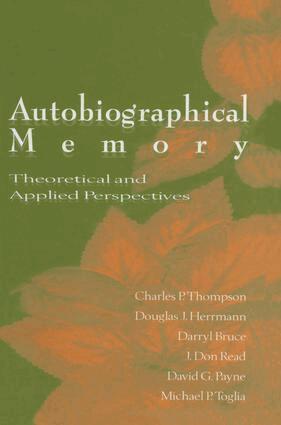
    Autobiographical Memory

    Theoretical and Applied Perspectives

    AvCharles P. Thompson,Douglas J. Herrmann

    Häftad, Engelska, 2014

    851 kr

    Beställningsvara. Skickas inom 10-15 vardagar. Fri frakt över 249 kr.

    Beskrivning

    The organization of the first Society for Applied Research in Memory and Cognition (SARMAC) conference centered around two specifically identifiable research topics -- autobiographical memory and eyewitness memory. These two areas -- long-time staples on the menu of investigators of memory in more natural settings -- differ on a variety of dimensions, perhaps most notably in their specific goals for scientific inquiry and application. For many questions about memory and cognition that are of interest to scientific psychology, there have been historical as well as rather arbitrary reasons for their assignment to the autobiographical or eyewitness memory fields. Perhaps as a result of differing historical orientations, the first volume's seven autobiographical memory chapters focus upon the qualities or types of recall from research participants, whereas the seven chapters in the eyewitness memory volume generally focus upon the quantity (a concern for completeness) and accuracy of recall. This interest in the ultimate end-product and its application within the legal process in general encourages eyewitness memory investigators to modify their testing procedures continually in an attempt to gain even more information from participants about an event. Indeed, several of the eyewitness memory chapters reflect such attempts. Beyond the specific contributions of each chapter to the literature on autobiographical and eyewitness memory, the editors hope that the reader will come away with some general observations: * the autobiographical and eyewitness memory fields are thriving; * these two fields are likely to remain center stage in the further investigation of memory in natural contexts; * although the autobiographical and eyewitness memory chapters have been segregated in these two volumes, the separation is often more arbitrary than real and connections between the two areas abound; * the two research traditions are entirely mindful of fundamental laboratory methods, research, and theory -- sometimes drawing their research inspirations from that quarter; and * the two fields -- though driven largely by everyday memory concerns -- can contribute to a more basic understanding of memory at both an empirical and a theoretical level.

    Produktinformation

    • Utgivningsdatum:2014-08-12
    • Mått:152 x 229 x 12 mm
    • Vikt:294 g
    • Format:Häftad
    • Språk:Engelska
    • Antal sidor:199
    • Förlag:Taylor & Francis Ltd
    • ISBN:9781138002555

    Utforska kategorier

    • Kognitiv psykologi inom Psykologi och pedagogik
    • Psykologi: jaget, identitet och personlighet inom Psykologi och pedagogik

    Mer om författaren

    Charles P. Thompson, Douglas J. Herrmann, Darryl Bruce, J. Don Read, David G. Payne, Michael P. Toglia

    Recensioner i media

    "...the chapters are well-written essays that should be valuable for either undergraduate or graduate psychology students. These books are an excellent introduction to the research literature on autobiographical and eyewitness memory."—Journal of Mathematical Psychology"...these two books serve as striking evidence that the fields of autobiographical and eyewitness memory have matured into rich and exciting areas of study. They are clearly far from bankruptcy."—Contemporary Psychology

    Innehållsförteckning

    • Contents: Preface. Part I: Overview and General IssuesD. Bruce, J.D. Read, Autobiographical Memory: Themes and Variations. D. Herrmann, The Relationship Between Basic Research and Applied Research in Memory and Cognition. C.P. Thompson, The Bounty of Everyday Memory. Part II: Autobiographical Memory.D.C. Rubin, Ruminations on Reminiscence. H.P. Bahrick, Loss and Distortion of Autobiographical Memory Content. R. Fivush, Gendered Narratives: Elaboration, Structure, and Emotion in Parent Child Reminiscing Across the Preschool Years. G. Cohen, The Effects of Aging on Autobiographical Memory. J.A. Robinson, L.R. Taylor, Autobiographical Memory and Self-Narratives: A Tale of Two Stories. D. Pillemer, A.B. Desrochers, C.M. Ebanks, Remembering the Past in the Present: Verb Tense Shifts in Autobiographical Memory Narratives. S.F. Larsen, What Is It Like to Remember? On Phenomenal Qualities of Memory.