• Fri frakt över 249 kr
  • •
  • Snabba leveranser
  • •
  • Billiga böcker
Kundservice

Du är på sajten för privatpersoner.

Företag, bibliotek eller offentlig verksamhet?

Du handlar på classic.bokus.com, där alla dina funktioner finns intakta.
Till classic.bokus.com
Bokus logotyp. Gå till startsidan.
  • Erbjudanden
  • Nyheter
  • Student
  • Topplistor
  • Barn & ungdom
  • Bokus Play
  • E-böcker
  • Pocketböcker
  • Spel & pussel

10% rabatt på allt med kod: NYSTART10 →

Sidfot

Mina sidor

    Hjälp

    • Kundservice
    • Vanliga frågor och svar
    • Frakt och leverans
    • Retur vid ångerrätt
    • Reklamera vara
    • Betalning
    • Köpvillkor
    • Allmänna villkor
    • Information om webbplatsens tillgänglighet

    Om Bokus

    • Om oss
    • Pressrum
    • För studenter
    • För företag
    • För bibliotek och offentlig verksamhet
    • För leverantörer
    • Hållbarhet

    Populärt

    • Aktuella erbjudanden
    • Presentkort
    • Studentlitteratur
    • Nya böcker
    • Topplistor
    • Signerade böcker
    • Engelska böcker

    Inspiration

    • Boktips
    • BookTok
    • Populära bokserier
    • Barnbokskaraktärer
    • Populära författare
    Logotyp för Bokus
    Följ oss på Facebook (extern länk)Följ oss på Instagram (extern länk)Följ oss på YouTube (extern länk)Följ oss på TikTok (extern länk)
    bokus @ CookiesAnpassa cookiesIntegritetspolicyKöpvillkor
    Till Citymail hemsida (extern länk)Till Budbee hemsida (extern länk)Till Postnord hemsida (extern länk)Till Schenker hemsida (extern länk)Till Early Bird hemsida (extern länk)Till Walleys hemsida (extern länk)
    1. Ekonomi och Ledarskap
    2. Företagsekonomi
    3. Entreprenörskap

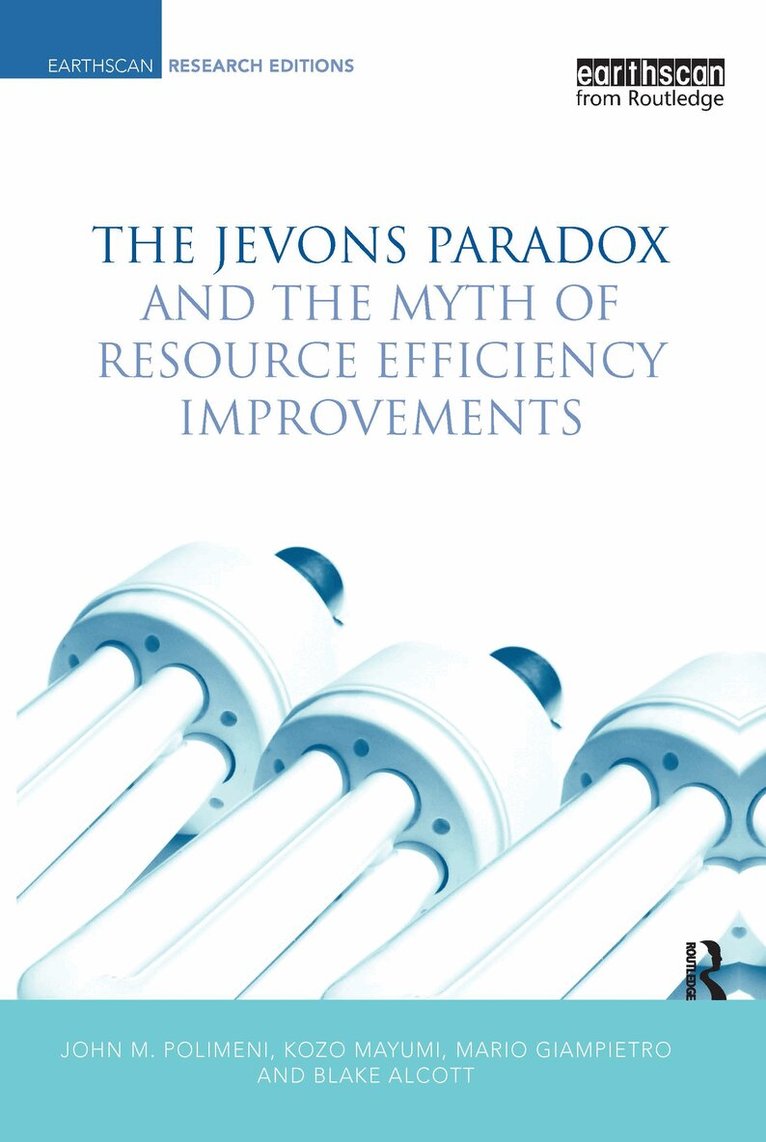
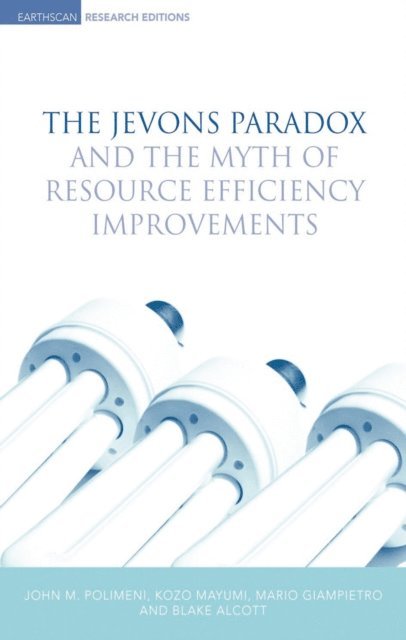
    Jevons Paradox and the Myth of Resource Efficiency Improvements

    AvBlake Alcott,Mario Giampietro

    Häftad, Engelska, 2015

    Del i serien Earthscan Research Editions

    793 kr

    Beställningsvara. Skickas inom 10-15 vardagar. Fri frakt över 249 kr.

    Fler format och utgåvor

    Inbunden

    2 421 kr

    Beskrivning

    �The Jevons Paradox�, which was first expressed in 1865 by William Stanley Jevons in relation to use of coal, states that an increase in efficiency in using a resource leads to increased use of that resource rather than to a reduction. This has subsequently been proved to apply not just to fossil fuels, but other resource use scenarios. For example, doubling the efficiency of food production per hectare over the last 50 years (due to the Green Revolution) did not solve the problem of hunger. The increase in efficiency increased production and worsened hunger because of the resulting increase in population. The implications of this in today�s world are substantial. Many scientists and policymakers argue that future technological innovations will reduce consumption of resources; the Jevons Paradox explains why this may be a false hope.This is the first book to provide a historical overview of the Jevons Paradox, provide evidence for its existence and apply it to complex systems. Written and edited by world experts in the fields of economics, ecological economics, technology and the environment, it explains the myth of efficiency and explores its implications for resource usage (particularly oil). It is a must-read for policymakers, natural resource managers, academics and students concerned with the effects of efficiency on resource use.

    Produktinformation

    • Utgivningsdatum:2015-06-25
    • Mått:156 x 234 x 17 mm
    • Vikt:370 g
    • Format:Häftad
    • Språk:Engelska
    • Serie:Earthscan Research Editions
    • Antal sidor:200
    • Förlag:Taylor & Francis Ltd
    • ISBN:9781138866959

    Utforska kategorier

    • Entreprenörskap inom Ekonomi och Ledarskap
    • Energiteknik inom Naturvetenskap och teknik
    • Internationell ekonomi inom Ekonomi och Ledarskap

    Mer om författaren

    John M. Polimeni is assistant professor of economics at Albany College of Pharmacy, US. Kozo Mayumi is professor at Faculty of Integrated Arts and Sciences, the University of Tokushima, Japan. Mario Giampietro is an ICREA research professor in the Institute of Environmental Science and Technology at the Universitat Aut noma de Barcelona in Spain. Blake Alcott received his MPhil in the Department of Land Economy, Cambridge University, in 2006 and is now working as an unaffiliated scholar in Z rich.

    Recensioner i media

    'Given both the importance of the topic and the analytical and policy vacuum that surrounds it, a book devoted to Jevons Paradox is both timely and welcome... contain(s) a great deal of valuable material.' Steve Sorrell, Science Policy Research Unit, University of Sussex'This extraordinary and timely book focuses on a basic problem involved in achieving major energy conservation. As the authors explain, the Jevons Paradox emphasizes that simply reducing energy use in one system actually often results in increasing energy use in another system. The issue of sustainability cannot be handled just by looking for silver bullets ...' David Pimentel, Professor Emeritus, Department of Ecology and Evolutionary Biology, Cornell University'Efficiency first does not give frugality second; it makes frugality less necessary. But if we seek frugality first we get efficiency second as an adaptation to scarcity. Recognizing the Jevons Paradox, this book cogently argues, is the major key to a rational energy policy. Highly recommended!' Herman E. Daly, Professor at the School Of Public Affairs, University Of Maryland, and former senior economist in the Environment Department of the World Bank'This book is the most comprehensive attempt at dismantling the efficiency myth: it examines the subject from a variety of practical and theoretical perspectives, and while it may leave an unsuspecting reader rather depressed it leaves all of us better prepared to face the reality.' Vaclav Smil, FRSC, Distinguished Professor, University Of Manitoba, Canada'A thoughtful compilation of the best multidisciplinary approaches to modeling energy and resource use, looking at the extent to which energy efficiency leads to increased consumption and if so, how this price-determined effect can be mitigated.' Hazel Henderson, Ethical Markets'Truly fascinating... an enlightening, provocative work.' Choice'A remarkable and unsettling critique of energy policy.' Crosslands Bulletin

    Innehållsförteckning

    • Foreword by Joseph A. Tainter * Introduction * Historical Overview of the Jevons Paradox in the Literature * The Jevons Paradox: The Evolution of Complex Adaptive Systems and the Challenge for Scientific Analysis * Empirical Evidence for the Jevons Paradox * Conclusion * Index