• Fri frakt över 249 kr
  • •
  • Snabba leveranser
  • •
  • Billiga böcker
Kundservice

Du är på sajten för privatpersoner.

Företag, bibliotek eller offentlig verksamhet?

Du handlar på classic.bokus.com, där alla dina funktioner finns intakta.
Till classic.bokus.com
Bokus logotyp. Gå till startsidan.
  • Erbjudanden
  • Nyheter
  • Student
  • Topplistor
  • Barn & ungdom
  • Bokus Play
  • E-böcker
  • Pocketböcker
  • Spel & pussel

10% rabatt på allt med kod: NYSTART10 →

Sidfot

Mina sidor

    Hjälp

    • Kundservice
    • Vanliga frågor och svar
    • Frakt och leverans
    • Retur vid ångerrätt
    • Reklamera vara
    • Betalning
    • Köpvillkor
    • Allmänna villkor
    • Information om webbplatsens tillgänglighet

    Om Bokus

    • Om oss
    • Pressrum
    • För studenter
    • För företag
    • För bibliotek och offentlig verksamhet
    • För leverantörer
    • Hållbarhet

    Populärt

    • Aktuella erbjudanden
    • Presentkort
    • Studentlitteratur
    • Nya böcker
    • Topplistor
    • Signerade böcker
    • Engelska böcker

    Inspiration

    • Boktips
    • BookTok
    • Populära bokserier
    • Barnbokskaraktärer
    • Populära författare
    Logotyp för Bokus
    Följ oss på Facebook (extern länk)Följ oss på Instagram (extern länk)Följ oss på YouTube (extern länk)Följ oss på TikTok (extern länk)
    bokus @ CookiesAnpassa cookiesIntegritetspolicyKöpvillkor
    Till Citymail hemsida (extern länk)Till Budbee hemsida (extern länk)Till Postnord hemsida (extern länk)Till Schenker hemsida (extern länk)Till Early Bird hemsida (extern länk)Till Walleys hemsida (extern länk)
    1. Samhälle och politik
    2. Samhälle och kultur
    3. Kultur och medier
    4. Medievetenskap

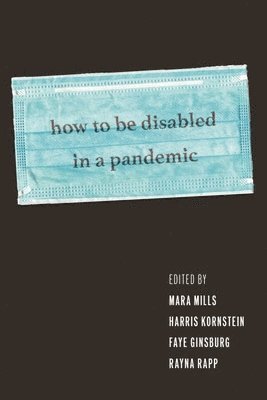
    How to Be Disabled in a Pandemic

    AvMara Mills,Harris Kornstein

    Inbunden, Engelska, 2025

    1 141 kr

    Beställningsvara. Skickas inom 10-15 vardagar. Fri frakt över 249 kr.

    Beskrivning

    A chronicle of ableism and disability activism in New York City during the COVID-19 pandemicHow to Be Disabled in a Pandemic documents the pivotal experiences of disabled people living in an early epicenter of COVID-19: New York City. Among those hardest hit by the pandemic, disability communities across the five boroughs have been disproportionately impacted by city and national policies, work and housing conditions, stigma, racism, and violence—as much as by the virus itself. Disabled and chronically-ill activists have protested plans for medical rationing and refuted the eugenic logic of mainstream politicians and journalists who "reassure" audiences that only older people and those with disabilities continue to die from COVID-19. At the same time, as exemplified by the viral hashtag #DisabledPeopleToldYou, disability expertise has become widely recognized in practices such as accessible remote work and education, quarantine, and distributed networks of support and mutual aid. This edited volume charts the legacies of this "mass disabling event" for uncertain viral futures, exploring the dialectic between disproportionate risk and the creativity of a disability justice response.How to Be Disabled in a Pandemic includes contributions by wide-ranging disability scholars, writers, and activists whose research and lived experiences chronicle the pandemic's impacts in prisons, migrant detention centers, Chinatown senior centers, hospitals in Queens and the Bronx, subways, schools, housing shelters, social media, and other locations of public and private life. By focusing on New York City over the course of three years, the book reveals key themes of the pandemic, including hierarchies of disability "vulnerability," the deployment of disability as a tool of population management, and innovative crip pandemic cultural production. How to Be Disabled in a Pandemic honors those lost, as well as those who survived, by calling for just policies and caring infrastructures, not only in times of crisis but for the long haul.

    Produktinformation

    • Utgivningsdatum:2025-02-25
    • Mått:152 x 229 x undefined mm
    • Vikt:871 g
    • Format:Inbunden
    • Språk:Engelska
    • Antal sidor:392
    • Förlag:New York University Press
    • ISBN:9781479830831

    Utforska kategorier

    • Medievetenskap inom Samhälle och politik
    • Socialrätt och hälso- och sjukvårdsrätt inom Juridik
    • Sociala och etiska frågor inom Samhälle och politik

    Mer om författaren

    Judith Heumann (Afterword by) Judith Heumann (1947-2023) was an internationally recognized disability rights activist, widely regarded as one of the leaders of the Disability Rights Movement. Judy worked in the Clinton and Obama Administrations, as an advisor at the World Bank, and as a Senior Fellow at the Ford Foundation. Her story is featured in the Oscar-nominated documentary Crip Camp: A Disability Revolution (2020) and her book, Being Heumann: An Unrepentant Memoir of a Disability Rights Activist (2020). She continued to be active until her death at age 75 on March 5, 2023. See https://judithheumann.com/Mara Mills (Editor) Mara Mills is Associate Professor in the Department of Media, Culture, and Communication at New York University. Mills is cofounder of the NYU Center for Disability Studies and coeditor of Crip Authorship: Disability as Method.Harris Kornstein (Editor) Harris Kornstein is Assistant Professor of Public and Applied Humanities at the University of Arizona. They have published research and essays in Surveillance & Society, Curriculum Inquiry, Wired, and others.Faye Ginsburg (Editor) Faye Ginsburg is Kriser Professor of Anthropology at New York University. Ginsburg is cofounder of the NYU Center for Disability Studies and author of Contested Lives: The Abortion Debate in an American Community and coauthor of Disability Worlds.Rayna Rapp (Editor) Rayna Rapp is Professor Emerita in the Department of Anthropology at New York University, and the author of Testing Women, Testing the Fetus: The Social Impact of Amniocentesis in America and coauthor of Disability Worlds.Ed Yong (Foreword by) Ed Yong is a science writer. For his coverage of the COVID-19 pandemic, he won the Pulitzer Prize in explanatory journalism, among other honors. He is the author of two New York Times bestsellers: I Contain Multitudes, and An Immense World, which won the Carnegie Medal for Excellence in Nonfiction.

    Recensioner i media

    "An exciting, deep, and moving contribution to Disability Studies. How to be Disabled in a Pandemic is a model for real-time pandemic theorizing that includes the most affected—as subjects, interlocutors, collaborators, and authors. This eloquent record of the brutal first years of Covid is set in its early epicenter of New York City. The holdings and methods of this impressive anthology will inform the ways we continue to engage with the critical connections between Covid, illness, disability, and place in the future." (Alexandra Juhasz, Brooklyn College, CUNY) "So many forces want us to forget about the pandemic, to say that it's over and not a concern anymore. How To Be Disabled in a Pandemic documents the wisdom of disabled oracles who resisted and challenged the system during the first three years of the pandemic in New York City. After reading this book, it'll leave you wondering what could have happened if our ableist society centered disabled people and took them seriously." (Alice Wong, author of Year of the Tiger: An Activist's Life) "Captures the history and textures of our present moment during the ongoing COVID-19 pandemic, using the best ethnographic tools to take us into New York City's most impacted spaces and communities. In the process, How to be Disabled in a Pandemic opens up new paths of inquiry about chronic illness, institutional violence, accessibility, and mutual aid. A must-read for disability activists and scholars." (Aimi Hamraie, author of Building Access: Universal Design and the Politics of Disability) "Required reading for anyone who wants to understand the impact of COVID-19 in the United States. To be living with a disability in this country is to be a disposable person in the eyes of the state, even with the rights struggled for by generations of people living with disabilities. Over the past half-decade, New York City and the US implemented policies that made life more dangerous for disabled people, but disabled communities, of which there are many, figured out ways forward together to fight for their own survival—they will not be silent." (Gregg Gonsalves, Yale University) "This volume chronicles the experiences and activism of disabled people in New York City during the COVID-19 pandemic and includes contributions from scholars, writers and organizers." (Ms. Magazine)