• Fri frakt över 249 kr
  • •
  • Snabba leveranser
  • •
  • Billiga böcker
Kundservice

Du är på sajten för privatpersoner.

Företag, bibliotek eller offentlig verksamhet?

Du handlar på classic.bokus.com, där alla dina funktioner finns intakta.
Till classic.bokus.com
Bokus logotyp. Gå till startsidan.
  • Erbjudanden
  • Nyheter
  • Student
  • Topplistor
  • Barn & ungdom
  • Bokus Play
  • E-böcker
  • Pocketböcker
  • Spel & pussel

10% rabatt på allt med kod NYSTART10 →

Sidfot

Mina sidor

    Hjälp

    • Kundservice
    • Vanliga frågor och svar
    • Frakt och leverans
    • Retur vid ångerrätt
    • Reklamera vara
    • Betalning
    • Köpvillkor
    • Allmänna villkor
    • Information om webbplatsens tillgänglighet

    Om Bokus

    • Om oss
    • Pressrum
    • För studenter
    • För företag
    • För bibliotek och offentlig verksamhet
    • För leverantörer
    • Hållbarhet

    Populärt

    • Aktuella erbjudanden
    • Presentkort
    • Studentlitteratur
    • Nya böcker
    • Topplistor
    • Signerade böcker
    • Engelska böcker

    Inspiration

    • Boktips
    • BookTok
    • Populära bokserier
    • Barnbokskaraktärer
    • Populära författare
    Logotyp för Bokus
    Följ oss på Facebook (extern länk)Följ oss på Instagram (extern länk)Följ oss på YouTube (extern länk)Följ oss på TikTok (extern länk)
    bokus @ CookiesAnpassa cookiesIntegritetspolicyKöpvillkor
    Till Citymail hemsida (extern länk)Till Budbee hemsida (extern länk)Till Postnord hemsida (extern länk)Till Schenker hemsida (extern länk)Till Early Bird hemsida (extern länk)Till Walleys hemsida (extern länk)
    1. Medicin
    2. Medicin: allmänt
    3. Den medicinska professionen
    4. Medicinsk etik och läkaretik

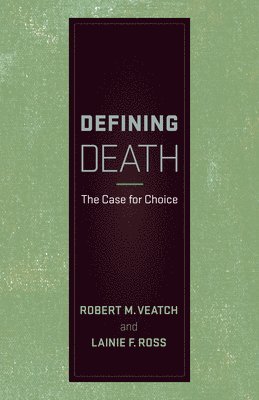
    Defining Death

    The Case for Choice

    AvRobert M. Veatch,Lainie F. Ross

    Inbunden, Engelska, 2016

    2 287 kr

    Beställningsvara. Skickas inom 5-8 vardagar. Fri frakt över 249 kr.

    Fler format och utgåvor

    Häftad

    623 kr

    Beskrivning

    New technologies and medical treatments have complicated questions such as how to determine the moment when someone has died. The result is a failure to establish consensus on the definition of death and the criteria by which the moment of death is determined. This creates confusion and disagreement not only among medical, legal, and insurance professionals but also within families faced with difficult decisions concerning their loved ones. Distinguished bioethicists Robert M. Veatch and Lainie F. Ross argue that the definition of death is not a scientific question but a social one rooted in religious, philosophical, or social beliefs. Drawing on history and recent court cases, the authors detail three potential definitions of death--the whole-brain concept; the circulatory, or somatic, concept; and the higher-brain concept. Because no one definition of death commands majority support, it creates a major public policy problem. The authors cede that society needs a default definition to proceed in certain cases, like those involving organ transplantation.But they also argue the decision-making process must give individuals the space to choose among plausible definitions of death according to personal beliefs. Taken in part from the authors' latest edition of their groundbreaking work on transplantation ethics, Defining Death is an indispensable guide for professionals in medicine, law, insurance, public policy, theology, and philosophy as well as lay people trying to decide when they want to be treated as dead.

    Produktinformation

    • Utgivningsdatum:2016-11-03
    • Mått:140 x 216 x 14 mm
    • Vikt:386 g
    • Format:Inbunden
    • Språk:Engelska
    • Antal sidor:168
    • Förlag:Georgetown University Press
    • ISBN:9781626163546
    • Utmärkelser:Commended for Catholic Press AssociationBook Award for Faith and Science 6 (United States)

    Utforska kategorier

    • Medicinsk etik och läkaretik inom Medicin
    • Etiska frågor och debatter inom Samhälle och politik
    • Sociologi inom Samhälle och politik

    Mer om författaren

    Robert M. Veatch, PhD, is professor of medical ethics emeritus at the Kennedy Institute of Ethics, Georgetown University. He has received the Lifetime Achievement Award from the American Society of Bioethics and the Humanities. The author of fifty books, he is coauthor of Transplantation Ethics, Second Edition, with Lainie F. Ross. He serves on the United Network for Organ Sharing Ethics Committee and the Board of Directors of the Washington Regional Transplant Community. Lainie F. Ross, MD, is the Carolyn and Matthew Bucksbaum Professor of Clinical Medical Ethics at the University of Chicago. She is the author of Children, Families and Health Care Decision-Making, Children in Medical Research: Access versus Protection, and coauthor of Transplantation Ethics, Second Edition, with Robert M. Veatch. She has served on the United Network for Organ Sharing Ethics Committee.

    Innehållsförteckning

    • 1. Defining Death: An IntroductionThe Emergence of the ControversyThree Groups of DefinitionsThe Emergence of a Uniform Brain-Oriented DefinitionIrreversible vs. Permanent Loss of FunctionDefining Death and Transplanting OrgansThe Structure of the Book 2. The Dead Donor Rule and the Concept of DeathThe Dead Donor RuleCandidates for a Concept of "Death"The Public Policy Question 3. The Whole-Brain Concept of DeathThe Case for the Whole-Brain ConceptCriteria for the Destruction of All Brain FunctionsProblems with the Whole-Brain DefinitionAlternatives to the Whole-Brain Definition 4. The Circulatory, or Somatic, Concept of DeathTwo Measurements of DeathCirculatory Death and Organ ProcurementThe DCD ProtocolsShewmon's Somatic ConceptThe Two Definitions of the US President's Council on Bioethics 5. The Higher-Brain Concept of DeathWhich Brain Functions Are Critical?Altered States of Consciousness: A ContinuumMeasuring the Loss of Higher-Brain FunctionAncillary TestsThe Legal Status of Death 6. The Conscience Clause: How Much Individual Choice Can Our Society Tolerate in Defining Death?The Present State of the LawConcepts, Criteria, and the Role of Value PluralismExplicit Patient Choice, Substituted Judgment, and Best InterestLimits on the Range of DiscretionThe Problem of Order: Objections to a Conscience ClauseImplementation of a Conscience ClauseConclusion 7. Crafting a New Definition-of-Death LawIncorporating the Higher-Brain-Function NotionThe Conscience ClauseClarification of the Concept of "Irreversibility"A Proposed New Definition of Death for Public Policy PurposesConclusion