• Fri frakt över 249 kr
  • •
  • Snabba leveranser
  • •
  • Billiga böcker
Kundservice

Du är på sajten för privatpersoner.

Företag, bibliotek eller offentlig verksamhet?

Du handlar på classic.bokus.com, där alla dina funktioner finns intakta.
Till classic.bokus.com
Bokus logotyp. Gå till startsidan.
  • Erbjudanden
  • Nyheter
  • Student
  • Topplistor
  • Barn & ungdom
  • Bokus Play
  • E-böcker
  • Pocketböcker
  • Spel & pussel

Må bättre, för mindre! Upp till 50% rabatt på hälsoböcker

Sidfot

Mina sidor

    Hjälp

    • Kundservice
    • Vanliga frågor och svar
    • Frakt och leverans
    • Retur vid ångerrätt
    • Reklamera vara
    • Betalning
    • Köpvillkor
    • Allmänna villkor
    • Information om webbplatsens tillgänglighet

    Om Bokus

    • Om oss
    • Pressrum
    • För studenter
    • För företag
    • För bibliotek och offentlig verksamhet
    • För leverantörer
    • Hållbarhet

    Populärt

    • Aktuella erbjudanden
    • Presentkort
    • Studentlitteratur
    • Nya böcker
    • Topplistor
    • Signerade böcker
    • Engelska böcker

    Inspiration

    • Boktips
    • BookTok
    • Populära bokserier
    • Barnbokskaraktärer
    • Populära författare
    Logotyp för Bokus
    Följ oss på Facebook (extern länk)Följ oss på Instagram (extern länk)Följ oss på YouTube (extern länk)Följ oss på TikTok (extern länk)
    bokus @ CookiesAnpassa cookiesIntegritetspolicyKöpvillkor
    Till Citymail hemsida (extern länk)Till Budbee hemsida (extern länk)Till Postnord hemsida (extern länk)Till Schenker hemsida (extern länk)Till Early Bird hemsida (extern länk)Till Walleys hemsida (extern länk)
    1. Samhälle och politik
    2. Politik och statsskick
    3. Politiska ideologier och rörelser
    4. Nationalism

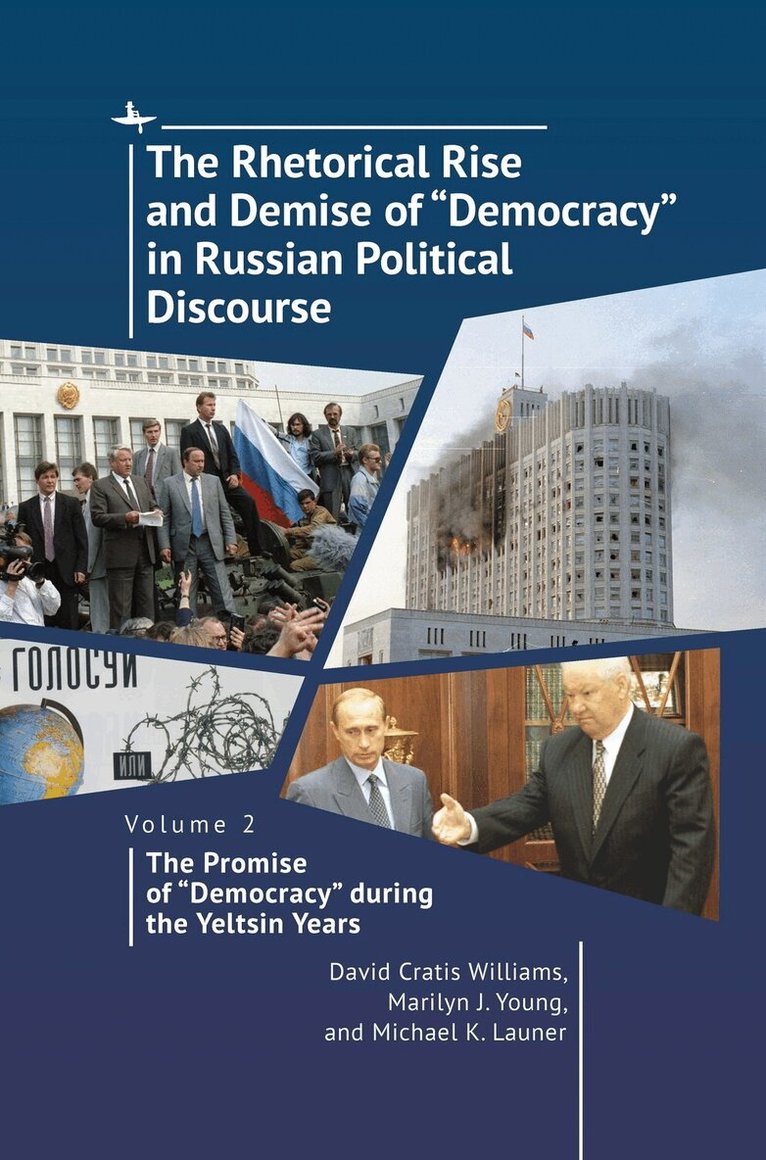
    Rhetorical Rise and Demise of “Democracy” in Russian Political Discourse, Volume 2

    The Promise of “Democracy” during the Yeltsin Years

    AvDavid Cratis Williams,Marilyn J. Young

    Inbunden, Engelska, 2022

    1 276 kr

    Skickas . Fri frakt över 249 kr.

    Beskrivning

    Post-Soviet Russia in the 1990s saw a surge in civic participation. The traditional power structure officially relinquished control of political rhetoric and a nascent civil society had begun to emerge. Free elections and political partisanship between reformist and conservative elements of Russian society, spurred on by Russia’s economic troubles, gave a “Wild West” tenor to public rhetoric that was reflected in the election campaigns of 1993, 1995, and 1996. In this volume, the authors examine, through a series of contemporaneously written essays, the arc of government rhetoric during the height of media freedom, the quest for a new national identity, and the struggle for self-government.

    Produktinformation

    • Utgivningsdatum:2022-06-02
    • Mått:155 x 234 x 32 mm
    • Vikt:830 g
    • Format:Inbunden
    • Språk:Engelska
    • Antal sidor:470
    • Förlag:Academic Studies Press
    • ISBN:9781644696507

    Utforska kategorier

    • Nationalism inom Samhälle och politik
    • Ekonomisk politik inom Ekonomi och Ledarskap
    • Statsvetenskap och politisk teori inom Samhälle och politik

    Mer om författaren

    David Cratis Williams is Professor of Communication and Rhetorical Studies at Florida Atlantic University. His scholarship focuses on argumentation, rhetorical theory, and criticism; he is a recognized authority on Kenneth Burke. His work on Russian political discourse began during a meeting in Russia in January 1992.Marilyn J. Young is the Wayne C. Minnick Professor of Communication Emerita at Florida State University. Her research has focused on political argument with an emphasis on the development of political rhetoric and argument in the former Soviet Union, particularly Russia. She remains an active scholar in retirement.Michael K. Launer is Professor Emeritus of Russian at Florida State University. In 1987 he interpreted for the first group of Soviet scientists visiting the US following Chernobyl. A State Department certified technical interpreter, he supported Nuclear Regulatory Commission and Department of Energy assistance programs through 2012.

    Innehållsförteckning

    • List of PhotosAcknowledgementsContributorsNote to ReadersAlexander YurievAlexander YurievDedication: Alexander Ivanovich Yuriev (1942–2020)Alexander YurievPrefaceMarilyn Young at a Political Communication ConferenceIntroduction to Volume TwoYeltsin and Gorbachev Part One: Framework for Understanding the Immediate Post-Soviet Political Environment: Ecological Depredation, Economic Challenges, the Press, and National IdentityYeltsin Standing on a Tank 1991A New Day for the Soviet EnvironmentThe Former Soviet Union Leaves Environmental Legacy of ShameReview of Environmental Management in the Soviet Union by Philip R. PrydeRussian Scientists Struggle to SurviveReview of The Russian Press from Brezhnev to Yeltsin: Behind the Paper Curtain by John MurrayArgumentation, Globalization, and the New Nationalism: Implications and New DirectionsPart Two: Politics and Political Argumentation during the Yeltsin YearsDemocratization and Cultures of Communication: The Mission of the International Center for the Advancement of Political Communication and ArgumentationThe Role of Public Argument in Emerging Democracies: A Case Study of the December 12, 1993, Elections in the Russian FederationAnalysis of Political Argumentation and Party Campaigning Prior to the 1993 and 1995 State Duma Elections: Lessons Learned and Not LearnedArgument and Political Party Formulations: A Continuing Case Study of Democratization in the Russian FederationRussian Electoral Politics and the Search for National IdentityYeltsin Campaign PhotographRunoff Election Sample BallotChoose or Lose: Campaign ButtonChoose or Lose: T-shirt FrontChoose or Lose: T-shirt BackChoose or Lose: Globe and Barbed WireChoose or Lose: Jeans Jacket and Prison GarbFrameworks for Russian Identity: Arguing the Past, Defining the FutureHistorical Metaphor and the Search for National Identity in RussiaRussia’s First Elected President Buries Its Last Czar: Reclaiming Cultural Memory in the Search for National IdentityPart Three: Yeltsin’s Multiple Political Profiles (The Three Faces of Boris)Yeltsin as an Autocrat: The “Constitutional Crisis of 1993” as the Beginning of the End of Russian DemocracyShelling of the White HouseShelling of the White HouseShelling of the White HouseYeltsin as a Democrat: A Lexical Content Analysis of his Presidential Addresses to the Federal Assembly 1994–1999Yeltsin as a Man of the People: A Case Study of His Campaign Rhetoric during the 1996 Russian Presidential ElectionYeltsin on the Campaign TrailPart Four: Looking Backward, Looking ForwardTen Years of Frustration: Transitional Rhetoric and Democratization in the Russian FederationThe Fear of Politics and the Politics of Fear in Russia—Images in the US MediaEchoes of Berlin 1989: Post-Soviet Discourse and the Rhetoric of National UnityForeign Policy Challenges and The Historical “Anchors” of Russian Federation Foreign Policy after September 11, 2001Alexei SalminInstant Democracy: Rhetorical Crises and the Russian Federation, 1991–2007Yeltsin and Putin in the President’s OfficeAfterwordIndex Bibliography