• Fri frakt över 249 kr
  • •
  • Snabba leveranser
  • •
  • Billiga böcker
Kundservice

Du är på sajten för privatpersoner.

Företag, bibliotek eller offentlig verksamhet?

Du handlar på classic.bokus.com, där alla dina funktioner finns intakta.
Till classic.bokus.com
Bokus logotyp. Gå till startsidan.
  • Erbjudanden
  • Nyheter
  • Student
  • Topplistor
  • Barn & ungdom
  • Bokus Play
  • E-böcker
  • Pocketböcker
  • Spel & pussel

10% rabatt på allt med kod: NYSTART10 →

Sidfot

Mina sidor

    Hjälp

    • Kundservice
    • Vanliga frågor och svar
    • Frakt och leverans
    • Retur vid ångerrätt
    • Reklamera vara
    • Betalning
    • Köpvillkor
    • Allmänna villkor
    • Information om webbplatsens tillgänglighet

    Om Bokus

    • Om oss
    • Pressrum
    • För studenter
    • För företag
    • För bibliotek och offentlig verksamhet
    • För leverantörer
    • Hållbarhet

    Populärt

    • Aktuella erbjudanden
    • Presentkort
    • Studentlitteratur
    • Nya böcker
    • Topplistor
    • Signerade böcker
    • Engelska böcker

    Inspiration

    • Boktips
    • BookTok
    • Populära bokserier
    • Barnbokskaraktärer
    • Populära författare
    Logotyp för Bokus
    Följ oss på Facebook (extern länk)Följ oss på Instagram (extern länk)Följ oss på YouTube (extern länk)Följ oss på TikTok (extern länk)
    bokus @ CookiesAnpassa cookiesIntegritetspolicyKöpvillkor
    Till Citymail hemsida (extern länk)Till Budbee hemsida (extern länk)Till Postnord hemsida (extern länk)Till Schenker hemsida (extern länk)Till Early Bird hemsida (extern länk)Till Walleys hemsida (extern länk)
    1. Samhälle och politik
    2. Politik och statsskick
    3. Statsskick och politiska processer
    4. Statsskick: demokrati

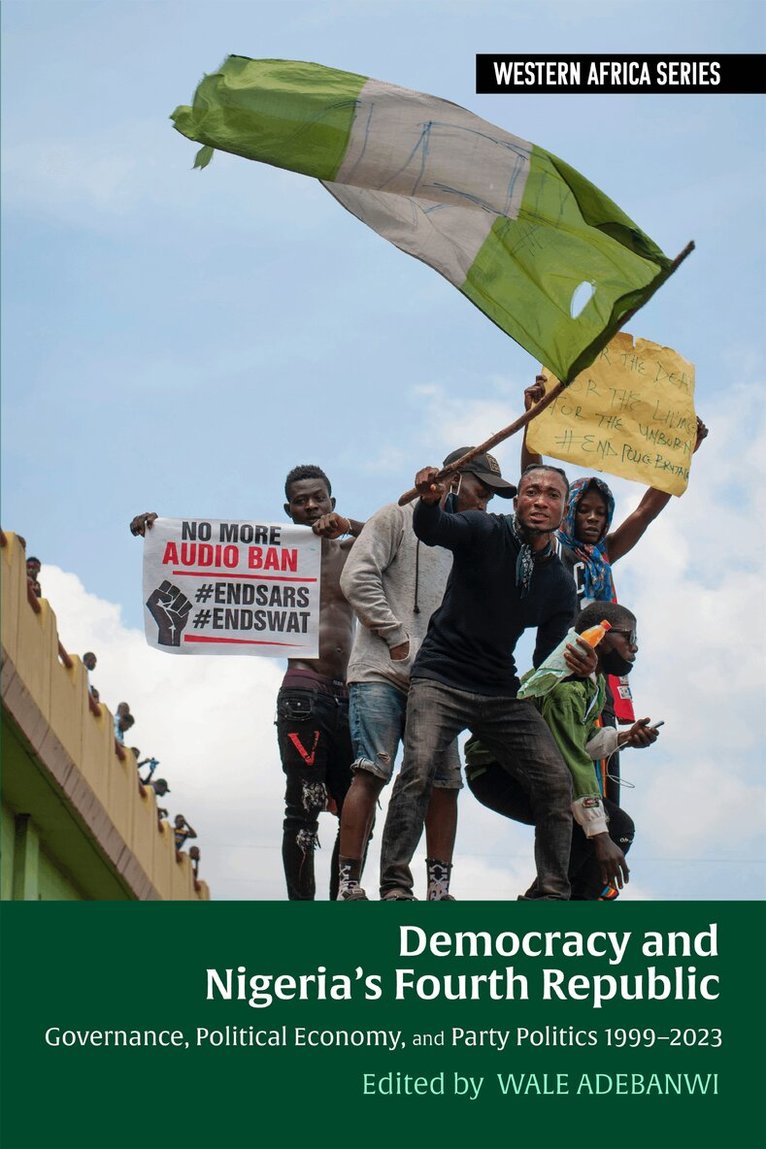
    Democracy and Nigeria’s Fourth Republic

    Governance, Political Economy, and Party Politics 1999–2023

    AvWale Adebanwi

    Häftad, Engelska, 2025

    Del 19 i serien Western Africa Series

    512 kr

    Beställningsvara. Skickas inom 5-8 vardagar. Fri frakt över 249 kr.

    Beskrivning

    Examines Nigeria's challenges with consolidating democracy and the crisis of governance arising from structural errors of the state and the fundamental contradictions of society in Nigeria's Fourth Republic.'Today we are taking a decisive step on the path of democracy,' the newly sworn-in President Olusegun Obasanjo told Nigerians on 27 May 1999. 'We will leave no stone unturned to ensure sustenance of democracy, because it is good for us, it is good for Africa, and it is good for the world.' Nigeria's Fourth Republic has survived longer than any of the previous three Republics, the most durable Republic in Nigeria's more than six decades of independence. At the same time, however, the country has witnessed sustained periods of violence, including violent clashes over the imposition of Sharia'h laws, insurgency in the Niger Delta, inter-ethnic clashes, and the Boko Haram insurgency. Despite these tensions of, and anxieties about, democratic viability and stability in Nigeria, has democratic rule come to stay in Africa's most populous country? Are the overall conditions of Nigerian politics, economy, and socio-cultural dynamics now permanently amenable to uninterrupted democratic rule? Have all the social forces which, in the past, pressed Nigeria towards military intervention and autocratic rule resolved themselves in favour of unbroken representative government? If so, what are the factors and forces that produced this compromise and how can Nigeria's shallow democracy be sustained, deepened, and strengthened? This book attempts to address these questions by exploring the various dimensions of Nigeria's Fourth Republic in a bid to understand the tensions and stresses of democratic rule in a deeply divided major African state. The contributors engage in comparative analysis of the political, economic, and social challenges that Nigeria has faced in the more than two decades of the Fourth Republic and the ways in which these were resolved - or left unresolved - in a bid to ensure the survival of democratic rule. This key book, which examines both the quality of Nigeria's democratic state and its international relations, as well as issues such as human rights and the peace infrastructure, will be invaluable in increasing our understanding of contemporary democratic experiences in the neoliberal era in Africa.

    Produktinformation

    • Utgivningsdatum:2025-09-23
    • Mått:156 x 234 x 25 mm
    • Vikt:702 g
    • Format:Häftad
    • Språk:Engelska
    • Serie:Western Africa Series
    • Antal sidor:464
    • Förlag:James Currey
    • ISBN:9781847013798

    Utforska kategorier

    • Statsskick: demokrati inom Samhälle och politik
    • Politiska partier inom Samhälle och politik
    • Ekonomisk politik inom Ekonomi och Ledarskap

    Mer om författaren

    WALE ADEBANWI is Presidential Penn Compact Professor of Africana Studies, University of Pennsylvania. He is the author of Nation as Grand Narrative: The Nigerian Press and the Politics of Meaning (2016) and editor of The Political Economy of Everyday Life in Africa (2017). Jibrin Ibrahim is a Senior Fellow with the Centre for Development, CDD, where he had earlier served as Director. Ibrahim has lectured, published and consulted extensively on democratisation and governance in Africa. Browne Onuoha of the Political Science Department, Faculty of Social Sciences, University of Lagos (UNILAG), Nigeria. He has published numerous articles in peer-reviewed journals such as the Journal of Contemporary African Studies, Social Dynamics, Contemporary Justice Review, African Journal of Conflict Resolution, and Asia Journal of Global Studies. Adigun Agbaje is Professor of Political Science at the University of Ibadan, Nigeria and Visiting Professor and Director-General, Oba (Dr) Sikiru Kayode Adetona I statute for Governance Studies, Olabisi Onabanjo University, Ago-Iwoye, Nigeria. He is the author of The Nigerian Press, Hegemony, and the Social Construction of Legitimacy, 1960-1983. Sa'eed Husaini is a Research Fellow at the Center for Democracy and Development (CDD) and a post-doctoral researcher on the UCRI-GCFR funded project on Migration, Urbanization, and Conflict (MUCA) at the University of Lagos, Nigeria. He completed a DPhil in International Development at the University of Oxford in 2019. Aliyu Modibbo Umar was a Visiting Fellow at the African Studies Centre, University of Oxford (2019-2021), Lecturer in the University of Abuja (1993-1994). He was previously Nigeria's Federal Minister of State for Power and Steel (2002-2003), Minister of Commerce and Industry (2006-2007), and Minister of the Federal Capital Territory, Abuja (2007-2008). V. Adefemi Isumonah is a Professor of Political Science and former Head of Department, University of Ibadan. He is co-author of Confronting Islamist Terrorism in Africa: The Cases of Nigeria and Kenya and Federal Presence in Nigeria: The Sung and Unsung Basis for Ethnic Grievance. Matthew T. Page is a non-resident scholar with the Carnegie Endowment for International Peace, USA, Associate Fellow with the Africa Programme at Chatham House, UK, and non-resident fellow with the Centre for Democracy and Development in Abuja, Nigeria. He co-authored Nigeria: What Everyone Needs to Know (Oxford University Press, 2018). Olly Owen is an anthropologist and political economist, currently a Research Associate at University of Oxford Institute of Social and Cultural Anthropology. He is also a Technical Advisor to Ekiti State Government. Sarah Burns is Founder and CEO of Nia Impact Consult Ltd. She has a DPhil from the University of Oxford, where she teaches on integrating the private sector with development. She has advised for the CDC, IFC, World Bank and HNWIs. Eyene Okpanachi is Marie Curie Fellow at the University of South Wales, UK. He was previously Banting Postdoctoral Fellow at the University of Victoria and Vanier Canada Graduate Scholar at the University of Alberta. Nkwachukwu Orji is a research fellow at the Institute for Development Studies, University of Nigeria, Nsukka, Nigeria. Between 2017 and 2022, he served as a Resident Electoral Commissioner in the Independent National Electoral Commission (INEC). Idayat Hassan is the Director of the Centre for Democracy and Development (CDD), an Abuja (Nigeria) think-tank focusing on deepening democracy and development in West Africa. Her interests span democracy, peace and security, transitional justice, and ICT4D across West Africa. Gbemisola Animasawun is an Associate Professor (Reader) at the Center for Peace & Strategic Studies, University of Ilorin, Nigeria. His essays have been published in leading peer-reviewed journals, edited books, policy briefs, working papers and op-eds that have earned him national and international research grants and honour.

    Recensioner i media

    This book is the most comprehensive, dispassionate and critical evaluation of the trials and tribulations of Nigeria's democratic development in the Fourth Republic, undertaken by some of the most distinguished scholars on/of Nigeria. Fresh insights are offered by the contributors, towards a better understanding of the complex issues which constrain or obstruct progress and development, and which require the most urgent consideration and resolution. Reading this book is intellectual exciting and immensely beneficial.

    Innehållsförteckning

    • Foreword: Democratization and Nigeria's Fourth Republic: Successes and Challenges - Kayode Fayemi, Governor of Ekiti State of NigeriaNigeria's Fourth Republic: An Introduction - Wale Adebanwi PART I: DEMOCRACY AND THE NIGERIAN STATE1. Reconstructions, Resilience and Relevance: Political Elites and Ethnic Mobilization, 1999-2019 - Eghosa E. Osaghae2. Federalism, Constitutional Reform, and the Elusive Quest for "Political Restructuring" in Nigeria's Fourth Republic - Rotimi Suberu3. Democracy in Nigeria: Crises and Consequences of Military Dictatorship - Browne Onuoha PART II: PARTY POLITICS, THE PRESIDENCY AND THE INTERNATIONAL COMMUNITY4. Democratic Regression, Political Parties and the Negation of the Popularity Principle - Jibrin Ibrahim5. A Republic of Dashed Hopes? Party Politics and the Travails of Democracy in Nigeria's Fourth Republic - Adigun Agbaje6. Governing Party Constituency-building in Nigeria's Fourth Republic - Sa'eed Husaini7. Presidential Leadership Styles in the Fourth Republic - Aliyu Modibbo Umar and V. Adefemi Isumonah8. Double Standards or Different Lenses? Comparing US Approaches to the Buhari and Abacha Governments - Matthew T. Page PART III: THE POLITICAL ECONOMY: OIL AND ECONOMIC REFORMS9. We live in the Future: Is Nigeria no longer an Oil State? - Sarah Burns and Olly Owen10. Economic Reforms and Human Development in Post-Military Nigeria: A Critical Assessment - Eyene OkpanachiPART IV: ELECTORAL GOVERNANCE, CIVIL-POLITICAL SOCIETY AND CONFLICT11. The Promise and Problems of Electoral Reforms - Nkwachukwu Orji12. From a Human Rights Movement to Civil Society: Changing Contours of Civic Groups - Idayat Hassan13. Communal Conflicts, State Responses, and Local Peace Infrastructure - Gbemisola AnimasawunAfterword: Nigeria's Long Search for a Viable Political Order - Larry Diamond