• Fri frakt över 249 kr
  • •
  • Snabba leveranser
  • •
  • Billiga böcker
Kundservice

Du är på sajten för privatpersoner.

Företag, bibliotek eller offentlig verksamhet?

Du handlar på classic.bokus.com, där alla dina funktioner finns intakta.
Till classic.bokus.com
Bokus logotyp. Gå till startsidan.
  • Erbjudanden
  • Student
  • Topplistor
  • Barn & ungdom
  • Bokus Play
  • E-böcker
  • Ljudböcker
  • Pocketböcker
  • Spel och pussel

Pocketfynda! Hundratals böcker för 49 kr/st →

Sidfot

Mina sidor

    Hjälp

    • Kundservice
    • Vanliga frågor och svar
    • Frakt och leverans
    • Retur vid ångerrätt
    • Reklamera vara
    • Betalning
    • Köpvillkor
    • Allmänna villkor
    • Information om webbplatsens tillgänglighet

    Om Bokus

    • Om oss
    • Pressrum
    • För studenter
    • För företag
    • För bibliotek och offentlig verksamhet
    • För leverantörer
    • Hållbarhet

    Populärt

    • Aktuella erbjudanden
    • Presentkort
    • Studentlitteratur
    • Nya böcker
    • Topplistor
    • Signerade böcker
    • Engelska böcker

    Inspiration

    • Boktips
    • BookTok
    • Barnbokskaraktärer
    • Populära författare
    Logotyp för Bokus
    Följ oss på Facebook (extern länk)Följ oss på Instagram (extern länk)Följ oss på YouTube (extern länk)Följ oss på TikTok (extern länk)
    bokus @ CookiesAnpassa cookiesIntegritetspolicyKöpvillkor
    Till Citymail hemsida (extern länk)Till Budbee hemsida (extern länk)Till Postnord hemsida (extern länk)Till Schenker hemsida (extern länk)Till Early Bird hemsida (extern länk)Till Walleys hemsida (extern länk)
    1. Naturvetenskap och teknik
    2. Matematik och naturvetenskap
    3. Matematik
    4. Matematisk statistik

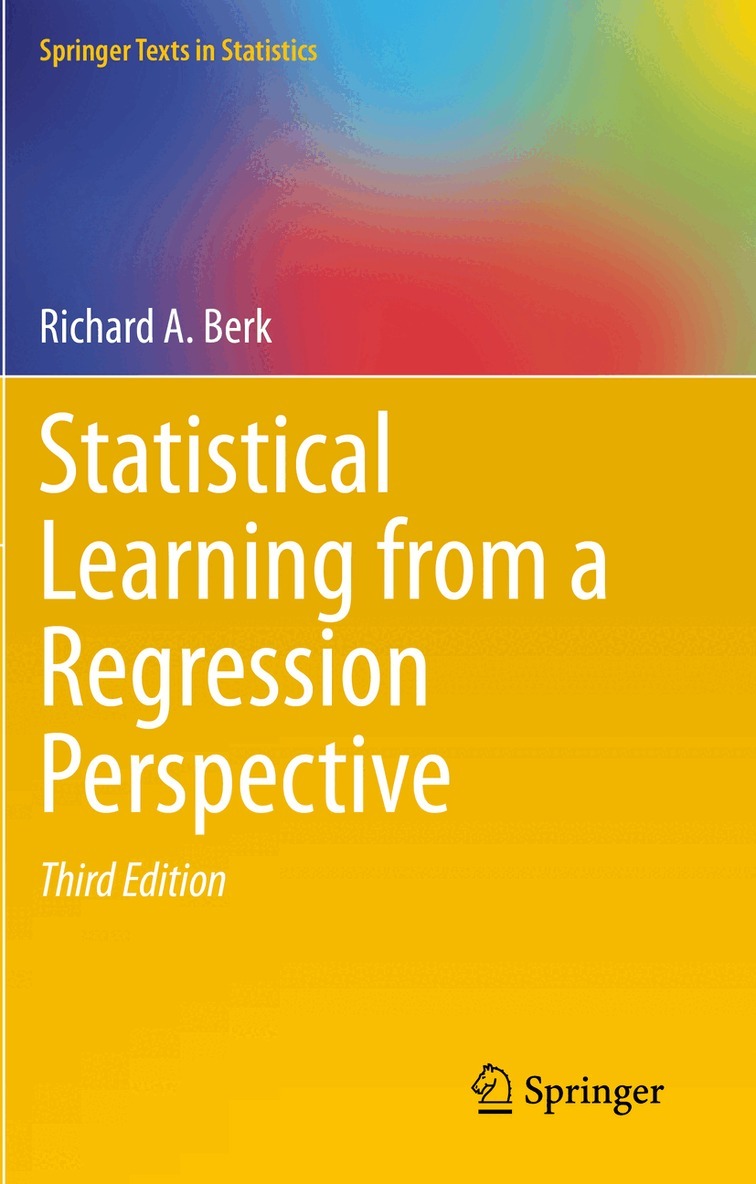
    Statistical Learning from a Regression Perspective

    AvRichard A. Berk

    Häftad, Engelska, 2021

    909 kr

    Beställningsvara. Skickas inom 5-8 vardagar. Fri frakt över 249 kr.

    Fler format och utgåvor

    Inbunden

    1 435 kr

    E-bok

    1 459 kr

    Inbunden

    1 331 kr

    E-bok

    1 211 kr

    E-bok

    813 kr

    Häftad

    828 kr

    Beskrivning

    This textbook considers statistical learning applications when interest centers on the conditional distribution of a response variable, given a set of predictors, and in the absence of a credible model that can be specified before the data analysis begins. Consistent with modern data analytics, it emphasizes that a proper statistical learning data analysis depends in an integrated fashion on sound data collection, intelligent data management, appropriate statistical procedures, and an accessible interpretation of results. The unifying theme is that supervised learning properly can be seen as a form of regression analysis. Key concepts and procedures are illustrated with a large number of real applications and their associated code in R, with an eye toward practical implications. The growing integration of computer science and statistics is well represented including the occasional, but salient, tensions that result. Throughout, there are links to the big picture.The third edition considers significant advances in recent years, among which are:the development of overarching, conceptual frameworks for statistical learning;the impact of  “big data” on statistical learning;the nature and consequences of post-model selection statistical inference;deep learning in various forms;the special challenges to statistical inference posed by statistical learning;the fundamental connections between data collection and data analysis;interdisciplinary ethical and political issues surrounding the application of algorithmic methods in a wide variety of fields, each linked to concerns about transparency, fairness, and accuracy.This edition features new sections on accuracy, transparency, and fairness, as well as a new chapter on deep learning. Precursors to deep learning get an expanded treatment. The connections between fitting and forecasting are considered in greater depth. Discussion of the estimation targets for algorithmic methods is revised and expanded throughout to reflect the latest research. Resampling procedures are emphasized. The material is written for upper undergraduate and graduate students in the social, psychological and life sciences and for researchers who want to apply statistical learning procedures to scientific and policy problems.

    Produktinformation

    • Utgivningsdatum:2021-06-30
    • Mått:155 x 235 x 34 mm
    • Vikt:694 g
    • Format:Häftad
    • Språk:Engelska
    • Antal sidor:433
    • Upplaga:3
    • Förlag:Springer Nature Switzerland AG
    • ISBN:9783030429232

    Utforska kategorier

    • Matematisk statistik inom Naturvetenskap och teknik
    • Tillämpad matematik inom Naturvetenskap och teknik
    • Sociologi inom Samhälle och politik

    Mer om författaren

    Richard Berk is Distinguished Professor of Statistics Emeritus at UCLA and currently a Professor at the University of Pennsylvania in the Department of Statistics and in the Department of Criminology. He is an elected fellow of the American Statistical Association and the American Association for the Advancement of Science and has served in a professional capacity with a number of organizations such as the Committee on Applied and Theoretical Statistics for the National Research Council and the Board of Directors of the Social Science Research Council. His research has ranged across a variety of statistical applications in the social and natural sciences.

    Recensioner i media

    “It could readily be a textbook for an applications-focused course at the graduate level as each chapter comes with exercises … . Examples with accompanying code also appear throughout the chapters which provide a scaffold for getting started … . Berk’s pragmatic advice will serve a wide audience from practitioners to educators to students.” (Sara Stoudt, MAA Reviews, December 12, 2021)

    Innehållsförteckning

    • Preface.- Preface To Second Edition.- Preface To Third Edition.- 1 Statistical Learning as a Regression Problem.- 2 Splines, Smoothers, and Kernels.- 3 Classification and Regression Trees (CART).- 4 Bagging.- 5 Random Forests.- 6 Boosting.- 7 Support Vector Machines.- 8 Neural Networks.- 9 Reinforcement Learning and Genetic Algorithms.- 10 Integration Themes and a Bit of Craft Lore.- Index.