• Fri frakt över 249 kr
  • •
  • Snabba leveranser
  • •
  • Billiga böcker
Kundservice

Du är på sajten för privatpersoner.

Företag, bibliotek eller offentlig verksamhet?

Du handlar på classic.bokus.com, där alla dina funktioner finns intakta.
Till classic.bokus.com
Bokus logotyp. Gå till startsidan.
  • Erbjudanden
  • Nyheter
  • Student
  • Topplistor
  • Barn & ungdom
  • Bokus Play
  • E-böcker
  • Pocketböcker
  • Spel & pussel

10% rabatt på allt med kod NYSTART10 →

Sidfot

Mina sidor

    Hjälp

    • Kundservice
    • Vanliga frågor och svar
    • Frakt och leverans
    • Retur vid ångerrätt
    • Reklamera vara
    • Betalning
    • Köpvillkor
    • Allmänna villkor
    • Information om webbplatsens tillgänglighet

    Om Bokus

    • Om oss
    • Pressrum
    • För studenter
    • För företag
    • För bibliotek och offentlig verksamhet
    • För leverantörer
    • Hållbarhet

    Populärt

    • Aktuella erbjudanden
    • Presentkort
    • Studentlitteratur
    • Nya böcker
    • Topplistor
    • Signerade böcker
    • Engelska böcker

    Inspiration

    • Boktips
    • BookTok
    • Populära bokserier
    • Barnbokskaraktärer
    • Populära författare
    Logotyp för Bokus
    Följ oss på Facebook (extern länk)Följ oss på Instagram (extern länk)Följ oss på YouTube (extern länk)Följ oss på TikTok (extern länk)
    bokus @ CookiesAnpassa cookiesIntegritetspolicyKöpvillkor
    Till Citymail hemsida (extern länk)Till Budbee hemsida (extern länk)Till Postnord hemsida (extern länk)Till Schenker hemsida (extern länk)Till Early Bird hemsida (extern länk)Till Walleys hemsida (extern länk)
    1. Naturvetenskap och teknik
    2. Matematik och naturvetenskap
    3. Biologi
    4. Biovetenskap

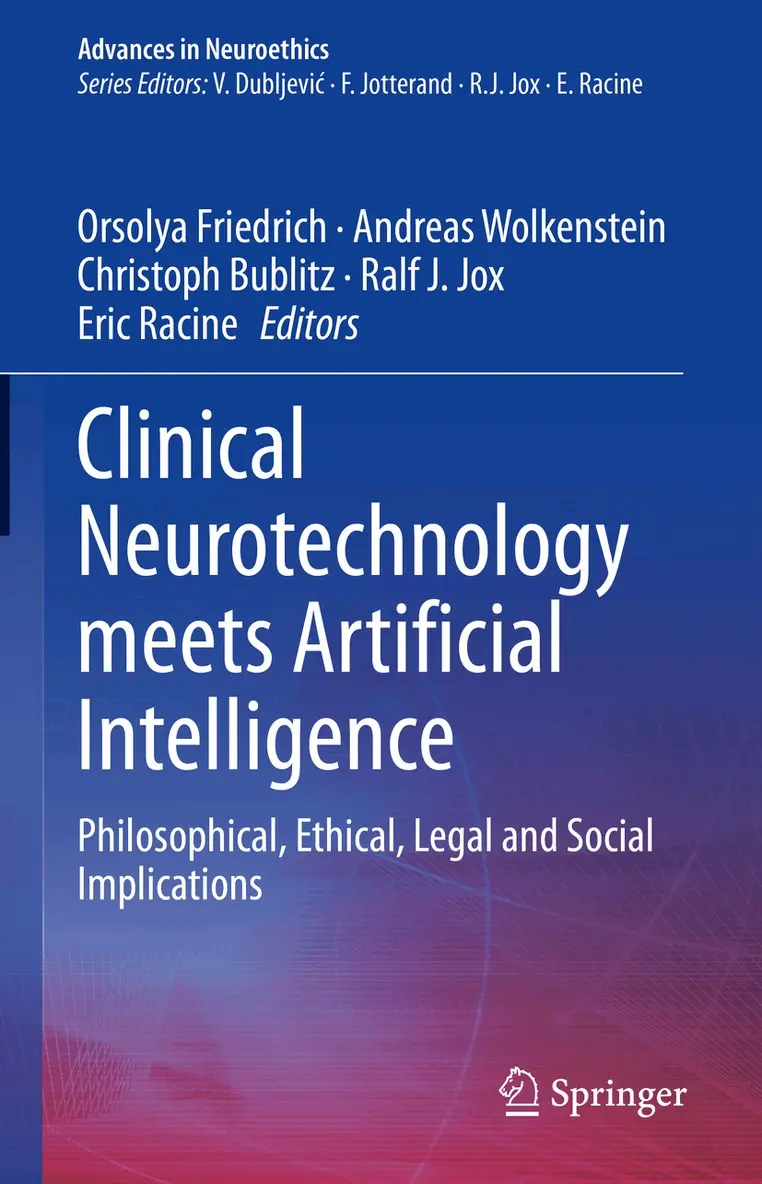
    Clinical Neurotechnology meets Artificial Intelligence

    Philosophical, Ethical, Legal and Social Implications

    AvOrsolya Friedrich,Andreas Wolkenstein

    Inbunden, Engelska, 2021

    Del i serien Advances in Neuroethics

    2 378 kr

    Beställningsvara. Skickas inom 10-15 vardagar. Fri frakt över 249 kr.

    Beskrivning

    Neurotechnologies such as brain-computer interfaces (BCIs), which allow technical devices to be used with the power of thought or concentration alone, are no longer a futuristic dream or, depending on the viewpoint, a nightmare. Moreover, the combination of neurotechnologies and AI raises a host of pressing problems. Now that these technologies are about to leave the laboratory and enter the real world, these problems and implications can and should be scrutinized.This volume brings together scholars from a wide range of academic disciplines such as philosophy, law, the social sciences and neurosciences, and is unique in terms of both its focus and its methods. The latter vary considerably, and range from philosophical analysis and phenomenologically inspired descriptions to legal analysis and socio-empirical research. This diversified approach allows the book to explore the entire spectrum of philosophical, normative, legal and empirical dimensions of intelligent neurotechnologies.  Philosophical and legal analyses of normative problems are complemented by a thorough empirical assessment of how BCIs and other forms of neurotechnology are being implemented, and what their measurable implications are. To take a closer look at specific neurotechnologies, a number of applications are addressed. Case studies, previously unidentified issues, and normative insights on these cases complement the rich portrait this volume provides.  Clinicians, philosophers, lawyers, social scientists and engineers will greatly benefit from the collection of articles compiled in this book, which will likely become a standard reference work on the philosophy of intelligent neurotechnologies.

    Produktinformation

    • Utgivningsdatum:2021-03-04
    • Mått:155 x 235 x 18 mm
    • Vikt:567 g
    • Format:Inbunden
    • Språk:Engelska
    • Serie:Advances in Neuroethics
    • Antal sidor:226
    • Förlag:Springer Nature Switzerland AG
    • ISBN:9783030645892

    Utforska kategorier

    • Biovetenskap inom Naturvetenskap och teknik
    • Filosofiska discipliner inom Filosofi och religion
    • Neurologi och klinisk neurofysiologi inom Medicin

    Mer om författaren

    Prof. Friedrich is philosopher and physician by training and has worked intensively in the field of philosophy of medicine, neuroethics and philosophy of technology. Her latest work covers the conceptual and ethical implications of BCI use and of novel human-machine-interactions.Wolkenstein has studied philosophy, history and theology and works on philosophical and ethical aspects of neurotechnologies. He also uses political philosophy to think about how all sorts of emerging technology can be governed. His latest articles cover the ethics of algorithms, the ethics of self-driving cars and legal responsibility as well as personhood in BCIs.Dr. Bublitz is a legal scholar working on various philosophical and legal aspects of neurotechnologies, AI and psychology. His latest work includes articles on legal responsibility and BCIS, political implications of moral enhancement, and a human right to mental liberty. He co-edits the Palgrave Studies in Law, Neuroscienceand Human Behavior.Prof. Jox is a trained physician and philosopher, specializing in bioethics. He has extensive experience with a whole range of neuroethical questions. His latest work includes the examination of various aspects of brain-computer interfaces (autonomy, agency, algorithms) as well as work on the professionalization of the field of neuroethics itself. He has edited several books and special issues. Also, he is co-editor of the Springer series “Advances in Neuroethics”, together with E. Racine and others.Prof. Racine is a bioethicist who has made recognized contributions to the development of neuroethics and pragmatic ethics.  Inspired by philosophical pragmatism, his research aims to bring to the forefront the lived experience of ethically problematic situations by patients and stakeholders and then to resolve them collaboratively through deliberative and evidenced-informed processes. His latest includes, among other things, surveys about public and professional attitudes toward BCIs and investigations about the impact of BCI on agency and autonomy.

    Innehållsförteckning

    • I Neurotechnologies and AI: State of the Art: Non-invasive Brain-Computer Communication: from basic science to application.- Towards a framework for the responsible development and use of intelligent neurotechnology.- II Philosophical aspects: Assessing human responsibility for actions mediated by neurotechnology: Complications, confusions and questions.- Will the real cyborg please stand up?.- Consenti et faciam quod vis? Anthropological and ethical implications of consenting to Black Box-algorithms.- Speech BCIs.- Agency, Responsibility, Selves, and the Mechanical Mind.- TBA (project member).- III Legal aspects: Diffusion on both ends - legal protection and criminalisation in neurotechnological uncertainty.- Brain-computer interfaces and the law.- IV Social aspects: Eric Racine (University of Montréal) & Matthew Sample (University of Montréal): Pragmatism in a Digital Society: Unpacking the (In)Significance of Emerging Digital Technologies for Academics and Their Publics.- The Utopian Mundane: A Design Perspective on Future Technologies.- V Applications: TBA (invited for neurotech and nursing).- Ethical implications of medical BCIs.- Subjectivation by Neurotechnologies: Some Irritating Implications.- Ethics of neuroprothetics.- Security Implications of Neurotechnology & Artificial Intelligence.- Connecting Brain and Machine: When your mind can directly interact with technology.- Wired emotions: affective brain-computer interfaces and beyond.- TBA (invited for brain hacking).- Ethics and Brain-Computer Interfaces: A Mixed-Methods-Study with Healthy Users.- In your (inter-)face! Between participation and competitive interest – Findings from an empirical interview study with brain-computer interface users.- Philosophical and ethical implications of Brain-to-Brain Interfaces.