• Fri frakt över 249 kr
  • •
  • Snabba leveranser
  • •
  • Billiga böcker
Kundservice

Du är på sajten för privatpersoner.

Företag, bibliotek eller offentlig verksamhet?

Du handlar på classic.bokus.com, där alla dina funktioner finns intakta.
Till classic.bokus.com
Bokus logotyp. Gå till startsidan.
  • Erbjudanden
  • Nyheter
  • Student
  • Topplistor
  • Barn & ungdom
  • Bokus Play
  • E-böcker
  • Pocketböcker
  • Spel & pussel

Må bättre, för mindre! Upp till 50% rabatt på hälsoböcker

Sidfot

Mina sidor

    Hjälp

    • Kundservice
    • Vanliga frågor och svar
    • Frakt och leverans
    • Retur vid ångerrätt
    • Reklamera vara
    • Betalning
    • Köpvillkor
    • Allmänna villkor
    • Information om webbplatsens tillgänglighet

    Om Bokus

    • Om oss
    • Pressrum
    • För studenter
    • För företag
    • För bibliotek och offentlig verksamhet
    • För leverantörer
    • Hållbarhet

    Populärt

    • Aktuella erbjudanden
    • Presentkort
    • Studentlitteratur
    • Nya böcker
    • Topplistor
    • Signerade böcker
    • Engelska böcker

    Inspiration

    • Boktips
    • BookTok
    • Populära bokserier
    • Barnbokskaraktärer
    • Populära författare
    Logotyp för Bokus
    Följ oss på Facebook (extern länk)Följ oss på Instagram (extern länk)Följ oss på YouTube (extern länk)Följ oss på TikTok (extern länk)
    bokus @ CookiesAnpassa cookiesIntegritetspolicyKöpvillkor
    Till Citymail hemsida (extern länk)Till Budbee hemsida (extern länk)Till Postnord hemsida (extern länk)Till Schenker hemsida (extern länk)Till Early Bird hemsida (extern länk)Till Walleys hemsida (extern länk)
    1. Samhälle och politik
    2. Samhälle och kultur
    3. Kultur och medier
    4. Kulturvetenskap

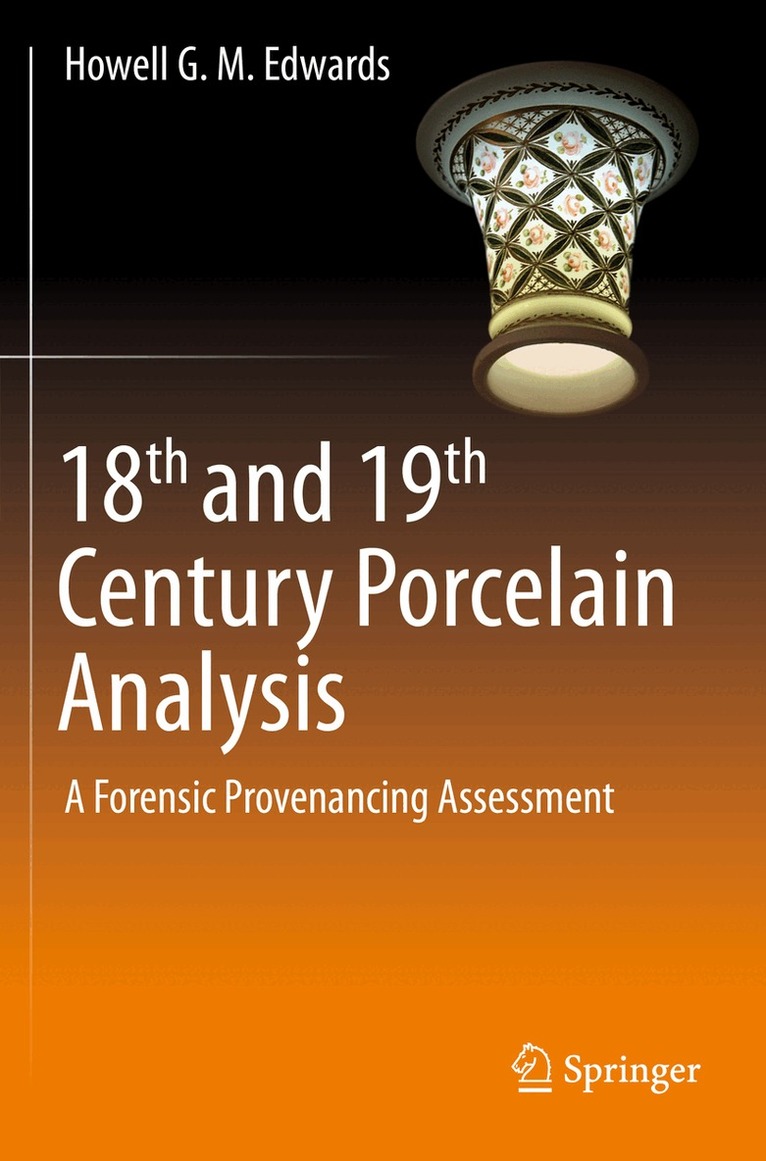
    Porcelain Analysis and Its Role in the Forensic Attribution of Ceramic Specimens

    AvHowell G. M. Edwards

    Häftad, Engelska, 2022

    Del i serien Cultural Heritage Science

    1 949 kr

    Beställningsvara. Skickas inom 10-15 vardagar. Fri frakt över 249 kr.

    Fler format och utgåvor

    Inbunden

    1 949 kr

    E-bok

    2 592 kr

    Beskrivning

    The material for this book arose from the author’s research into porcelains over many years, as a collector in appreciation of their artistic beauty , as  an analytical chemist in the scientific interrogation of their body paste, enamel pigments and glaze compositions, and as a ceramic historian in the assessment of their manufactory foundations and their correlation with available documentation relating to their recipes and  formulations. A discussion of the role of analysis in the framework of a holistic assessment of artworks and specifically the composition of porcelain, namely  hard paste, soft paste, phosphatic, bone china and magnesian, is followed by its growth from its beginnings in China to its importation into Europe in the 16th Century. A survey of European porcelain manufactories in the 17th and 18th Centuries is followed by a description of the raw materials, minerals and recipes for porcelain manufacture and details of thechemistry of the high temperature firing processes involved therein. The historical backgrounds to several important European factories are considered, highlighting the imperfections in the written record that have been perpetuated through the ages. The analytical chemical information derived from the interrogation of specimens, from fragments, shards or perfect finished items, is reviewed and operational protocols established for the identification of a factory output from the data presented. Several case studies are examined in detail across several porcelain manufactories to indicate the role adopted by modern analytical science, with information provided at the quantitative elemental oxide and qualitative molecular spectroscopic levels, where applicable. The attribution of a specimen to a particular factory is either supported thereby or in some cases a potential reassessment of an earlier attribution is indicated. Overall, the information provided by analytical chemical data is seen to be extremely useful for porcelain identification and for its potential attribution in the context of a holistic forensic evaluation of hitherto unknown porcelain exemplars of questionable factory origins.

    Produktinformation

    • Utgivningsdatum:2022-11-11
    • Mått:155 x 235 x 30 mm
    • Vikt:999 g
    • Format:Häftad
    • Språk:Engelska
    • Serie:Cultural Heritage Science
    • Antal sidor:571
    • Förlag:Springer Nature Switzerland AG
    • ISBN:9783030809546

    Utforska kategorier

    • Kulturvetenskap inom Samhälle och politik
    • Referensverk och tvärvetenskap inom Samhälle och politik
    • Maskinteknik och material inom Naturvetenskap och teknik

    Mer om författaren

    Professor H.G.M. Edwards M.A., B.Sc., D.Phil., C.Chem., F.R.S.C. Emeritus Professor of Molecular Spectroscopy, Director of the Centre for Astrobiology and Extremophiles Research , Faculty of Life Sciences , University of Bradford, Bradford BD7 1DP, UK. Honorary Scientific Adviser to The De Brecy Trust for the scientific evaluation and pigment composition of Renaissance and later period paintings.Howell Edwards studied Chemistry at Jesus College, University of Oxford. Following a Research Fellowship at Jesus College at the University of Cambridge, he took a lectureship in Structural and Inorganic Chemistry at the University of Bradford where he subsequently became Professor of Molecular Spectroscopy and Head of the Chemical and Forensic Sciences Division. In 2003, he received the Sir Harold Thompson Award from Elsevier Science for his international contributions to vibrational spectroscopy. He is the recipient of the Emanuel Boricky Medal for 2008/2009 from Charles University, Prague, for distinguished international contributions to geochemistry and mineralogical analysis. He was awarded the Charles Mann Award from the US Federation of Analytical Chemical Spectroscopic Societies in 2011 for his distinguished international work on the applications of Raman spectroscopy.Professor Edwards has wide-ranging interests in the applications of Raman spectroscopy to the characterisation of materials particularly in forensic, art historical, astrobiological and archaeological contexts. He is a guest editor and contributing author of the Philosophical Transactions of the Royal Society, the oldest scientific journal in the world. He has been a forerunner in the Raman spectroscopic identification of chemicals produced in biodegradation processes for prehistoric and contemporary systems in an archaeological context — he first investigated the Raman spectra of Dirina lichen colonization of toxic metal substrates on Italian Renaissance wall–paintings in 1991 and has extensively studied the pigments and associated materials involved in paintings from prehistoric cave art to the 20th Century. He is science lead on the European Space agency/Roscosmos ExoMars Raman Laser spectrometer instrument in the Pasteur suite of a planetary rover which will interrogate the Martina surface and subsurface to search for biosignatures and signs of extant and extinct life, scheduled to launch in 2020, with particular responsibility for the interpretation of Raman spectroscopic biosignatures from biogeological niche environments on Mars. He is also UK representative on the ESA/Roscosmos Landing Site Selection Group dedicated to determine where the spacecraft will land on Mars for the deployment of the rover vehicle.

    Innehållsförteckning

    • Chapter 1: Introduction - Setting the Scene: Analytical Data and Connoisseurship for Attribution in Art.- Chapter 2 . Chinese Porcelains and Their Early European Competitors.- Chapter 3. Establishing the Historical Baseline Chronology for European Porcelains.- Chapter 4. Types of Porcelain and Their Elemental Oxide Compositions.- Chapter 5 . Analytical Science and Case Studies.- Chapter 6 . Case Studies I : Analytical Data Which Have  Materially Contributed to the Attribution of Porcelain Specimens.- Chapter 7 .Case Studies II : Analytical Data Which Have Revealed That Significant Revision is Required to Historical Knowledge  of Porcelain Manufactories  ( Part A).- Chapter 8 . Case Studies III : Analytical Data Which Have Revealed That a Significant Revision is Required to Historical Knowledge of Porcelain Manufactories  ( Part B ).- Chapter 9 . Case Studies IV : Challenges for Analytical Science.- Chapter 10. Assessment of the Role of Chemical Analysis inthe Holistic Attribution of Porcelains to Factory Sources, Their Characterisation and the Evaluation of their Chronology.- Appendix I: Lady Charlotte Schreiber  ( 1812-1895).- Appendix II : The Bearded Tulip : Who Was “de Junic” and Can Analysis Unravel the Mystery Surrounding this Artist?.- Appendix III : Retailers of Porcelain – A Source of Uncertainty for Analytical Attribution.- Appendix IV : The Importance of Establishing the Correct Chronology for Factory Operations in a Holistic Forensic Analytical Approach. Example : The Swansea and Nantgarw Manufactories,1814-1820.- Appendix V : Angela Georgina Burdett-Coutts, 1st Baroness.- Appendix VI : American Porcelain Manufactories.- Appendix VII :Curiosities in Ceramic Compositions Exposed by Chemical Analysis.- Appendix VIII :Knowledge Transfer in the Age of Enlightenment.- Appendix IX : Ancient Pigments Nomenclature Confusion : An Analytical Challenge.- Selected Bibliography.- Glossary.- Index.