• Fri frakt över 249 kr
  • •
  • Snabba leveranser
  • •
  • Billiga böcker
Kundservice

Du är på sajten för privatpersoner.

Företag, bibliotek eller offentlig verksamhet?

Du handlar på classic.bokus.com, där alla dina funktioner finns intakta.
Till classic.bokus.com
Bokus logotyp. Gå till startsidan.
  • Erbjudanden
  • Nyheter
  • Student
  • Topplistor
  • Barn & ungdom
  • Bokus Play
  • E-böcker
  • Pocketböcker
  • Spel & pussel

10% rabatt på allt med kod: NYSTART10 →

Sidfot

Mina sidor

    Hjälp

    • Kundservice
    • Vanliga frågor och svar
    • Frakt och leverans
    • Retur vid ångerrätt
    • Reklamera vara
    • Betalning
    • Köpvillkor
    • Allmänna villkor
    • Information om webbplatsens tillgänglighet

    Om Bokus

    • Om oss
    • Pressrum
    • För studenter
    • För företag
    • För bibliotek och offentlig verksamhet
    • För leverantörer
    • Hållbarhet

    Populärt

    • Aktuella erbjudanden
    • Presentkort
    • Studentlitteratur
    • Nya böcker
    • Topplistor
    • Signerade böcker
    • Engelska böcker

    Inspiration

    • Boktips
    • BookTok
    • Populära bokserier
    • Barnbokskaraktärer
    • Populära författare
    Logotyp för Bokus
    Följ oss på Facebook (extern länk)Följ oss på Instagram (extern länk)Följ oss på YouTube (extern länk)Följ oss på TikTok (extern länk)
    bokus @ CookiesAnpassa cookiesIntegritetspolicyKöpvillkor
    Till Citymail hemsida (extern länk)Till Budbee hemsida (extern länk)Till Postnord hemsida (extern länk)Till Schenker hemsida (extern länk)Till Early Bird hemsida (extern länk)Till Walleys hemsida (extern länk)
    1. Naturvetenskap och teknik
    2. Matematik och naturvetenskap
    3. Matematik
    4. Tillämpad matematik

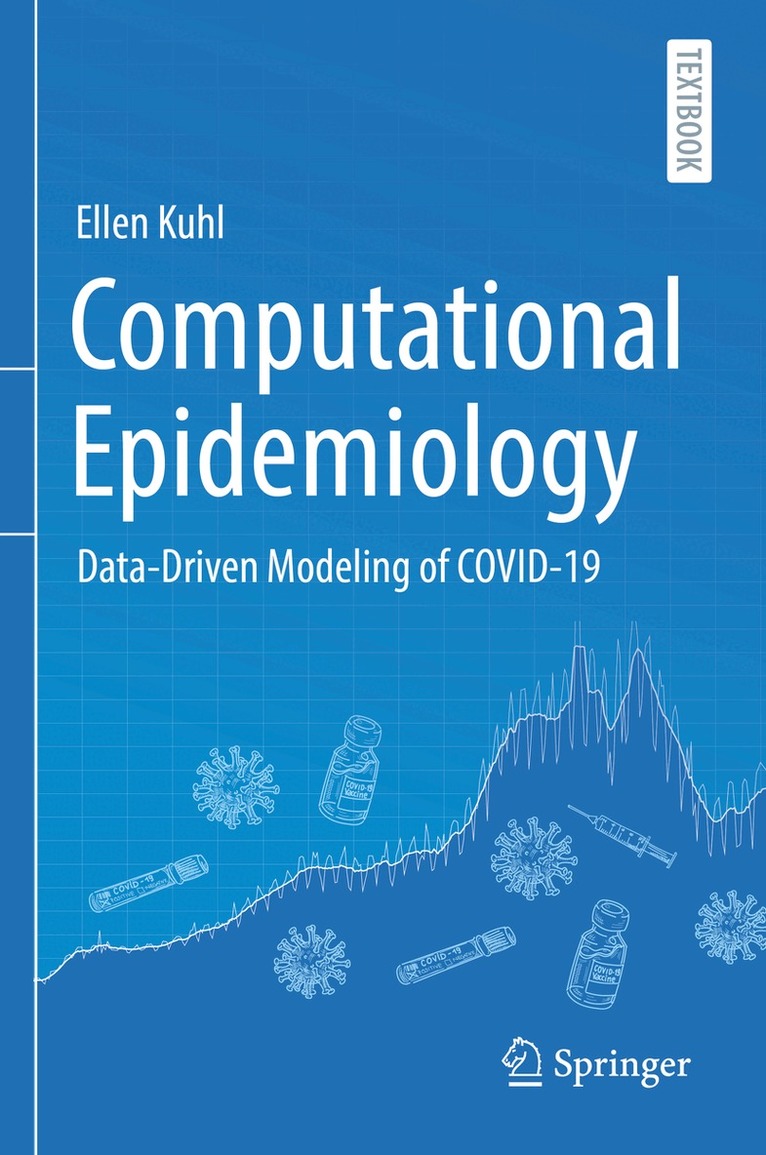
    Computational Epidemiology

    Data-Driven Modeling of COVID-19

    AvEllen Kuhl

    Häftad, Engelska, 2022

    730 kr

    Beställningsvara. Skickas inom 10-15 vardagar. Fri frakt över 249 kr.

    Fler format och utgåvor

    Inbunden

    1 119 kr

    E-bok

    894 kr

    Beskrivning

    This innovative textbook brings together modern concepts in mathematical epidemiology, computational modeling, physics-based simulation, data science, and machine learning to understand one of the most significant problems of our current time, the outbreak dynamics and outbreak control of COVID-19. It teaches the relevant tools to model and simulate nonlinear dynamic systems in view of a global pandemic that is acutely relevant to human health.If you are a student, educator, basic scientist, or medical researcher in the natural or social sciences, or someone passionate about big data and human health: This book is for you! It serves as a textbook for undergraduates and graduate students, and a monograph for researchers and scientists. It can be used in the mathematical life sciences suitable for courses in applied mathematics, biomedical engineering, biostatistics, computer science, data science, epidemiology, health sciences, machine learning, mathematical biology, numerical methods, and probabilistic programming. This book is a personal reflection on the role of data-driven modeling during the COVID-19 pandemic, motivated by the curiosity to understand it.

    Produktinformation

    • Utgivningsdatum:2022-09-24
    • Mått:155 x 235 x 18 mm
    • Vikt:499 g
    • Format:Häftad
    • Språk:Engelska
    • Antal sidor:312
    • Förlag:Springer Nature Switzerland AG
    • ISBN:9783030828929

    Utforska kategorier

    • Tillämpad matematik inom Naturvetenskap och teknik
    • Biologi inom Naturvetenskap och teknik
    • Epidemiologi och medicinsk statistik inom Medicin

    Mer om författaren

    Ellen Kuhl is the Walter B. Reinhold Professor in the School of Engineering and Robert Bosch Chair of Mechanical Engineering at Stanford University. She is a Professor of Mechanical Engineering and, by courtesy, Bioengineering. She received her PhD from the University of Stuttgart in 2000 and her Habilitation from the University of Kaiserslautern in 2004. Her area of expertise is Living Matter Physics, the design of theoretical and computational models to simulate and predict the behavior of living systems. Ellen has published more than 200 peer-reviewed journal articles and edited two books; she is an active reviewer for more than 20 journals at the interface of engineering and medicine and an editorial board member of seven international journals in her field. She is a founding member of the Living Heart Project, a translational research initiative to revolutionize cardiovascular science through realistic simulation with 400 participants from research, industry, and medicine from24 countries. Ellen is the current Chair of the US National Committee on Biomechanics and a Member-Elect of the World Council of Biomechanics. She is a Fellow of the American Society of Mechanical Engineers and of the American Institute for Mechanical and Biological Engineering. She received the National Science Foundation Career Award in 2010, was selected as Midwest Mechanics Seminar Speaker in 2014, and received the Humboldt Research Award in 2016 and the ASME Ted Belytschko Applied Mechanics Award in 2021. Ellen is an All American triathlete on the Wattie Ink. Elite Team, a multiple Boston, Chicago, and New York marathon runner, and a Kona Ironman World Championship finisher.

    Recensioner i media

    “Right off the bat, let me say that I really enjoyed Kuhl’s book. It is beautifully written, very engaging, and the topics and examples are thoughtfully chosen. … This is a timely and truly wonderful book.” (Anita T. Layton, SIAM Review, Vol. 64 (3), September, 2022)“This is a very ambitious book. … Every chapter has a collection of very good problems. … the many examples using real data make the book a valuable resource. Overall the book presents a number of important ideas and offers some significant new approaches for modeling real and complicated epidemics. It’s a great place to begin to understand where mathematical epidemiology is now and where it has to go.” (Bill Satzer, MAA Reviews, May 9, 2022)

    Innehållsförteckning

    • table of contents.- introduction.- infectious diseases.- a brief history of infectious diseases.- II. mathematical epidemiology.- introduction to compartment modeling.- compartment modeling of epidemiology.- concepts of endemic disease modeling.- data-driven modeling in epidemiology. - compartment modeling of COVID19.- early outbreak dynamics of COVID-19.- asymptomatic transmission of COVID-19.- inferring outbreak dynamics of COVID-19.- modeling outbreak control.- managing infectious diseases.- change-point modeling of COVID-19.- dynamic compartment modeling of COVID-19.- network modeling of epidemiology.- network modeling of epidemic processes.- network modeling of COVID-19.- dynamic network modeling of COVID-19.- informing political decision making through modeling.- exit strategies from lockdown.- vaccination strategies.- the second wave.- lessons learned.