• Fri frakt över 249 kr
  • •
  • Snabba leveranser
  • •
  • Billiga böcker
Kundservice

Du är på sajten för privatpersoner.

Företag, bibliotek eller offentlig verksamhet?

Du handlar på classic.bokus.com, där alla dina funktioner finns intakta.
Till classic.bokus.com
Bokus logotyp. Gå till startsidan.
  • Erbjudanden
  • Nyheter
  • Student
  • Topplistor
  • Barn & ungdom
  • Bokus Play
  • E-böcker
  • Pocketböcker
  • Spel & pussel

10% rabatt på allt med kod: NYSTART10 →

Sidfot

Mina sidor

    Hjälp

    • Kundservice
    • Vanliga frågor och svar
    • Frakt och leverans
    • Retur vid ångerrätt
    • Reklamera vara
    • Betalning
    • Köpvillkor
    • Allmänna villkor
    • Information om webbplatsens tillgänglighet

    Om Bokus

    • Om oss
    • Pressrum
    • För studenter
    • För företag
    • För bibliotek och offentlig verksamhet
    • För leverantörer
    • Hållbarhet

    Populärt

    • Aktuella erbjudanden
    • Presentkort
    • Studentlitteratur
    • Nya böcker
    • Topplistor
    • Signerade böcker
    • Engelska böcker

    Inspiration

    • Boktips
    • BookTok
    • Populära bokserier
    • Barnbokskaraktärer
    • Populära författare
    Logotyp för Bokus
    Följ oss på Facebook (extern länk)Följ oss på Instagram (extern länk)Följ oss på YouTube (extern länk)Följ oss på TikTok (extern länk)
    bokus @ CookiesAnpassa cookiesIntegritetspolicyKöpvillkor
    Till Citymail hemsida (extern länk)Till Budbee hemsida (extern länk)Till Postnord hemsida (extern länk)Till Schenker hemsida (extern länk)Till Early Bird hemsida (extern länk)Till Walleys hemsida (extern länk)
    1. Samhälle och politik
    2. Samhälle och kultur
    3. Kultur och medier
    4. Kulturvetenskap

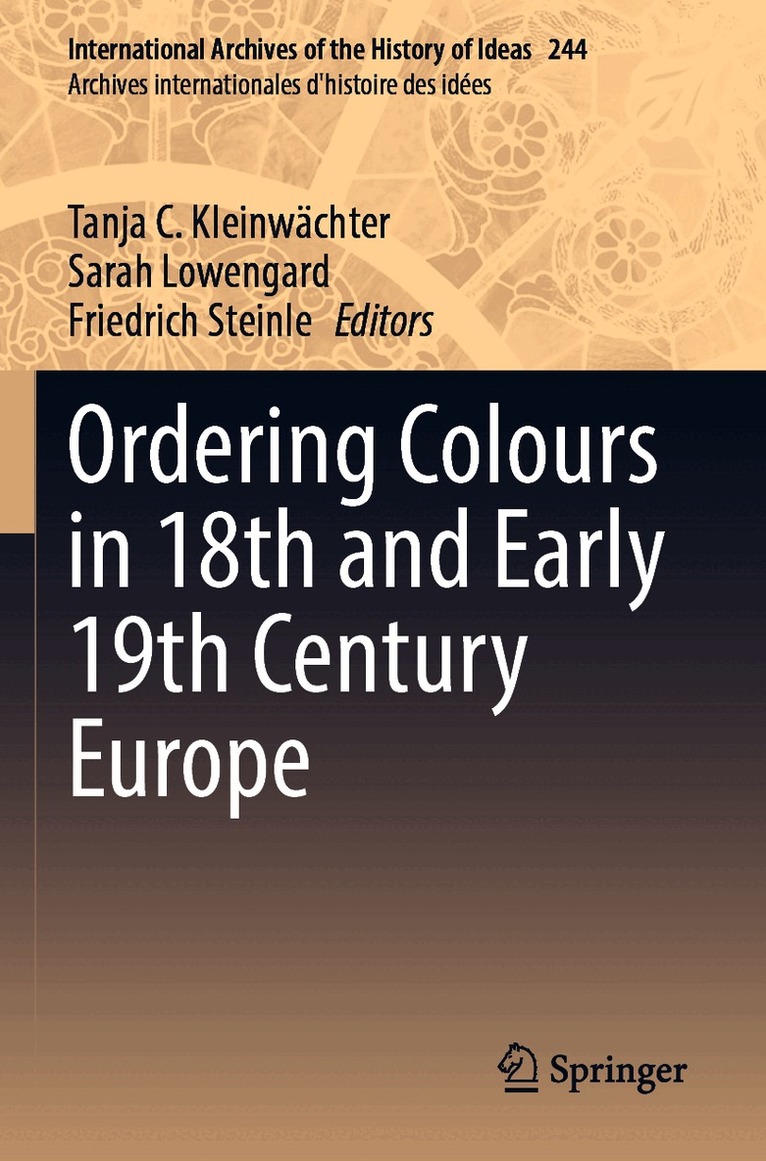
    Ordering Colours in 18th and Early 19th Century Europe

    AvTanja C. Kleinwächter,Sarah Lowengard

    Häftad, Engelska, 2024

    Del 244 i serien International Archives of the History of Ideas Archives internationales d'histoire des idées

    1 302 kr

    Beställningsvara. Skickas inom 10-15 vardagar. Fri frakt över 249 kr.

    Beskrivning

    This book describes the international effort to give order to colours and thus facilitate communication about it, two topics deemed essential to a modernising world that were also recognizably complex. Expert essays will enhance readers' understanding of the struggle to coordinate nature with art at a time when approaches to both were undergoing rapid change. Ordering Colours shows how such seemingly trivial concerns as identifying the basic colours and disseminating appropriate colour diagrams had to meet philosophical, scientific and professional needs across Europe. Contributors detail the many schemes for colour systematization and their real-world applications; questions of concern to both academic- and manufacturing-focused investigators throughout the long 18th century. They bring together original research and new thinking about landmark early modern studies to address important developments as well as neglected historical contributions of European arts, sciences, andeconomies. This collection is an important addition to the libraries of all who are interested in public culture and manufacturing developments in the early modern period and is aimed at historians of art, technology, philosophy and physics.

    Produktinformation

    • Utgivningsdatum:2024-10-05
    • Mått:155 x 235 x 12 mm
    • Vikt:330 g
    • Format:Häftad
    • Språk:Engelska
    • Serie:International Archives of the History of Ideas Archives internationales d'histoire des idées
    • Antal sidor:201
    • Upplaga:2023
    • Förlag:Springer International Publishing AG
    • ISBN:9783031349584

    Utforska kategorier

    • Kulturvetenskap inom Samhälle och politik
    • Teknik: allmänt inom Naturvetenskap och teknik
    • Konstteori inom Kultur

    Mer om författaren

    Tanja C. Kleinwächter studied history of science and technology as well as gender studies (Technische Universität and Humboldt Universität Berlin). Currently she is a PhD candidate at the Dept. for History of Science, TU Berlin. She was part of the project The Order of Colours. Colour Systems and Colour Reference Systems in 18th Century Europe, funded by German Research Foundation. Before embarking on the PhD she undertook research on Christian Friedrich Prangens der Weltweisheit und freyen Künste Magister Farbenlexicon (Interdisciplinary Centre for European Enlightenment Studies, MLU Halle,) as well as on Circles, Triangles, and Tables: European Colour Systematization in Science, Economy, and Art from ca 1720 to ca 1810 (Dept. of History of Science, TU Berlin).Sarah Lowengard is a historian of technology and sciences whose research focuses on practical and philosophical engagements with colour in the early modern West: Her special expertise is the materials sciences of material culture in the 18th century. An artisan colourmaker and art conservator as well as an award-winning historian, Lowengard resides in New York City.Friedrich Steinle is Professor of History of Science at Technische Universität Berlin. His research focuses on the history and philosophy of experiment, on the history of colour research, the history of electricity, and on the dynamics of scientific concepts. His books include Newton’s Manuskript ‘De gravitatione’ (1991) and Exploratory Experiments. Ampère, Faraday, and the origins of electrodynamics (2016). He is coeditor of Scientific concepts and investigative practice (2012, with U. Feest), Colour Histories. Science, art, and technology in the 17th and 18th centuries (2015, with M. Bushart) and of Die Farben der Klassik (2016, with M. Dönike and J. Müller-Tamm).

    Innehållsförteckning

    • 1. Introduction Kleinwächter, Tanja, Sarah Lowengard and Friedrich Steinle.- Part I Ordering Systems and Standards.- 2 The shape of colour order systems and the evolution of colour theory  Caivano, José Luis.- 3 Materialization of vision - Colour standards in the early sciences as a practice transfer from the arts and handicrafts Karliczek, André.- Part II Visual Studies to Prove a Theory.- 4. Jacob Christoff Le Blon and Trichromatic printing: A tale of five cities Stijnman, Ad.- 5. Colour theory by Mikhail Lomonosov: From dyes and mosaics to a trichromatic idea Stanulevich, Nadezhda.- 6. Schiffermüller and Newton in sinter united - Franz Uibelakers two-colour theory (1781) Kleinwächter, Tanja.- Part III Objects in Colours/Objects and Colours.- 7. Calau’s Punic Wax, Lambert’s Farbenpyramide (1772), and prefabricated watercolour cakes Simonini, Giulia.- 8. Testing ground: Colour samples in European porcelain manufactories Szalay, Gabriella.- 9 Fighting for the best pigment! Academic colour discourses in Kassel during the 19thcentury Mävers, Sophie-Luise.- General Bibliography.- Index of Names.- General Index.