• Fri frakt över 249 kr
  • •
  • Snabba leveranser
  • •
  • Billiga böcker
Kundservice

Du är på sajten för privatpersoner.

Företag, bibliotek eller offentlig verksamhet?

Du handlar på classic.bokus.com, där alla dina funktioner finns intakta.
Till classic.bokus.com
Bokus logotyp. Gå till startsidan.
  • Erbjudanden
  • Nyheter
  • Student
  • Topplistor
  • Barn & ungdom
  • Bokus Play
  • E-böcker
  • Pocketböcker
  • Spel & pussel

10% rabatt på allt med kod: NYSTART10 →

Sidfot

Mina sidor

    Hjälp

    • Kundservice
    • Vanliga frågor och svar
    • Frakt och leverans
    • Retur vid ångerrätt
    • Reklamera vara
    • Betalning
    • Köpvillkor
    • Allmänna villkor
    • Information om webbplatsens tillgänglighet

    Om Bokus

    • Om oss
    • Pressrum
    • För studenter
    • För företag
    • För bibliotek och offentlig verksamhet
    • För leverantörer
    • Hållbarhet

    Populärt

    • Aktuella erbjudanden
    • Presentkort
    • Studentlitteratur
    • Nya böcker
    • Topplistor
    • Signerade böcker
    • Engelska böcker

    Inspiration

    • Boktips
    • BookTok
    • Populära bokserier
    • Barnbokskaraktärer
    • Populära författare
    Logotyp för Bokus
    Följ oss på Facebook (extern länk)Följ oss på Instagram (extern länk)Följ oss på YouTube (extern länk)Följ oss på TikTok (extern länk)
    bokus @ CookiesAnpassa cookiesIntegritetspolicyKöpvillkor
    Till Citymail hemsida (extern länk)Till Budbee hemsida (extern länk)Till Postnord hemsida (extern länk)Till Schenker hemsida (extern länk)Till Early Bird hemsida (extern länk)Till Walleys hemsida (extern länk)
    1. Naturvetenskap och teknik
    2. Matematik och naturvetenskap
    3. Matematik
    4. Optimering

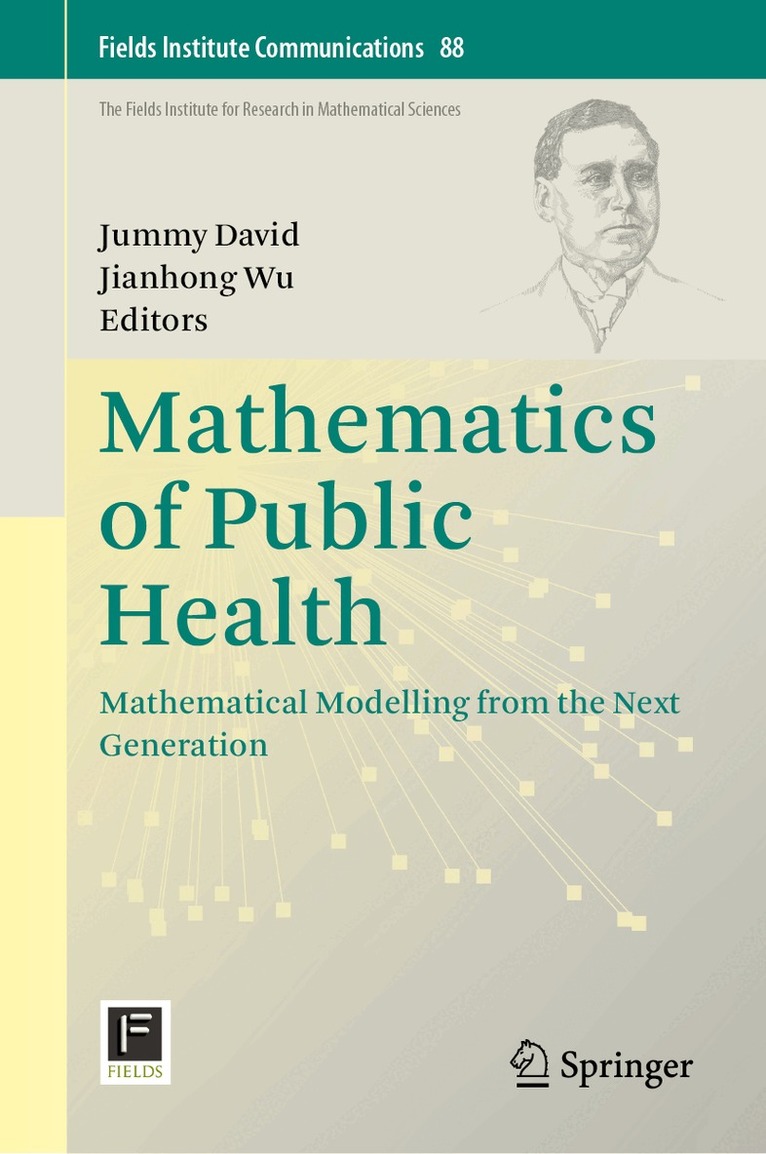
    Mathematics of Public Health

    Mathematical Modelling from the Next Generation

    AvJummy David,Jianhong Wu

    Inbunden, Engelska, 2023

    Del 88 i serien Fields Institute Communications

    1 785 kr

    Beställningsvara. Skickas inom 10-15 vardagar. Fri frakt över 249 kr.

    Beskrivning

    This volume addresses SDG 3 from a mathematical standpoint, sharing novel perspectives of existing communicable disease modelling technologies of the next generation and disseminating new developments in modelling methodologies and simulation techniques. These methodologies are important for training and research in communicable diseases and can be applied to other threats to human health.  The contributions contained in this collection/book cover a range of modelling techniques that have been and may be used to support decision-making on critical health related issues such as:Resource allocationImpact of climate change on communicable diseasesInteraction of human behaviour change, and disease spreadDisease outbreak trajectories projectionPublic health interventions evaluationPreparedness and mitigation of emerging and re-emerging infectious diseases outbreaksDevelopment of vaccines and decisions around vaccine allocation and optimizationThe diseases and public health issues in this volume include, but are not limited to COVID-19, HIV, Influenza, antimicrobial resistance (AMR), the opioid epidemic, Lyme Disease, Zika, and Malaria. In addition, this volume compares compartmental models, agent-based models, machine learning and network. Readers have an opportunity to learn from the next generation perspective of evolving methodologies and algorithms in modelling infectious diseases, the mathematics behind them, the motivation for them, and some applications to supporting critical decisions on prevention and control of communicable diseases.This volume was compiled from the weekly seminar series organized by the Mathematics for Public Health (MfPH) Next Generation Network. This network brings together the next generation of modellers from across Canada and the world, developing the latest mathematical models, modeling methodologies, and analytical and simulation tools for communicable diseases of global public health concerns. The weekly seminar series provides a unique forum for this network and their invited guest speakers to share their perspectives on the status and future directions of mathematics of public health.

    Produktinformation

    • Utgivningsdatum:2023-12-31
    • Mått:155 x 235 x 24 mm
    • Vikt:664 g
    • Format:Inbunden
    • Språk:Engelska
    • Serie:Fields Institute Communications
    • Antal sidor:317
    • Förlag:Springer International Publishing AG
    • ISBN:9783031408045

    Utforska kategorier

    • Optimering inom Naturvetenskap och teknik
    • Tillämpad matematik inom Naturvetenskap och teknik
    • Teknik: allmänt inom Naturvetenskap och teknik

    Mer om författaren

    Jummy David is currently a public health analytics and modeling fellow at the Centers for Disease Control and Prevention (CDC), USA. Prior to CDC, she was a postdoctoral fellow at York University, and obtained her PhD (2020) and Master’s degree from the University of British Columbia, Canada. She is an applied mathematician, a computational and research-driven scientist with in-depth, hands-on advanced mathematical modeling and simulation methods. She is great at leveraging on analytics and quantitative experiences to develop and analyze mechanistically relevant mathematical models, PK/PD models, and health economic models. Results of her modeling and simulation analysis are used to evaluate, forecast, predict, optimize and accelerate policy designs toward improving decision making in public health, medicine, computational biology and science. Jianhong Wu is the founding Director of the Laboratory for Industrial and Applied Mathematics, and theInaugural Director of the York Emergency Mitigation, Engagement, Response, and Governance Institute. He holds the life-time title of University Distinguished Research Professor, the Canada Research Chair (2001-2022) and York Research Chair (2022-) in Industrial and Applied Mathematics at York University. He was also awarded the NSERC/Sanofi Industrial Research Chair in Vaccine Mathematics, Modelling and Manufacturing in 2017-2022. He is an elected Fellow of the Canadian Academy of Health Sciences, and Fellow of the Royal Society of Canada. He received the 2003 Canadian Applied and Industrial Mathematical Society’s Research Prize and the 2019 CAIMS-Fields Industrial Mathematics Prize, for his contribution to the following fields: nonlinear dynamics and delay differential equations; neural networks and pattern recognition; mathematical ecology and epidemiology; big data analytics.

    Innehållsförteckning

    • Preface.- Mathematical models: perspectives of mathematical modelers and public health professionals.- Discovering first-principle of behavioural change in disease transmission dynamics by deep learning.- Understanding Epidemic Multi-Wave Patterns via Machine Learning Clustering and the Epidemic Renormalization Group.- Contact Matrices in Compartmental Disease Transmission Models.- An optimal control approach for public health interventions on an Epidemic-Viral model in deterministic and stochastic environments.- Modeling airborne disease dynamics: progress and questions.- Modelling mutation-driven emergence of drug-resistance: a case study of SARS-CoV-2.- A Categorical Framework for Modeling with Stock and Flow Diagrams.- Agent-Based Modeling and its Tradeoffs: An Introduction & Examples.- Mathematical assessment of the role of interventions against SARS-CoV-2.- Long term dynamics of COVID-19 in a multi-strain model.