• Fri frakt över 249 kr
  • •
  • Snabba leveranser
  • •
  • Billiga böcker
Kundservice

Du är på sajten för privatpersoner.

Företag, bibliotek eller offentlig verksamhet?

Du handlar på classic.bokus.com, där alla dina funktioner finns intakta.
Till classic.bokus.com
Bokus logotyp. Gå till startsidan.
  • Erbjudanden
  • Nyheter
  • Student
  • Topplistor
  • Barn & ungdom
  • Bokus Play
  • E-böcker
  • Pocketböcker
  • Spel & pussel

10% rabatt på allt med kod: NYSTART10 →

Sidfot

Mina sidor

    Hjälp

    • Kundservice
    • Vanliga frågor och svar
    • Frakt och leverans
    • Retur vid ångerrätt
    • Reklamera vara
    • Betalning
    • Köpvillkor
    • Allmänna villkor
    • Information om webbplatsens tillgänglighet

    Om Bokus

    • Om oss
    • Pressrum
    • För studenter
    • För företag
    • För bibliotek och offentlig verksamhet
    • För leverantörer
    • Hållbarhet

    Populärt

    • Aktuella erbjudanden
    • Presentkort
    • Studentlitteratur
    • Nya böcker
    • Topplistor
    • Signerade böcker
    • Engelska böcker

    Inspiration

    • Boktips
    • BookTok
    • Populära bokserier
    • Barnbokskaraktärer
    • Populära författare
    Logotyp för Bokus
    Följ oss på Facebook (extern länk)Följ oss på Instagram (extern länk)Följ oss på YouTube (extern länk)Följ oss på TikTok (extern länk)
    bokus @ CookiesAnpassa cookiesIntegritetspolicyKöpvillkor
    Till Citymail hemsida (extern länk)Till Budbee hemsida (extern länk)Till Postnord hemsida (extern länk)Till Schenker hemsida (extern länk)Till Early Bird hemsida (extern länk)Till Walleys hemsida (extern länk)
    1. Samhälle och politik
    2. Samhälle och kultur
    3. Kultur och medier
    4. Medievetenskap

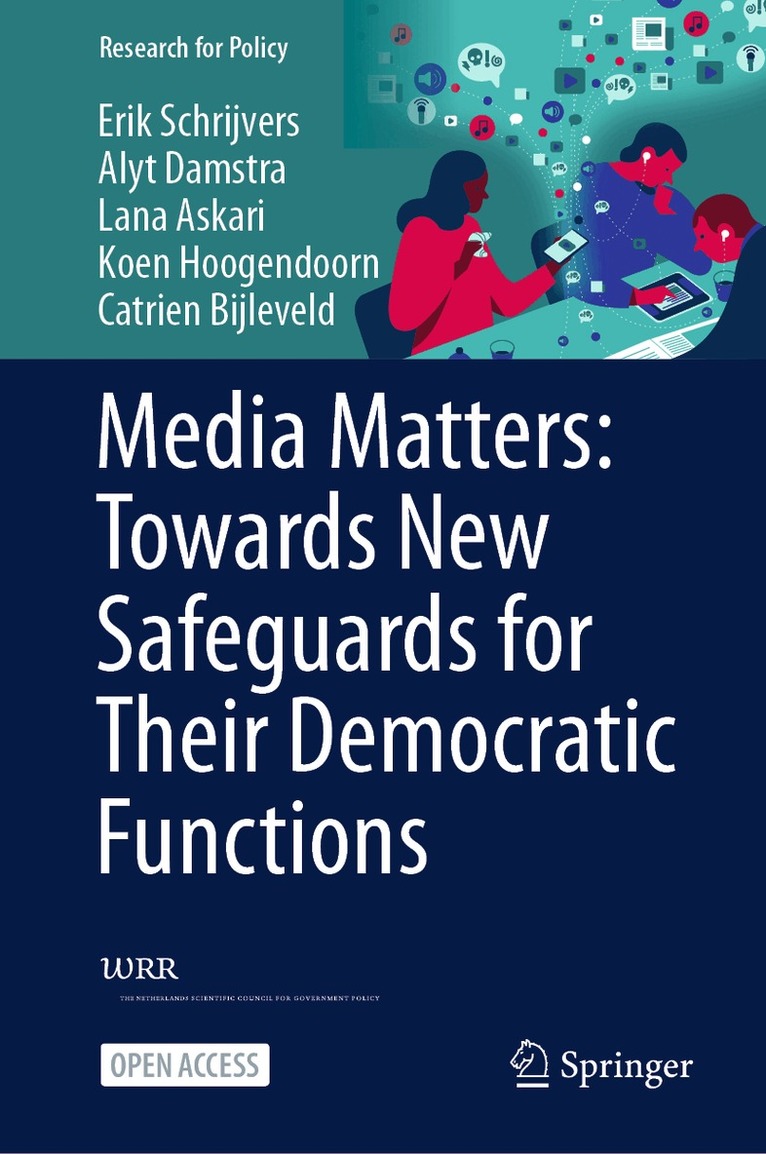
    Media Matters: Towards New Safeguards for Their Democratic Functions

    AvErik Schrijvers,Alyt Damstra

    Inbunden, Engelska, 2026

    Del i serien Research for Policy

    547 kr

    Beställningsvara. Skickas inom 10-15 vardagar. Fri frakt över 249 kr.

    Beskrivning

    This is an Open access Book. In this report, the Netherlands Scientific Council for Government Policy (WRR) examines how the changing media system influences Dutch democracy. The ability of the media to fulfil their democratic functions is under threat. Analyses show that there is more information than ever, information that is available anywhere, anytime. In this context of abundant supply, journalistic content is squeezed to the margins.  Tech- and platform companies attract the majority of all digital advertisement revenues, which confronts national media with financial challenges. Local journalism is in dire straits. The public debate has become broader and more dynamic, but also more unsafe as journalists, scientists, and political actors are regularly confronted with online intimidation and harassment.The WRR recommends new media policies and advises the government (1) to actively and urgently implement the new EU rules for tech and platforms companies; (2) to ensure that content of public interest remains accessible and visible in the online domain; (3) to strengthen local journalism; and (4) to encourage users – including key players such as government and politicians – to acknowledge their own media responsibility in the new media system and operate in line with it.

    Produktinformation

    • Utgivningsdatum:2026-01-17
    • Mått:155 x 235 x 17 mm
    • Vikt:475 g
    • Format:Inbunden
    • Språk:Engelska
    • Serie:Research for Policy
    • Antal sidor:188
    • Förlag:Springer Nature Switzerland AG
    • ISBN:9783032113269

    Utforska kategorier

    • Medievetenskap inom Samhälle och politik
    • Val och folkomröstningar inom Samhälle och politik
    • Centralt styre och förvaltning inom Samhälle och politik

    Mer om författaren

    * Lana Askari (PhD, 2018) is  research fellow at the Netherlands Scientific Council for Government Policy and Assistant Professor in Anthropology at the University of Amsterdam. A visual anthropologist by training, she previously worked at the Dutch Ministry of Foreign Affairs and AEF Consultancy before joining the Scientific Council. Her academic work focuses on migration, future imagination and planning, uncertainty, youth and ethnographic documentary filmmaking.   *Catrien Bijleveld (PhD, 1989) is senior researcher at the Netherlands Institute for the Study of Crime and Law Enforcement, professor of Research Methods in Empirical Legal Studies. Additionally, she is professor of Global Justice at Liverpool University’s Faculty of Law within the Department of Sociology, Social Policy and Criminology, and member of the Netherlands Scientific Council for Government Policy. Her main research interests are in the areas of criminal careers, experimental evaluation, intergenerational continuity in (sex) offending and crime victimization. She is the author of several textbooks as well as of edited books.* Alyt Damstra (PhD, 2020) is senior research fellow at the Netherlands Scientific Council for Government Policy, and professor of Knowledge and strategic policy advise at the Political Science Department of the University of Amsterdam. Her main research interests include media content and effects, both on public opinion and political decision making, and the role of knowledge in public administration.*Koen Hoogendoorn (MA, 2021) is junior research fellow at the Netherlands Scientific Council for Government Policy. He contributed to projects on media and democracy and published a working paper on the efficacy of media literacy policy. Holding an MA in Conflict Studies and Human Rights (cum laude) and a double bachelor's degree in Law and History from Utrecht University, Hoogendoorn’s research reflects a deep curiosity about human interactions and their implications for public policy.*Erik Schrijvers (PhD, 2012) is lecturer (professor) of crisis management at the Netherlands Academy of Crisis Management and Fire Services (NACB). He is also a member of the supervisory Board  of DE, knowledge institute for culture and digital transformation. Until recently he worked as a senior researcher and project coordinator at the Netherlands Scientific Council for Government Policy. His research there focused on the intersection of digital technology, culture and policy. He studied history of international relations and social and political philosophy at Utrecht University and obtained his PhD with a thesis on the history of forms of extra -parliamentary representation in the Netherlands.

    Innehållsförteckning

    • 1 Introduction.- 2 Media and democracy.- 3 Platformisation of the public space.- 4 A new playing field for journalistic media.- 5 Democratic opinion-forming under threat.- 6 Conclusion and recommendations.