• Fri frakt över 249 kr
  • •
  • Snabba leveranser
  • •
  • Billiga böcker
Kundservice

Du är på sajten för privatpersoner.

Företag, bibliotek eller offentlig verksamhet?

Du handlar på classic.bokus.com, där alla dina funktioner finns intakta.
Till classic.bokus.com
Bokus logotyp. Gå till startsidan.
  • Erbjudanden
  • Student
  • Topplistor
  • Barn & ungdom
  • Bokus Play
  • E-böcker
  • Ljudböcker
  • Pocketböcker
  • Spel och pussel

Pocketfynda! Hundratals böcker för 49 kr/st →

Sidfot

Mina sidor

    Hjälp

    • Kundservice
    • Vanliga frågor och svar
    • Frakt och leverans
    • Retur vid ångerrätt
    • Reklamera vara
    • Betalning
    • Köpvillkor
    • Allmänna villkor
    • Information om webbplatsens tillgänglighet

    Om Bokus

    • Om oss
    • Pressrum
    • För studenter
    • För företag
    • För bibliotek och offentlig verksamhet
    • För leverantörer
    • Hållbarhet

    Populärt

    • Aktuella erbjudanden
    • Presentkort
    • Studentlitteratur
    • Nya böcker
    • Topplistor
    • Signerade böcker
    • Engelska böcker

    Inspiration

    • Boktips
    • BookTok
    • Barnbokskaraktärer
    • Populära författare
    Logotyp för Bokus
    Följ oss på Facebook (extern länk)Följ oss på Instagram (extern länk)Följ oss på YouTube (extern länk)Följ oss på TikTok (extern länk)
    bokus @ CookiesAnpassa cookiesIntegritetspolicyKöpvillkor
    Till Citymail hemsida (extern länk)Till Budbee hemsida (extern länk)Till Postnord hemsida (extern länk)Till Schenker hemsida (extern länk)Till Early Bird hemsida (extern länk)Till Walleys hemsida (extern länk)
    1. Psykologi och pedagogik
    2. Pedagogik
    3. Socialpedagogik
    • Nyhet

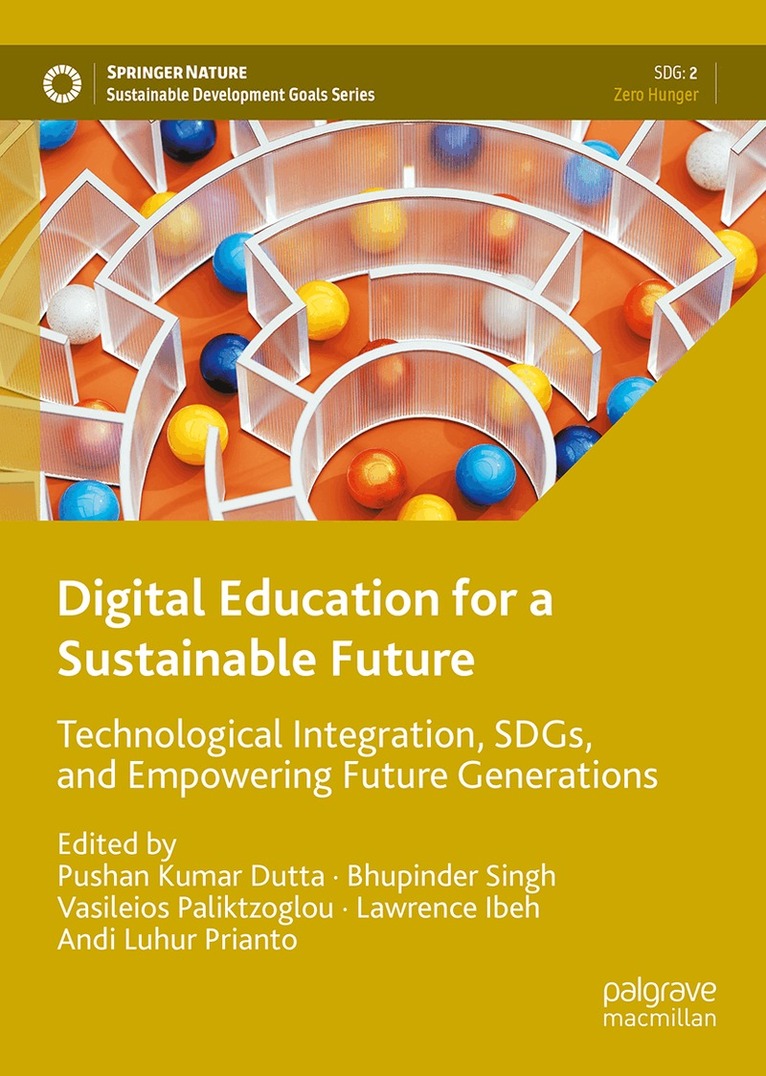
    Digital Education for a Sustainable Future

    Technological Integration, SDGs, and Empowering Future Generations

    AvPushan Kumar Dutta,Bhupinder Singh

    Inbunden, Engelska, 2026

    Del i serien Sustainable Development Goals Series

    1 881 kr

    Beställningsvara. Skickas inom 5-8 vardagar. Fri frakt över 249 kr.

    Beskrivning

    This book shows what happens when classrooms meet climate action and AI meets equality. Bringing together educators, technologists, and policy thinkers, this volume maps how AI, ICT, data, and IoT can advance the UN SDGs—especially SDG 4 (Quality Education), SDG 8 (Decent Work), SDG 10 (Reduced Inequalities), SDG 11 (Sustainable Cities), and SDG 13 (Climate Action). With Generation Beta growing up in hyper-digital environments, the book asks a timely question: how do we design learning that is tech-empowered, human-centered, and planet-positive? Readers will find pragmatic guidance on AI-supported teaching and assessment with clear privacy and ethics guardrails; low-bandwidth, multilingual, offline-first models that narrow divides; studio projects using IoT and digital twins for real urban and climate challenges; routes from micro-credentials to green jobs; and faculty development that scales. We also examine rankings, gender gaps, and research incentives—where they drive excellence and where they distort it. Acknowledging debate around AI in assessment, personalization versus agency, and ed-tech’s carbon footprint, the book offers metrics that matter and a practical roadmap for teachers, leaders, policymakers, funders, and researchers committed to equitable, sustainable learning.

    Produktinformation

    • Utgivningsdatum:2026-08-05
    • Mått:148 x 210 x undefined mm
    • Format:Inbunden
    • Språk:Engelska
    • Serie:Sustainable Development Goals Series
    • Antal sidor:369
    • Förlag:Springer Nature Switzerland AG
    • ISBN:9783032154323

    Utforska kategorier

    • Socialpedagogik inom Psykologi och pedagogik
    • Lärarutbildning inom Psykologi och pedagogik
    • Material och digital teknik i undervisningen inom Psykologi och pedagogik

    Mer om författaren

    Pushan Kumar Dutta is an Associate Professor at School of Engineering and Technology, Amity University Kolkata, India.Bhupinder Singh working as Professor in Sharda School of Law, Sharda University Greater Noida, India.Vasileios Paliktzoglou, an academic and industry professional, holds a Ph.D. in Computer Science from the University of Eastern Finland. He is an active contributor to academia, serving as a guest and associate editor for prestigious journals like the Journal of Information Systems Education (JISE) and IAFOR Journal of Education.Lawrence Ibeh is an accomplished academic, industry leader and a professor with extensive expertise in sustainable management, digital transformation, artificial intelligence, environmental management and multidisciplinary research.Andi Luhur Prianto is an associate professor, editor, and researcher in political science and government. Currently serves as Dean at the Faculty of Social and Political Science, Universitas Muhammadiyah Makassar, Indonesia.

    Innehållsförteckning

    • Chapter 1. Mapping the Landscape of Digital Pedagogies: Analyzing Learner Experiences in the Digital Age.- Chapter 2. Barriers and Breakthroughs: Assessing Equity, Access and Innovation in Digital Learning Environments.- Chapter 3. Blended, Adaptive and Micro-Learning Models: Comparing Efficacy in Digital Classrooms.- Chapter 4. Shifting Roles in Online Classrooms: Empowering Educators and Learners in Digital Contexts.- Chapter 5. Policy Frameworks and Regulation for Equitable Digital Education.- Chapter 6. Leveraging Green Technologies in Schools: Sustainability and Carbon Footprint Reduction through Digital Tools.- Chapter 7. Digital Feminism and Inclusion in STEM Education Platforms Bridging Gender Equality in Technology.- Chapter 8. Ethics, Privacy and Law in AI-Powered Learning: Ensuring Trustworthy Educational Technologies.- Chapter 9. Data-Driven Education for Policy and Practice: Translating Educational Big Data into Effective Policy and Instruction.- Chapter 10. Educating Future Generations with AI for Legal Sustainability and SDG Compliance: Reimagining Global Insolvency and Bankruptcy through Mediation.- Chapter 11. Sustainable Legal Education with Antitrust Law and AI Disruption: Comparative Legal Insights from the US and UK in the Context of Technological Integration.- Chapter 12. Barriers in Digital Education: Overcoming Infrastructure, Cultural and Financial Obstacles Fostering Sustainable Digital Education.- Chapter 13. Promoting Digital Literacy and Workforce Skills: Integrating Digital Literacy and 21st-Century Skills into Curriculum Design.- Chapter 14. Digital Classrooms and Paperless Learning: A Pathway to Eco-friendly Education.- Chapter 15. Global Sacred Values with Sustainable Future: Transforming Religious Education through Digital Platforms.- Chapter 16. Digital Education and Sustainability: Policies and Regulations.- Chapter 17. Strengthening Research Foundations for Data-Driven Digital Education in Institutions.- Chapter 18. Utilizing Public Platforms to Support Marginalized Learners in Digital Education Arena for Sustainable and Secured Future.- Chapter 19. Climate-Resilient Education Infrastructure: Adapting Education Infrastructure to Climate Risk and Disruption.- Chapter 20. Enhancing Institutional Research Capacity for Evidence-based Digital Education with Emerging Technologies.- Chapter 21. Global Cooperation in Digital Education Partnership Models to Advance Digital Education Access.