• Fri frakt över 249 kr
  • •
  • Snabba leveranser
  • •
  • Billiga böcker
Kundservice

Du är på sajten för privatpersoner.

Företag, bibliotek eller offentlig verksamhet?

Du handlar på classic.bokus.com, där alla dina funktioner finns intakta.
Till classic.bokus.com
Bokus logotyp. Gå till startsidan.
  • Erbjudanden
  • Nyheter
  • Student
  • Topplistor
  • Barn & ungdom
  • Bokus Play
  • E-böcker
  • Pocketböcker
  • Spel & pussel

10% rabatt på allt med kod: NYSTART10 →

Sidfot

Mina sidor

    Hjälp

    • Kundservice
    • Vanliga frågor och svar
    • Frakt och leverans
    • Retur vid ångerrätt
    • Reklamera vara
    • Betalning
    • Köpvillkor
    • Allmänna villkor
    • Information om webbplatsens tillgänglighet

    Om Bokus

    • Om oss
    • Pressrum
    • För studenter
    • För företag
    • För bibliotek och offentlig verksamhet
    • För leverantörer
    • Hållbarhet

    Populärt

    • Aktuella erbjudanden
    • Presentkort
    • Studentlitteratur
    • Nya böcker
    • Topplistor
    • Signerade böcker
    • Engelska böcker

    Inspiration

    • Boktips
    • BookTok
    • Populära bokserier
    • Barnbokskaraktärer
    • Populära författare
    Logotyp för Bokus
    Följ oss på Facebook (extern länk)Följ oss på Instagram (extern länk)Följ oss på YouTube (extern länk)Följ oss på TikTok (extern länk)
    bokus @ CookiesAnpassa cookiesIntegritetspolicyKöpvillkor
    Till Citymail hemsida (extern länk)Till Budbee hemsida (extern länk)Till Postnord hemsida (extern länk)Till Schenker hemsida (extern länk)Till Early Bird hemsida (extern länk)Till Walleys hemsida (extern länk)
    1. Samhälle och politik
    2. Samhälle och kultur
    3. Kultur och medier
    4. Referensverk och tvärvetenskap

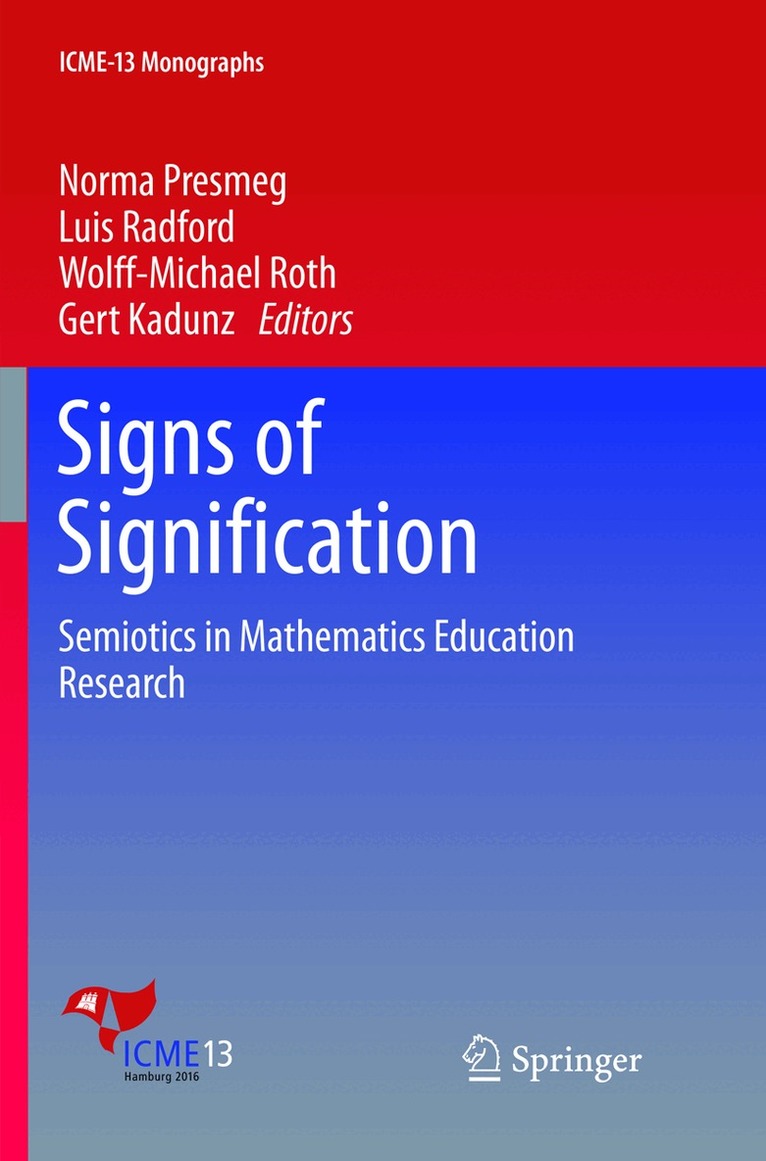
    Signs of Signification

    Semiotics in Mathematics Education Research

    AvNorma Presmeg,Luis Radford

    Häftad, Engelska, 2019

    Del i serien ICME-13 Monographs

    1 248 kr

    Beställningsvara. Skickas inom 10-15 vardagar. Fri frakt över 249 kr.

    Beskrivning

    This book discusses a significant area of mathematics education research in the last two decades and presents the types of semiotic theories that are employed in mathematics education. Following on the summary of significant issues presented in the Topical Survey, Semiotics in Mathematics Education, this book not only introduces readers to semiotics as the science of signs, but it also elaborates on issues that were highlighted in the Topical Survey. In addition to an introduction and a closing chapter, it presents 17 chapters based on presentations from Topic Study Group 54 at the ICME-13 (13th International Congress on Mathematical Education). The chapters are divided into four major sections, each of which has a distinct focus. After a brief introduction, each section starts with a chapter or chapters of a theoretical nature, followed by others that highlight the significance and usefulness of the relevant theory in empirical research.

    Produktinformation

    • Utgivningsdatum:2019-06-04
    • Mått:155 x 235 x 21 mm
    • Vikt:575 g
    • Format:Häftad
    • Språk:Engelska
    • Serie:ICME-13 Monographs
    • Antal sidor:372
    • Förlag:Springer International Publishing AG
    • ISBN:9783319889160

    Utforska kategorier

    • Referensverk och tvärvetenskap inom Samhälle och politik
    • Matematik inom Naturvetenskap och teknik
    • Pedagogisk metodik inom Psykologi och pedagogik

    Innehållsförteckning

    • Chapter 1. Introduction. The editors.- Section 1: Sociocultural perspectives on semiosis.- Chapter 1. Introduction to Section 1.- Chapter 2. Semiosis and subjectification: The classroom constitution of mathematical objects.- Chapter 3. Birth of signs: A (Spinozist-Marxian) materialist approach.- Chapter 4. Relating computational Cartesian graphs to a real motion: An analysis of high school students’ activity.- Chapter 5. Joint attention in resolving the ambiguity of different presentations: A dual eye-tracking study of the teaching-learning process.- Chapter 6. Attention catching: Connecting the space of joint action and togethering.- Section 2: Language and text orientations.- Introduction to Section 2.- Chapter 7.  A matter of translation.- Chapter 8. Using social semiotics to explore institutional assumptions about mathematics students and teachers.- Chapter 9. Semiotics, epistemology, and mathematics.- Chapter 10. A semiotic-conceptual analysis of conceptual development in learningmathematics.- Section 3: Peircean semiotics, including semiotic chaining and representations.- Introduction to Section 3.- Chapter 11. Adalira Sáenz-Ludlow: Iconicity and diagrammatic reasoning in meaning-making.- Chapter 12. Semiotic representations: A study of dynamic figural register.- Chapter 13. Progressive visualization tasks and semiotic chaining for mathematics teacher preparation: Towards a conceptual framework.- Chapter 14. Primary teachers’ semiotics praxis: Windows into the handling of division tasks.- Section 4: Semiotic resources including gesturing and tools.- Introduction to Section 4.- Chapter 15. Gradual change of perception: Signs, tools, and meaning-making of fractions.- Chapter 16. On the role of gestures for the descriptive analysis of ‘Grundvorstellungen’: A case of linear functions.- Chapter 17. Diagramming and gesturing during mathematizing: Kinesthetic and haptic interactions support mathematical ideation.- Chapter 18. Objectifying the inclusion relationshipof quadrilaterals in a synchronic-interactive and collaborative computer supported environment.- Chapter 19. Discussion and conclusions.