• Fri frakt över 249 kr
  • •
  • Snabba leveranser
  • •
  • Billiga böcker
Kundservice

Du är på sajten för privatpersoner.

Företag, bibliotek eller offentlig verksamhet?

Du handlar på classic.bokus.com, där alla dina funktioner finns intakta.
Till classic.bokus.com
Bokus logotyp. Gå till startsidan.
  • Erbjudanden
  • Nyheter
  • Student
  • Topplistor
  • Barn & ungdom
  • Bokus Play
  • E-böcker
  • Pocketböcker
  • Spel & pussel

Må bättre, för mindre! Upp till 50% rabatt på hälsoböcker

Sidfot

Mina sidor

    Hjälp

    • Kundservice
    • Vanliga frågor och svar
    • Frakt och leverans
    • Retur vid ångerrätt
    • Reklamera vara
    • Betalning
    • Köpvillkor
    • Allmänna villkor
    • Information om webbplatsens tillgänglighet

    Om Bokus

    • Om oss
    • Pressrum
    • För studenter
    • För företag
    • För bibliotek och offentlig verksamhet
    • För leverantörer
    • Hållbarhet

    Populärt

    • Aktuella erbjudanden
    • Presentkort
    • Studentlitteratur
    • Nya böcker
    • Topplistor
    • Signerade böcker
    • Engelska böcker

    Inspiration

    • Boktips
    • BookTok
    • Populära bokserier
    • Barnbokskaraktärer
    • Populära författare
    Logotyp för Bokus
    Följ oss på Facebook (extern länk)Följ oss på Instagram (extern länk)Följ oss på YouTube (extern länk)Följ oss på TikTok (extern länk)
    bokus @ CookiesAnpassa cookiesIntegritetspolicyKöpvillkor
    Till Citymail hemsida (extern länk)Till Budbee hemsida (extern länk)Till Postnord hemsida (extern länk)Till Schenker hemsida (extern länk)Till Early Bird hemsida (extern länk)Till Walleys hemsida (extern länk)
    1. Samhälle och politik
    2. Samhälle och kultur
    3. Kultur och medier
    4. Kulturvetenskap

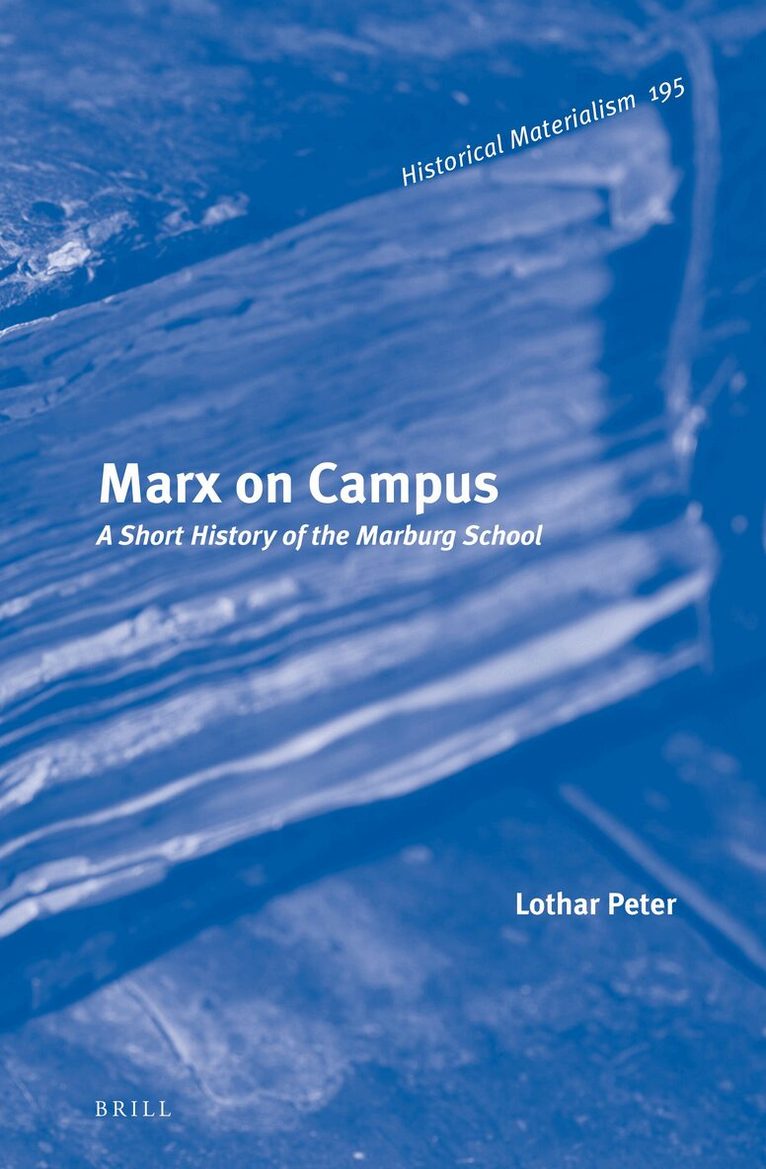
    Marx on Campus: A Short History of the Marburg School

    AvLothar Peter

    Inbunden, Engelska, 2019

    Del 195 i serien Historical Materialism Book Series

    2 211 kr

    Beställningsvara. Skickas inom 5-8 vardagar. Fri frakt över 249 kr.

    Beskrivning

    Alongside the ‘critical theory’ of the Frankfurt School, West Germany was also home to another influential Marxist current known as the Marburg School. In this volume, Marburg disciple Lothar Peter traces the school’s history and situates it in the political discourse and developments of its time. The renowned political scientist Wolfgang Abendroth plays a large role, but unlike most histories of the Marburg School Peter also takes the sociologists Werner Hofmann and Heinz Maus into account as well as their many students and successors. They were united by the conviction that teaching and scholarship must necessarily be tied to the practical goal of transforming society – an approach that met with considerable opposition in the harshly anti-Communist atmosphere of the period.This book was first published in 2014 as Marx an die Uni. Die "Marburger Schule" – Geschichte, Probleme, Akteure by PapyRossa Verlag, Cologne, ISBN 978-38-94-38546-0. With a new Introduction by Ingar Solty.

    Produktinformation

    • Utgivningsdatum:2019-10-17
    • Mått:155 x 235 x 17 mm
    • Vikt:450 g
    • Format:Inbunden
    • Språk:Engelska
    • Serie:Historical Materialism Book Series
    • Antal sidor:184
    • Förlag:Brill
    • ISBN:9789004349414
    • Originaltitel:Marx an die Uni. Die "Marburger Schule" - Geschichte, Probleme, Akteure
    • Översättare:Loren Balhorn

    Utforska kategorier

    • Kulturvetenskap inom Samhälle och politik
    • Marxism och kommunism inom Samhälle och politik
    • Filosofiska discipliner inom Filosofi och religion

    Mer om författaren

    Lothar Peter, Prof. Dr. phil. (1942), completed his Ph.D. at the University of Marburg under Wolfgang Abendroth and Heinz Maus. He taught sociology at the University of Bremen until 2005, and has published numerous articles and books on the subject.

    Recensioner i media

    “Peter’s Marx on Campus is notable as the first appearance of a book in English dedicated to the Marburg School [...] The aim of the volume is, as Peter puts it, ‘to remedy this circumstance by describing for the reader how the Marburg School helped to keep the critique of capitalism and society alive during a period in (West) German history when such critique earned its proponents more outrage, scorn, and rejection than it did reputation or public recognition’ [...] The book successfully shows the Marburg School to be a genuine ‘epistemic community’ and provides a useful account of its development, summarizing key works and the career arcs of its major figures."—Bo Harvey, in: Marx & Philosophy Society, 7 February 2023.

    Innehållsförteckning

    • PrefaceAbbreviationsIntroductionIngar Solty1 Abendroth School or Marburg School?1 What Constitutes a School of Thought?2 Why the ‘Marburg School’?2 First Phase: Gradual Formation, 1950 to the Mid-1960s1 Social and Political Context2 Wolfgang Abendroth (1906–85)3 Students, Doctoral Candidates, Staff3 Second Phase: Emergence of an ‘Epistemic Community’, Mid-1960s to Early 1970s1 Social and Political Context2 Werner Hofmann (1922–69)3 Heinz Maus (1911–78)4 Abendroth, Hofmann, and Maus’s Understanding of Marx and Marxism5 The Marburg and Frankfurt Schools: ‘Social Critique’ or ‘Artistic Critique’?6 Dominance of the Marxist Paradigm4 Third Phase: Continuity and New Challenges. Abendroth’s Retirement to the Early 1980s1 Social and Political Context2 The Political Sociology of Worker Consciousness and the Trade Unions (Frank Deppe)3 The History of German Social Democracy (Georg Fülberth and Jürgen Harrer)4 Studying Fascism (Reinhard Kühnl)5 The Political Sociology of Latin America (Dieter Boris)6 External Pressure, Administrative Interference, Difficult Encounters7 A Controversial History of the Trade Unions8 Theoretical Conflict: The Identity of Marxism5 The Marburg School since the 1980s1 A Premature Farewell2 A Contribution to Constitutional Law (Peter Römer)3 Marburg in the Historikerstreit (Reinhard Kühnl)4 Activities and Interactions in the Academic Sphere6 Fourth Phase: From the ‘Epochal Rupture’ of 1989–90 to the Early 2000s1 Social and Political Context2 Confronting the ‘Epochal Rupture’ (Georg Fülberth)3 Reacting to a Changed Situation4 Excursus: A Conversation between Ulrich Beck and Frank Deppe on the State of Political Opposition in Germany7 Scholarly Focuses since the 1990s1 Research Activity and a New Conflict2 Social Movements in Latin America (Dieter Boris)3 Capitalism and Kapitalistik (Georg Fülberth)4 Political Thought from the Late Nineteenth to the Early Twenty-First Century (Frank Deppe)8 ConclusionBibliographyIndex