Louis de Saussure - Böcker
Visar alla böcker från författaren Louis de Saussure. Handla med fri frakt och snabb leverans.
12 produkter
12 produkter
1 548 kr
Skickas inom 5-8 vardagar
This book considers linguistic and mental representations of time. Prominent linguists and philosophers from all over the world examine and report on recent work on the representation of temporal reference; the interaction of the temporal information from tense, aspect, modality, temporal adverbials, and context; and the representation of the temporal relations between events and states, as well as between facts, propositions, sentences, and utterances. They link this to current research on the cognitive processing of temporal reference, linguistic and philosophical semantics, psychology, and anthropology. The book is divided into three parts: Time, Tense, and Temporal Reference in Discourse; Time and Modality; and Cognition and Metaphysics of Time. It will interest scholars and advanced students of time and temporal reference in linguistics, philosophy, anthropology, psychology, and cognitive science.
475 kr
Skickas inom 5-8 vardagar
531 kr
Skickas inom 5-8 vardagar
310 kr
Skickas inom 7-10 vardagar
It has long been received wisdom in semantics and pragmatics that 'the head' and 'the heart' are two opposing forces, a view that has led scholars, until now, to explore the mental processes behind cognition, and the mental processes behind emotion, as two separate entities. This bold, innovative book challenges this view, and provides an original study of how we communicate our emotions through language, drawing on both pragmatic theory and affective science. It begins with the assumption that emotional or expressive meaning plays such a central role in human interaction that any pragmatic theory worth its salt must account for it. It meets the associated challenges head-on and strives to integrate affect within one theory of utterance interpretation, showing that emotional meaning and rationality/reasoning can be analysed within one framework. Written in a clear and concise style, it is essential reading for anyone interested in communication and emotion.
1 258 kr
Skickas inom 7-10 vardagar
It has long been received wisdom in semantics and pragmatics that 'the head' and 'the heart' are two opposing forces, a view that has led scholars, until now, to explore the mental processes behind cognition, and the mental processes behind emotion, as two separate entities. This bold, innovative book challenges this view, and provides an original study of how we communicate our emotions through language, drawing on both pragmatic theory and affective science. It begins with the assumption that emotional or expressive meaning plays such a central role in human interaction that any pragmatic theory worth its salt must account for it. It meets the associated challenges head-on and strives to integrate affect within one theory of utterance interpretation, showing that emotional meaning and rationality/reasoning can be analysed within one framework. Written in a clear and concise style, it is essential reading for anyone interested in communication and emotion.
1 258 kr
Skickas inom 5-8 vardagar
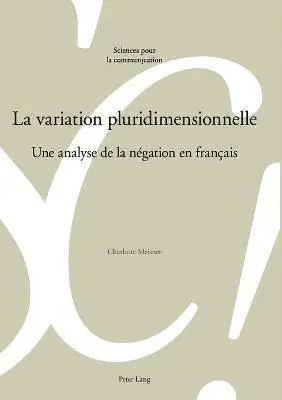
Del 118 - Sciences Pour La Communication
variation pluridimensionnelle
Une analyse de la négation en français
Häftad, Franska, 2016
590 kr
Skickas inom 5-8 vardagar
967 kr
Skickas inom 5-8 vardagar
676 kr
Tillfälligt slut
2 783 kr
Skickas inom 5-8 vardagar
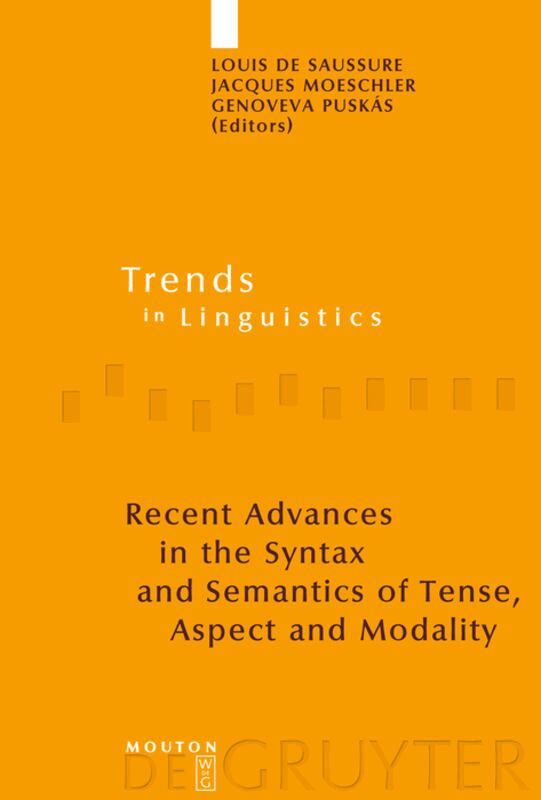
It is a fact that tense, aspect and modality together form one of the most recurring and active areas of research in contemporary syntax and semantics, as well as in other disciplines of linguistics. A large number of syntactic and semantic phenomena are concerned by the temporal-aspectual-modal level of representation: information about time, aspect and modality is part of virtually all sentences; inflexion is quite widely considered as the core of syntactic projections. Because of this very crucial situation and role in the sentence structure, temporal-aspectual and modal information concerns virtually any part of the sentence and this information has scope over the whole characterization of the eventuality denoted by the sentence.This book is an up-to-date milestone for the studies of temporality and language, in particular regarding syntax and semantics, but with incidental hints to pragmatics and theories of human natural language understanding. Through this very tight selection of 15 papers (originally delivered during the 6th Chronos colloquium), tenses, aspect and modality are investigated both at the descriptive and theoretical levels, involving many different Indo-European and non-Indo-European languages. The volume sheds light on a wide array of phenomena that remained too little explored until now. These include the following: modal subordination in Japanese, epistemic modals in Dutch and English in Free Indirect Speech contexts, aspectual readings of idioms, adverb-licensing with the German perfect, French imperfective past compared with English progressive past, infinitival perfect in English, Adult Root Infinitives, economy constraints on temporal subordinations, future modality, past interpretation of present tense in embedded clauses, and time without tenses in Mandarin and Navajo.The book is of interest to scholars and advanced students in the fields of linguistics (general linguistics, semantics, syntax) as well as philosophy and logic.
3 068 kr
Skickas inom 5-8 vardagar
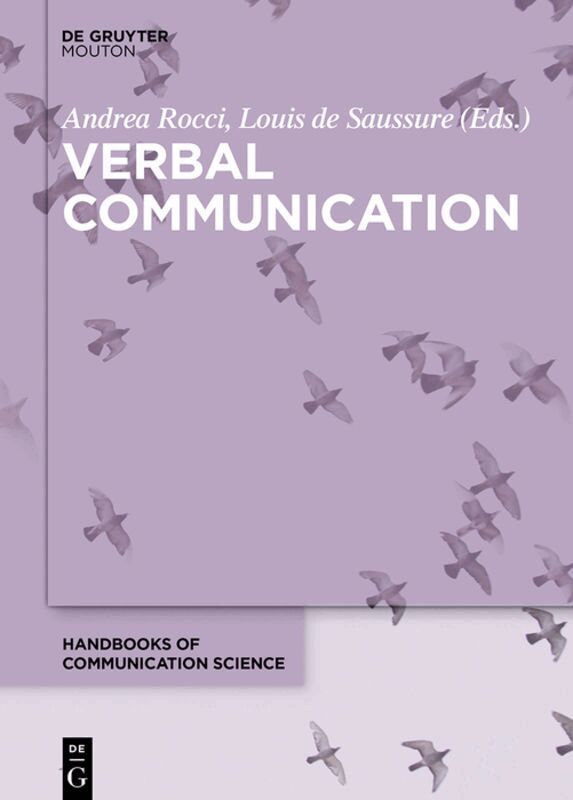
Common sense tells us that verbal communication should be a central concern both for the study of communication and for the study of language. Language is the most pervasive means of communication in human societies, especially if we consider the huge gamut of communication phenomena where spoken and written language combines with other modalities, such as gestures or pictures. Most communication researchers have to deal with issues of language use in their work. Classic methods in communication research - from content analysis to interviews and questionnaires, not to mention the obvious cases of rhetorical analysis and discourse analysis - presuppose the understanding of the meaning of spontaneous or elicited verbal productions. Despite its pervasiveness, verbal communication does not currently define one cohesive and distinct subfield within the communication discipline.The Handbook of Verbal Communication seeks to address this gap. In doing so, it draws not only on the communication discipline, but also on the rich interdisciplinary research on language and communication that developed over the last fifty years as linguistics interacted with the social sciences and the cognitive sciences. The interaction of linguistic research with the social sciences has produced a plethora of approaches to the study of meanings in social context - from conversation analysis to critical discourse analysis, while cognitive research on verbal communication, carried out in cognitive pragmatics as well as in cognitive linguistics, has offered insights into the interaction between language, inference and persuasion and into cognitive processes such as framing or metaphorical mapping.The Handbook of Verbal Communication volume takes into account these two traditions selecting those issues and themes that are most relevant for communication scholars. It addresses background matters such as the evolution of human verbal communication and the relationship between verbal and non-verbal means of communication and offers a an extensive discussion of the explicit and implicit meanings of verbal messages, with a focus on emotive and figurative meanings. Conversation and fundamental types of discourse, such as argument and narrative, are presented in-depth, as is the key notion of discourse genre. The nature of writing systems as well as the interaction of spoken or written language with non-verbal modalities are devoted ample attention.Different contexts of language use are considered, from the mass media and the new media to the organizational contexts. Cultural and linguistic diversity is addressed, with a focus on phenomena such as multilingual communication and translation.A key feature of the volume is the coverage of verbal communication quality. Quality is examined both from a cognitive and from a social perspective. It covers topics that range from to the cognitive processes underlying deceptive communication to the methods that can be used to assess the quality of texts in an organizational context.
434 kr
Skickas inom 5-8 vardagar