Sara Heinamaa – författare
840 kr
Läs direkt efter köp
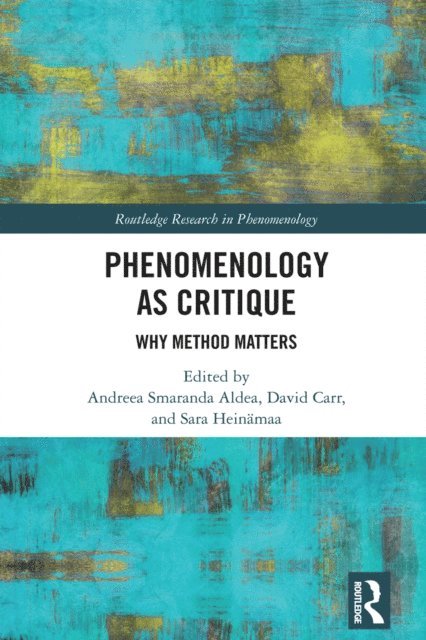
Drawing on classical Husserlian resources as well as existentialist and hermeneutical approaches, this book argues that critique is largely a question of method. It demonstrates that phenomenological discussions of acute social and political problems draw from a rich tradition of radically critical investigations in epistemology, social ontology, political theory, and ethics.
The contributions show that contemporary phenomenological investigations of various forms of oppression and domination develop new critical-analytical tools that complement those of competing theoretical approaches, such as analytics of power, critical theory, and liberal philosophy of justice. More specifically, the chapters pay close attention to the following methodological themes: the conditions for the possibility of phenomenology as critique; critique as radical reflection and free thinking; eidetic analysis and reflection of transcendental facticity and contingency of the self, of others, of the world; phenomenology and immanent critique; the self-reflective dimensions of phenomenology; and phenomenological analysis and self-transfermation and world transformation. All in all, the book explicates the multiple critical resources phenomenology has to offer, precisely in virtue of its distinctive methods and methodological commitments, and thus shows its power in tackling timely issues of social injustice.
Phenomenology as Critique: Why Method Matters will appeal to researchers and advanced students working in phenomenology, Continental philosophy, and critical theory.
840 kr
Läs direkt efter köp
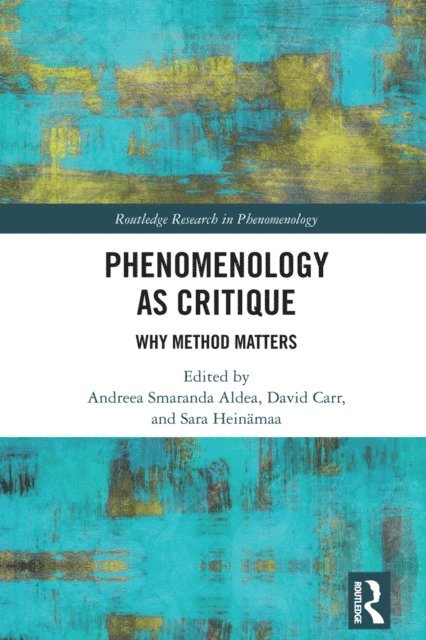
Drawing on classical Husserlian resources as well as existentialist and hermeneutical approaches, this book argues that critique is largely a question of method. It demonstrates that phenomenological discussions of acute social and political problems draw from a rich tradition of radically critical investigations in epistemology, social ontology, political theory, and ethics.
The contributions show that contemporary phenomenological investigations of various forms of oppression and domination develop new critical-analytical tools that complement those of competing theoretical approaches, such as analytics of power, critical theory, and liberal philosophy of justice. More specifically, the chapters pay close attention to the following methodological themes: the conditions for the possibility of phenomenology as critique; critique as radical reflection and free thinking; eidetic analysis and reflection of transcendental facticity and contingency of the self, of others, of the world; phenomenology and immanent critique; the self-reflective dimensions of phenomenology; and phenomenological analysis and self-transfermation and world transformation. All in all, the book explicates the multiple critical resources phenomenology has to offer, precisely in virtue of its distinctive methods and methodological commitments, and thus shows its power in tackling timely issues of social injustice.
Phenomenology as Critique: Why Method Matters will appeal to researchers and advanced students working in phenomenology, Continental philosophy, and critical theory.
730 kr
Läs direkt efter köp
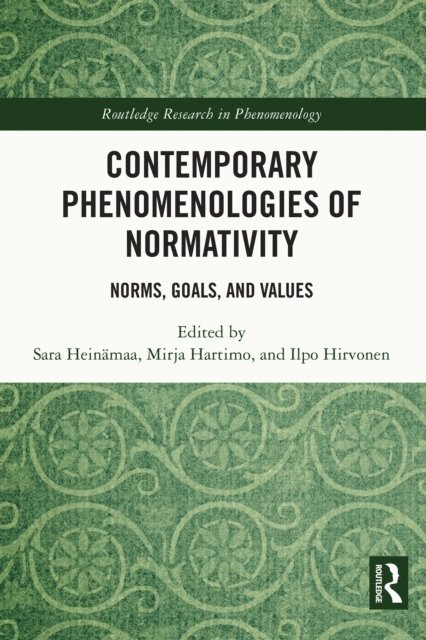
This volume investigates forms of normativity through the phenomenological methods of description, analysis, and interpretation. It takes a broad approach to norms, covering not only rules and commands but also goals, values, and passive drives and tendencies.
Part I "Basic Perspectives" begins with an overview of the phenomena of normativity and then clarifies the constitution of norms by Husserlian and Heideggerian concepts. It offers phenomenological alternatives to the neo-Kantian and neo-Hegelian approaches that dominate contemporary debates on the "sources of normativity." Part II "From Perception to Imagination" turns to the normativity of three basic types of experiences. This part first sheds light on the normativity of perception and then illuminates the kind of normativity characteristic of imagination and drive intentionality. Part III "Social Dimensions" analyzes the norms that regulate the formation of practical communities. It takes a broad view of practical norms, discussing social and moral norms as well as the epistemic norms of scientific practices. By clarifying the divergences and interrelations between various types and levels of norms, the volume demonstrates that normativity is not one phenomenon but a complex set of various phenomena with multiple sources.
Contemporary Phenomenologies of Normativity: Norms, Goals, and Values will be of interest to researchers and advanced students working on issues of normativity in phenomenology, epistemology, ethics, and social philosophy.
730 kr
Läs direkt efter köp
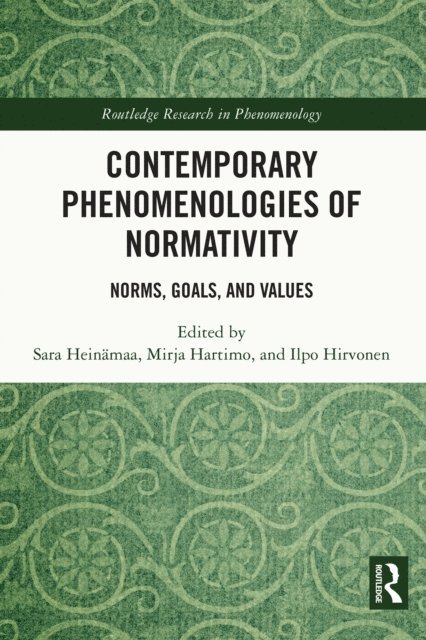
This volume investigates forms of normativity through the phenomenological methods of description, analysis, and interpretation. It takes a broad approach to norms, covering not only rules and commands but also goals, values, and passive drives and tendencies.
Part I "Basic Perspectives" begins with an overview of the phenomena of normativity and then clarifies the constitution of norms by Husserlian and Heideggerian concepts. It offers phenomenological alternatives to the neo-Kantian and neo-Hegelian approaches that dominate contemporary debates on the "sources of normativity." Part II "From Perception to Imagination" turns to the normativity of three basic types of experiences. This part first sheds light on the normativity of perception and then illuminates the kind of normativity characteristic of imagination and drive intentionality. Part III "Social Dimensions" analyzes the norms that regulate the formation of practical communities. It takes a broad view of practical norms, discussing social and moral norms as well as the epistemic norms of scientific practices. By clarifying the divergences and interrelations between various types and levels of norms, the volume demonstrates that normativity is not one phenomenon but a complex set of various phenomena with multiple sources.
Contemporary Phenomenologies of Normativity: Norms, Goals, and Values will be of interest to researchers and advanced students working on issues of normativity in phenomenology, epistemology, ethics, and social philosophy.
786 kr
Läs direkt efter köp
The aim of this volume is to offer an updated account of the transcendental character of phenomenology. The main question concerns the sense and relevance of transcendental philosophy today: What can such philosophy contribute to contemporary inquiries and debates after the many reasoned attacks against its idealistic, aprioristic, absolutist and universalistic tendencies—voiced most vigorously by late 20th century postmodern thinkers—as well as attacks against its apparently circular arguments and suspicious metaphysics launched by many analytic philosophers? Contributors also aim to clarify the relations of transcendental phenomenology to other post-Kantian philosophies, most importantly to pragmatism and Wittgenstein’s philosophical investigations. Finally, the volume offers a set of reflections on the meaning of post-transcendental phenomenology.
779 kr
Läs direkt efter köp
The aim of this volume is to offer an updated account of the transcendental character of phenomenology. The main question concerns the sense and relevance of transcendental philosophy today: What can such philosophy contribute to contemporary inquiries and debates after the many reasoned attacks against its idealistic, aprioristic, absolutist and universalistic tendencies—voiced most vigorously by late 20th century postmodern thinkers—as well as attacks against its apparently circular arguments and suspicious metaphysics launched by many analytic philosophers? Contributors also aim to clarify the relations of transcendental phenomenology to other post-Kantian philosophies, most importantly to pragmatism and Wittgenstein’s philosophical investigations. Finally, the volume offers a set of reflections on the meaning of post-transcendental phenomenology.
3 046 kr
Läs direkt efter köp
1 977 kr
Läs direkt efter köp
Psychology and Philosophy provides a history of the relations between philosophy and the science of psychology from late scholasticism to contemporary discussions. The book covers the development from 16th-century interpretations of Aristotle’s De Anima, through Kantianism and the 19th-century revival of Aristotelianism, up to 20th-century phenomenological and analytic studies of consciousness and the mind.
In this volume historically divergent conceptions of psychology as a science receive special emphasis. The volume illuminates the particular nature of studies of the psyche in the contexts of Aristotelian and Cartesian as well as 19th- and 20th-century science and philosophy. The relations between metaphysics, transcendental philosophy, and natural science are studied in the works of Kant, Brentano, Bergson, Husserl, Merleau-Ponty, Wittgenstein, and Davidson. Accounts of less known philosophers, such as Trendelenburg and Maine de Biran, throw new light onthe history of the field. Discussions concerning the connections between moral philosophy and philosophical psychology broaden the volume’s perspective and show new directions for development.
All contributions are based on novel research in their respective fields. The collection provides materials for researchers and graduate students in the fields of philosophy of mind, history of philosophy, and psychology.
687 kr
Läs direkt efter köp
This first volume of Husserlian Legacies: Themes for the 21st Century focuses on hitherto underexamined dimensions of Husserl’s philosophical thinking and in particular, values and love. Texts in this series draw from the variety of Husserl’s rich original works; they are selected and arranged with the support of the Husserl Archives, Leuven. The texts are made available in English and are primarily targeted to advanced undergraduates, graduate students, and scholars.
This volume helps the reader both to investigate the themes of value and love and to gauge their role in Husserl’s reflections on related topics: his analysis of philosophy, the sciences as vocational tasks, the emotions and the community of love, as well as his personalistic reformulation of the categorical imperative. The texts gathered, edited, and translated in this volume have far-reaching implications, ranging from axiology and individual and social ethics to the philosophy of emotions, action theory, and the philosophy of science.
1 367 kr
Läs direkt efter köp