A History of Western Philosophy – Serie
Visar alla böcker i serien A History of Western Philosophy. Handla med fri frakt och snabb leverans.
8 produkter
8 produkter
556 kr
Skickas inom 7-10 vardagar
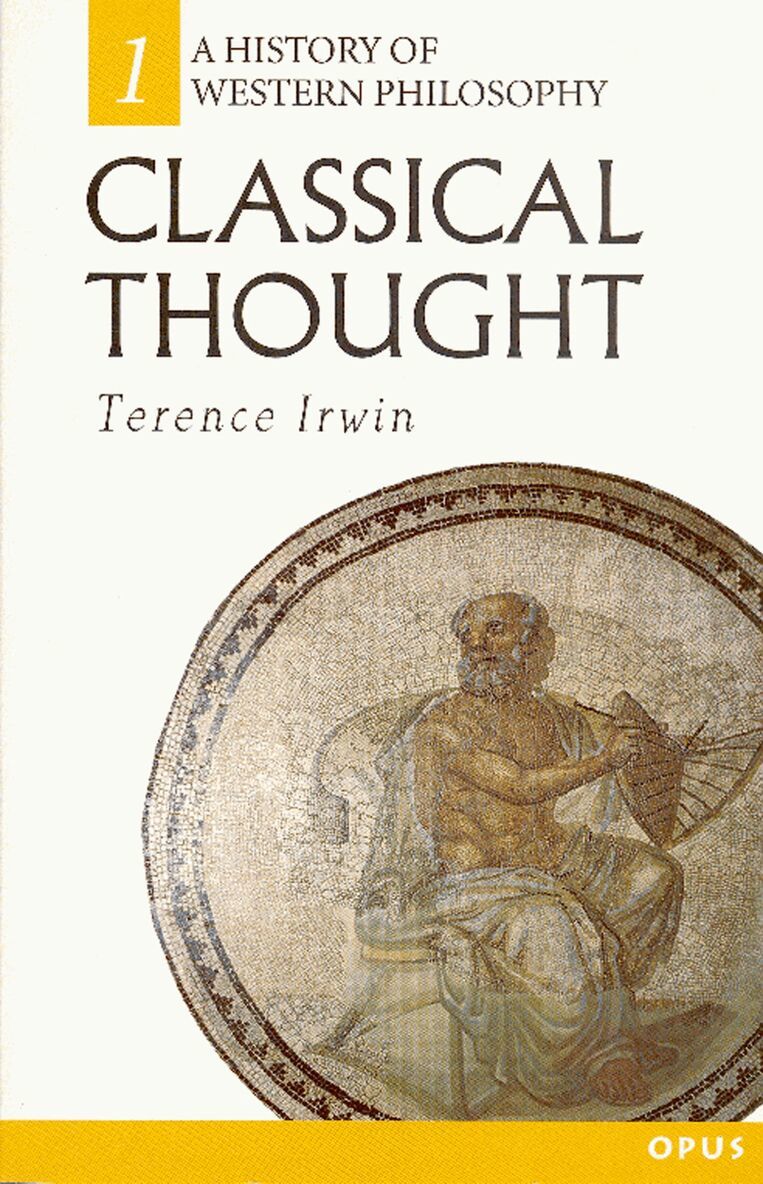
Spanning over a thousand years from Homer to Saint Augustine, Classical Thought encompasses a vast range of material in succinct style, while remaining clear and lucid even to those with no philosophical or Classical background The major philosophers and philosophical schools are examined---the Presocratics, Socrates, Plato, Aristotle, Stoicism, Epicureanism, Neoplatonism; but other important thinkers, such as Greek tragedians, historians, medical writers, and early Christian writers, are also discussed. The emphasis is naturally on questions of philosophical interest (although the literary and historical background to Classical philosophy is not ignored), and again the scope is broad---ethics, the theory of knowledge, philosophy of mind, philosophical theology. All this is presented in a fully integrated, highly readable text which covers may of the most important areas of ancient thought and in which stress is laid on the variety and continuity of philosophical thinking after Aristotle.
537 kr
Skickas inom 5-8 vardagar
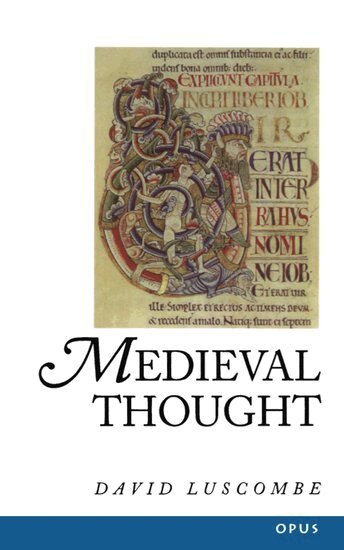
The Middle Ages span a period of well over a millennium: from the emperor Constantine's Christian conversion in 312 to the early sixteenth century. During this time there was remarkable continuity of thought, but there were also many changes made in different philosophies: various breaks, revivals, and rediscoveries. David Luscombe's history of Medieval Thought steers a clear path through this long period, beginning with the three greatest influences on medieval philosophy: Augustine, Boethius, and Pseudo-Denis, and focusing on Alcuin, Abelard, Anselm, Aquinas, Ockham, Duns Scotus, and Eckhart amongst others in the twelfth to fifteenth centuries. Medieval philosophy is widely regarded as having a theological and religious orientation, but more recently attention has been given to the early study of logic, language, and the philosophy of science. This history therefore gives a fascinating insight into medieval views on aspects such as astronomy, materialism, perception, and the nature of the soul.
555 kr
Skickas inom 5-8 vardagar
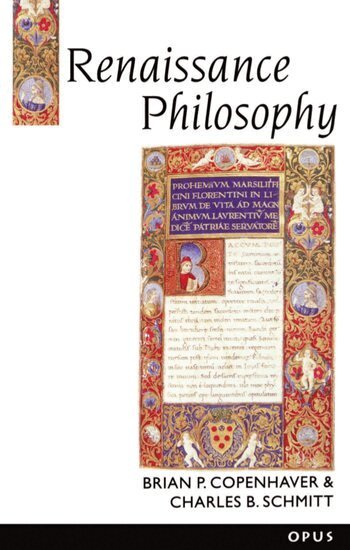
The Renaissance has long been recognized as a brilliant moment in the development of Western civilization. However, little attention has been devoted to the distinct contributions of philosophy to Renaissance culture. This volume introduces the reader to the philosophy written, read, taught, and debated during the period traditionally credited with the `revival of learning'. The authors examine the relation of Renaissance philosophy to humanism and the universities, the impact of rediscovered ancient sources, the recovery of Plato and the Neoplatonists, and the evolving ascendancy of Aristotle. Renaissance Philosophy also explores the original contributions of major figures including Bruni, Valla, Ficino, Pico della Mirandola, Pomponazzi, Machiavelli, More, Vitoria, Montaigne, Bruno, and Campanella. Renaissance Philosophy demonstrates the uses of ancient and medieval philosophy by Renaissance thinkers, and throws light on the early modern origins of modern philosophy.
595 kr
Skickas inom 7-10 vardagar
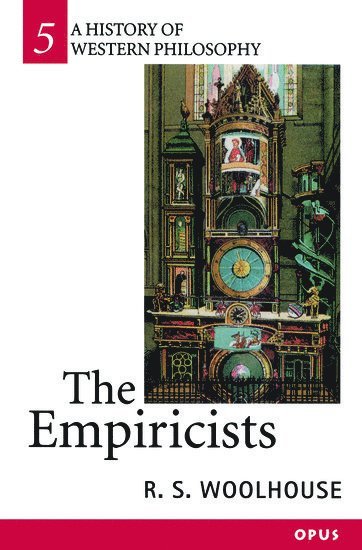
`One of the great historic controversies in philosophy' was how Bertrand Russell described the ideological conflict between rationalists and empiricists - the conflict between reason and experience as sources of knowledge and ideas. Yet in this study of the empiricists R.S. Woolhouse is not so much concerned to justify these conventional labels as to set forth the dominant philosophical ideas and let those ideas speak for themselves. Setting the empiricist philosophers in their contemporary cultural context, the author examines their various approaches to philosophy. He concentrates primarily on the major figures - Bacon, Hobbes, Locke, Berkeley and Hume - but also discusses the unjustly neglected French philosopher Pierre Gassendi and devotes a chapter to the Royal Society of London for the Improving of Natural Knowledge, which was founded in the 1660s. While focusing on their contribution to the new philosophy of the seventeenth century, which was primarily concerned with the nature of knowledge and science, he also highlights the moral and political aspects of their work and emphasises the significance of their ideas to twentieth-century thinking.
537 kr
Skickas inom 5-8 vardagar
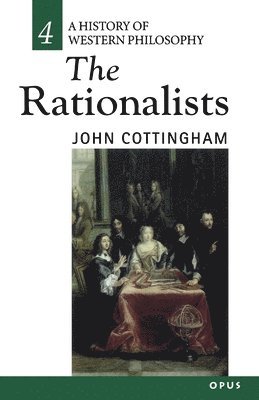
The seventeenth century saw a fundamental shift in our ways of thinking about ourselves and the universe. The reassuring medieval view of an earth-centred cosmos designed expressly for the benefit of mankind had been steadily eroded; yet at the same time there emerged a new optimism about the possibility of developing a clear and comprehensive account of the workings of the universe, together with a determination to penetrate the nature of the human mind and its relation to the material world. Against this background John Cottingham traces the attempts of the three great rationalist philosophers - Descartes, Spinoza, and Leibniz - to come to terms with man's new role in nature and to devise new systems of philosophy that would provide a unified understanding of reality. He aims to show how closely their ideas are related, and analyses their ways of tackling such central issues as the relation between mind and body, the nature of substance, and the way to achieve a free and fulfilled Human life. He engages with their ideas in a vigorously critical way, and in so doing reveals their capacity to throw light on major philosophical topics which are still very much alive today.
660 kr
Skickas inom 7-10 vardagar
From the end of the Enlightenment to the middle of the twentieth century philosophy took fascinating and controversial paths whose relevance to contemporary post-modernist thought is becoming increasingly clear. This volume traces the English-language side of the period, while also taking into account those continental thinkers who deeply influenced twentieth-century English-language philosophy.
Del 7 - A History of Western Philosophy
Continental Philosophy since 1750
The Rise and Fall of the Self
Häftad, Engelska, 1988
572 kr
Skickas inom 5-8 vardagar
The explosion of creative and speculative philosophy that emerged in Europe in the second half of the eighteenth century is a thrilling intellectual adventure story, as well as an essential chapter in the history of philosophy. The main theme of this story is the rise and fall of the Self. The Self in question is no ordinary self - no individual personality nor even one of the many heroic or mock-heroic personalities of the early nineteenth century. The Self is the Transcendental Self, whose nature and ambitions are unprecedently arrogant, cosmic and often obscure. In modest terms, this universal self is human nature. In less modest terms, the Transcendental Self is nothing less than God. This thesis is what Solomon terms the Transcendental Pretence.The book is an accessible introduction to the difficult authors of modern European philosophy. The major figures and movements are treated in an integrated narrative, free of jargon. Included are: The Enlightenment and Romanticism, German Idealism, Kant, Fichte, Schelling and the Romantics, Hegel, Schopenhauer, Kierkegaard, Feuerbach, Max Bretano, Meinong, Frege, Dilthey, Bergson, Nietzsche, Husserl, Freud, Wittgenstein, Heidegger, Hermeneutics, Sartre, Post-Modernism, Structuralism, Foucault and Derrida.
791 kr
Skickas inom 7-10 vardagar
This accessible and up-to-date survey introduces the central debates of English-language philosophy since 1945. A brief description of philosophical debates during the first half of the twentieth century is followed by extended discussions of some of the writings of Wittgenstein, Ryle, Austin, Quine, and Sellars. The book then describes several ensuing philosophical debates that have shaped philosophical discussions from the 1960s until the present day. There are chapters on: the Davidson/Dummett debate concerning language; the Kripke/Lewis debate concerning possible worlds; the Popper/Kuhn debate concerning science; the debates concerning epistemology, materialism, functionalism, and dual-aspect theories of mind; and recent work in moral psychology, metaethics, and normative ethics. The final chapter is a critical discussion of Rorty's metaphilosophical scepticism. In addition, there is extensive attention to writings of Strawson, Putnam, Evans, McDowell, Williams, Nagel, and many other contemporary philosophers. Thomas Baldwin's lively and coherent critical discussion of his subject demonstrates the connections between different areas of philosophy in a way which readers unfamiliar with philosophy will find both stimulating and accessible.