Regional Studies Policy Impact Books – serie
Visar alla böcker i serien Regional Studies Policy Impact Books. Handla med fri frakt och snabb leverans.
12 produkter
12 produkter
Häftad, Engelska, 2019
487 kr
Skickas inom 10-15 vardagar
In the context of the debate on the future of Europe, this book makes the case for a new approach to structural transformation, growth and cohesion in the EU. It explores both the opportunities and challenges from globalisation and technological change, the widening differences in productivity between leading and lagging regions, and the need for a new policy framework capable of delivering inclusive growth.The Regional Studies Association’s Policy Impact Books form a series of punchy, policy facing books addressing issues of contemporary concern. There is a consistent focus on the impact of policy research both in terms of its reach to policy, academic and practitioner communities and also in its significance, to show how evidence can inform policy change within regional and urban studies.
Häftad, Engelska, 2019
487 kr
Skickas inom 10-15 vardagar
This Expo book brings together leading academic and policymaker experts to reflect on the significant challenges faced by lagging regions in participating in the European Union’s Research and Innovation Strategies for Smart Specialisation (RIS3) programme. In doing so, the book offers a set of new policy recommendations on the design and implementation of appropriate Smart Specialisation Strategies (S3) in lagging regions, which may enable them to benefit from the opportunities of digitalisation and Industry 4.0 (I4.0).
Häftad, Engelska, 2020
487 kr
Skickas inom 10-15 vardagar
Across the globe policy makers implement, and academics teach and undertake research upon, place-based policy. But what is place-based policy, what does it aspire to achieve, what are the benefits of place-based approaches relative to other forms of policy, and what are the key determinants of success for this type of government intervention? This Policy Expo examines these questions, reviewing the literature and the experience of places and their governments around the world. We find place-based policies are essential in contemporary economies, providing solutions to otherwise intractable challenges such as the long-term decline of cities and regions. For those working in public sector agencies the success or failure of place-based policies is largely attributable to governance arrangements, but for researchers the community that is the subject of this policy effort, and its leadership, determines outcomes. This Policy Expo explores the differing perspectives on place-based policy and maps out the essential components of effective and impactful actions by government at the scale of individual places.
Häftad, Engelska, 2021
487 kr
Skickas inom 10-15 vardagar
The Belt and Road Initiative (BRI), launched by China in 2013, carries and projects powerful regional dimensions and transformations, with short- and long-term global, national and local consequences. The BRI’s regional significance lies in its designation and creation of several cross-border corridors that originate from inside China and extend out into its neighbouring countries, and those farther afield in Asia, Africa and Europe. Through driving and facilitating new trade and infrastructure connections along and beyond these corridors, the BRI has begun to reshape the master processes of globalisation, urbanisation and development by affecting the economic, social and spatial fortunes of many countries and cities.This book serves two purposes. First, through a new framework and three case studies, it examines the BRI’s impacts on globalisation, urbanisation and development via the China-Europe Freight Train, the paired construction of a new city and railway across the China-Laos borderland and the port-park-city development corridor between Djibouti and Ethiopia. Second, the comparative analysis and evidence guide the book to advance policy recommendations for targeted stakeholders that can potentially turn the BRI into a global public good with greater benefits and fewer risks.
Häftad, Engelska, 2021
488 kr
Skickas inom 10-15 vardagar
There have been several attempts in recent years to create conceptual frameworks and models to help universities and policy makers understand the role and contribution of higher education to local and regional development. However, these models have failed to fully reflect or give insufficient attention to the impact of the regional context (economic, social, political), the policy environment for higher education and territorial development and the diversity of management and leadership structures of universities themselves. This has led to the development of static models that rarely work outside of the immediate context in which they were developed and therefore risk leading to design of policies that are not fit for purpose. This Policy Expo is the result of work with partners in Europe, South America, Africa, Asia and Australia to develop a new approach, the ORPHIC Framework, to think about how the university can be adapted to the specificity of institutional and local contexts. The book examines:• What are the different roles that universities play in local and regional development and how do these manifest themselves?• How can we learn from comparing practice and experience internationally, and to what extent are policies aimed at promoting university–region relationships transferrable?• What are the internal university factors, such as management and leadership, history, mission, structures, and the external factors, such as territorial development policy context, governance system, nature of the ‘place’, that might help us explain the nature of the relationship?
Häftad, Engelska, 2021
488 kr
Skickas inom 10-15 vardagar
This book aims to understand the predicaments of ‘left behind places’ and the scale of the policy challenge of ‘levelling up’ their economic prosperity. Drawing out lessons of wider international significance, it examines how places (cities, towns and localities) have grown apart over recent decades amidst deindustrialisation, post-industrial transition and the disruptive shocks of the global financial crisis and COVID-19 pandemic. Using the UK case to illustrate its arguments, the analysis identifies the different types of ‘left behind places’ and their distinctive economic experiences. The key features of urban and regional institutions and policies are reviewed to understand more about why, despite some successes, geographical inequalities remain an entrenched feature of the UK, blighting the life chances and quality of life of its citizens, and national economic progress as a whole. The weaknesses of past policies are highlighted, and the case is made for a new, mission-oriented policy model, because only a radical shift in economic thinking, governance and management is likely to achieve the ‘levelling up’ that is now a prominent refrain in the political lexicon.
Häftad, Engelska, 2023
488 kr
Skickas inom 10-15 vardagar
The past decade has seen substantial progress towards the development of Connected and Autonomous Vehicles (CAVs). Accompanying the technological developments, there has been much dialogue around the potential for CAVs to help solve a range of economic, social, and environmental issues. Some of CAVs purported benefits include, for example, greater efficiency in the use of existing transport infrastructure, improved safety through removing human error, and widening access to automobility. However, there are also many potential downsides, and whether and how CAVs will deliver on their promise remains shrouded in much uncertainty and not a small degree of scepticism.This book views developments around CAVs through the lens of local policymakers and the towns and cities they represent. We argue it is now time to expand the dialogue to include consideration for towns and cities beyond those early adopters to understand how they will fare, and how CAVs might interact with other important policy agendas facing them.We discuss the different challenges that CAVs will pose for the urban built environment and the required forms of preparedness for these. We also explore how CAVs will interact with other uses and users of cities, including potentially competing efforts to enhance urban wellbeing and liveability. Finally, we consider how responses to CAVs are being developed and what the implications of these are.This book will appeal to policymakers, practitioners, and academics interested in the potential impacts of CAVs and in understanding more about how they will shape and interact with cities and regions in the near future.
Häftad, Engelska, 2023
488 kr
Skickas inom 10-15 vardagar
This Regional Studies Policy Impact Book brings together the latest academic evidence and public policy insights with global value chains (GVCs) and foreign direct investment (FDI). It comprises a comprehensive description and explanation of why they matter for regional development and policy. It focuses on how sub-national regions can leverage them for innovation and upgrading, or "levelling up". Specifically, its attention is on how regions can build, embed and reshape GVCs to their local enhancement. The book makes the case for proactive sub-national public policy, on the engagement of GVCs. Vertically engaging with FDI rather than setting the ground and letting manna drop from heaven. Its chosen approach is three-fold. First, it looks at why. Why GVCs and FDI matter and why sub-national policymakers should focus their attention on upgrading. It critically reviews different streams of research and evidence. This is in order to identify key definitions and conceptual foundations for the analysis of the link between GVCs, FDI and innovation at the sub-national and local level. Second, it looks at what. This is through new conceptualisations and critical insights on the regional drivers and impacts of global connectivity, bridging macro-international and micro-firm level approaches. Third, is the critical how. How policymakers can leverage GVCs and FDI for their regional benefit. It aims to review empirical evidence and available policy evaluation in order to highlight what works (and what does not) when leveraging these concepts to shape public policies with particular reference to less developed regions.If the above is of interest, then the book is for you. It is based on leading academic literature but uses non-technical language throughout making it engaging for policymakers, researchers and students alike.
Häftad, Engelska, 2023
488 kr
Skickas inom 10-15 vardagar
As COVID-19 took hold across local and international borders in 2020 and 2021, over 1.6 billion informal workers were estimated to have been adversely impacted by mobility restrictions and other 'lockdown' measures to tackle the coronavirus crisis. In the Global South, the pandemic has severely affected the sprawling megacities in Southeast and South Asia that have been driving urbanisation, and where there is a very high concentration of informal workers. This volume examines how informal workers were affected by the responses to the pandemic in five Asian megacities: Dhaka (Bangladesh), Hyderabad (India), Karachi (Pakistan), Jakarta (Indonesia), and Manila (Philippines).Gathering voices and experiences from across these subregions, this book engages with issues surrounding state measures to manage the COVID-19 pandemic. The chapters present the gaps and lessons learned in addressing the needs of informal workers. They also shed light on grassroots solidarity initiatives, civic practices, and social networks that have cushioned the devastating effects of the crisis. The book ends with a discussion on the implications of identified state measures and citizen-led responses for (post) pandemic planning and urban governance in Asian cities in an age of recovery.
Häftad, Engelska, 2024
488 kr
Skickas inom 10-15 vardagar
This book explores the making, unmaking and remaking of social infrastructure in ‘left-behind places’. Such places, typically once flourishing industrial communities that have been excluded from recent economic growth, now attract academic and policy attention as sites of a political backlash against globalisation and liberal democracy. The book focuses on the role of social infrastructure as a key component of this story.Seeking to move beyond a narrowly economistic of reading ‘left behind places’, the book addresses the understudied affective dimensions of ‘left-behindness’. It develops an analytical framework that emphasises the importance of place attachments and the consequences of their disruption; considers ‘left behind places’ as ‘moral communities’ and the making of social infrastructure as an expression of this; views the unmaking of social infrastructure through the lens of ‘root shock’; and explains efforts at remaking it in terms of the articulation of ‘radical hope’.The analysis builds upon a case study of a former mining community in County Durham, North East England. Using mixed methods, it offers a ‘deep place study’ of a single village to understand more fully the making, unmaking and remaking of social infrastructure. It shows how a place once richly endowed with social infrastructure, saw this endowment wither and the effects this had on the community. However, it also records efforts of the local people to rebuild social infrastructure, typically drawing the lessons of the past. Although the story of one village, the methods, results and policy recommendation have much wider applicability.The book will be of interest to researchers, policy makers and others concerned with the fate of ‘left behind places’.The Open Access version of this book, available at http://www.taylorfrancis.com, has been made available under a Creative Commons Attribution-Non Commercial (CC-BY-NC) 4.0 license.
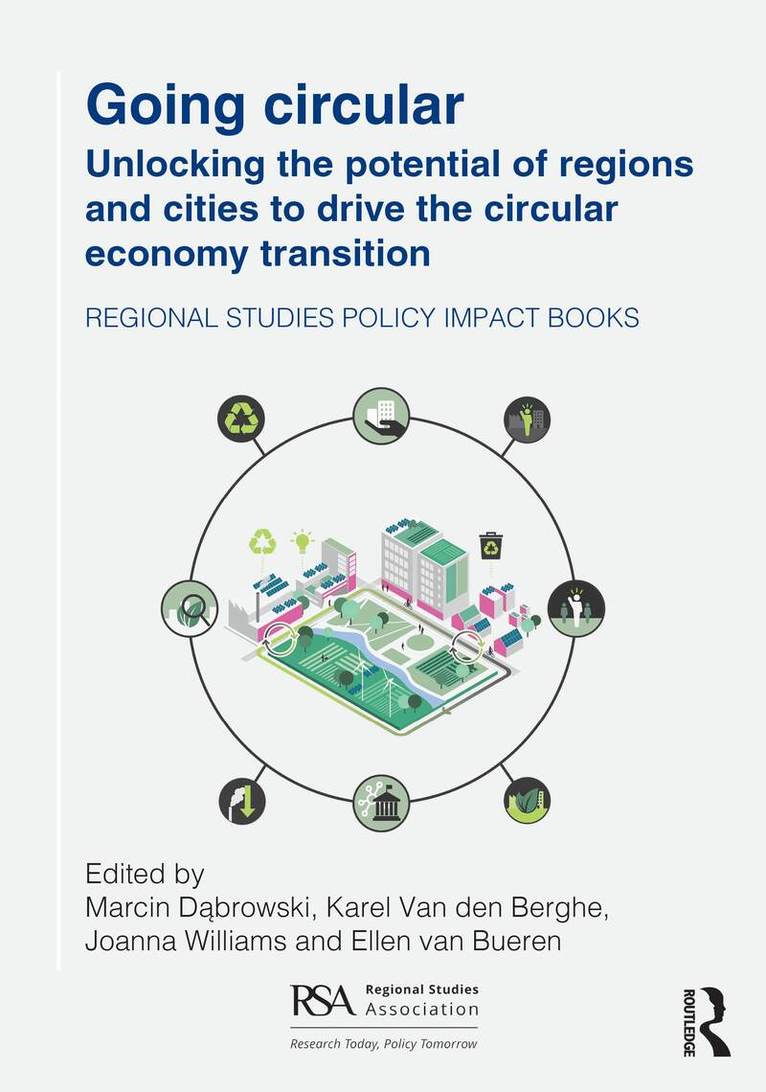
Going Circular
Unlocking the potential of regions and cities to drive the circular economy transition
Häftad, Engelska, 2025
488 kr
Skickas inom 10-15 vardagar
Going Circular explores the concept of a circular economy (CE) and its transformative potential for cities and regions. It emphasises the importance of spatial planning and the role of urban and regional authorities in driving the transition to a more sustainable, resilient and inclusive economic and societal model. The authors offer a critical perspective, arguing that there is no onesize-fits-all approach to regional and urban CE policies. Instead, they advocate for a context-specific understanding of CE, emphasising the importance of: local and regional conditions for circular activities; the spatial patterns in resource stocks and flows within territories, and the need to engage a range of stakeholders and communities in decision-making processes.Going Circular tackles the pivotal policy issues and challenges related to CE transitions in cities and regions. It will inform and equip public and private policymakers, urban planners and regional authorities with the knowledge and tools needed to foster a CE and nudge cities and regions towards sustainable futures.Despite extensive data and knowledge available on cities and regions, terms such as ‘circularity’, ‘economy’ and ‘space’ often remain disjointed for researchers, policymakers and practitioners alike. This book presents a frank and insightful exploration of the spatial dimension of the circular economy, challenging assumptions and idealisms. It provides practical opportunities for action by underscoring the importance of geopolitics, empathy and justice, ecosystems restoration, and assessment of progress on the transition pathways towards a circular economy. The book equips readers with language and visual concepts needed to engage with and communicate this topic confidently. I highly recommend it as both an introduction and a refresher on the topic of circular regions and cities.Adrian Vickery Hill, Strategist and designer - director, Osmos NetworkThis book outlines a path to trigger circular economy processes that can transform cities and regions, guiding them towards a more resilient and sustainable future, while producing context-appropriate solutions. Circular economy is a context-specific, place-based process that requires a holistic and systemic perspective, in which space plays a crucial role. In six thematic chapters, the book proposes a pathway analysing several key issues: the spatial dimension of circular economy; the opportunities for more ecologically healthy, resource-sufficient metropolitan regions; the integration of social justice and the concept of “care-full” circular economy; the ecological implications of the transition in line with the urban circular bioeconomy; the multidimensional assessment of the transition progress and cross-level interdependencies; as well as policy recommendations for multi-level governance at various scales. This book provides an inspiring perspective on circular economy, not only as a technical and economic challenge, but also as a social and political opportunity. It is highly recommended for anyone interested in fostering a more sustainable and circular future for our cities.Prof. Maria Cerreta, University of Naples “Federico II”
Häftad, Engelska, 2025
488 kr
Skickas inom 10-15 vardagar
In today’s innovation-driven global economy, there is much to be learned from the lived experience of disabled entrepreneurs in respect of support, be it by governments, charitable organisations, professional bodies or universities. Addressing the ongoing problem of inequality in access and opportunities unites all these entities. The issue this book addresses is how the innovation and entrepreneurship created by disabled people are variously supported in different national contexts. What influences the availability of resources in support of entrepreneurship and innovation by disabled people – and what works?Representative country case studies in this publication are India, Nigeria, Hungary, the United States and Türkiye. The book also draws on previous research in the UK. These countries illustrate the variations in how research into entrepreneurship undertaken by disabled people is focused on key national and regional issues. The contributions provide a summary and critique of existing legislative and policy approaches. These are detailed examples, but they are not unique and 14 different non-European countries have been identified where research on innovative entrepreneurs with disabilities has been undertaken. These include Brazil, China, Ecuador, Indonesia, Nepal and South Africa.In this Policy Expo the authors consider how inequalities in participation, access and opportunity are addressed in different countries and regions. They consider the design and implementation of policies in support of disabled entrepreneurs in order to provide an impetus to include and improve larger entrepreneurship and innovation systems. The country chapters provide an analysis and critique of current national and policy provisions and also address overall socioeconomic benefits, beyond those of the individual. Examples are given of the experiences of disabled entrepreneurs to illustrate these points.