• Fri frakt över 249 kr
  • •
  • Snabba leveranser
  • •
  • Billiga böcker
Kundservice

Du är på sajten för privatpersoner.

Företag, bibliotek eller offentlig verksamhet?

Du handlar på classic.bokus.com, där alla dina funktioner finns intakta.
Till classic.bokus.com
Bokus logotyp. Gå till startsidan.
  • Erbjudanden
  • Nyheter
  • Student
  • Topplistor
  • Barn & ungdom
  • Bokus Play
  • E-böcker
  • Pocketböcker
  • Spel & pussel

10% rabatt på allt med kod: NYSTART10 →

Sidfot

Mina sidor

    Hjälp

    • Kundservice
    • Vanliga frågor och svar
    • Frakt och leverans
    • Retur vid ångerrätt
    • Reklamera vara
    • Betalning
    • Köpvillkor
    • Allmänna villkor
    • Information om webbplatsens tillgänglighet

    Om Bokus

    • Om oss
    • Pressrum
    • För studenter
    • För företag
    • För bibliotek och offentlig verksamhet
    • För leverantörer
    • Hållbarhet

    Populärt

    • Aktuella erbjudanden
    • Presentkort
    • Studentlitteratur
    • Nya böcker
    • Topplistor
    • Signerade böcker
    • Engelska böcker

    Inspiration

    • Boktips
    • BookTok
    • Populära bokserier
    • Barnbokskaraktärer
    • Populära författare
    Logotyp för Bokus
    Följ oss på Facebook (extern länk)Följ oss på Instagram (extern länk)Följ oss på YouTube (extern länk)Följ oss på TikTok (extern länk)
    bokus @ CookiesAnpassa cookiesIntegritetspolicyKöpvillkor
    Till Citymail hemsida (extern länk)Till Budbee hemsida (extern länk)Till Postnord hemsida (extern länk)Till Schenker hemsida (extern länk)Till Early Bird hemsida (extern länk)Till Walleys hemsida (extern länk)
    1. Samhälle och politik
    2. Politik och statsskick
    3. Statsskick och politiska processer
    4. Val och folkomröstningar

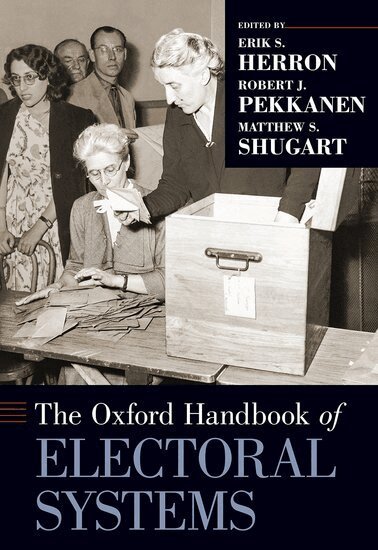
    The Oxford Handbook of Electoral Systems

    AvErik S. Herron,Robert J. Pekkanen

    Inbunden, Engelska, 2018

    Del i serien Oxford Handbooks

    2 965 kr

    Beställningsvara. Skickas inom 5-8 vardagar. Fri frakt över 249 kr.

    Beskrivning

    No subject is more central to the study of politics than elections. All across the globe, elections are a focal point for citizens, the media, and politicians long before--and sometimes long after--they occur. Electoral systems, the rules about how voters' preferences are translated into election results, profoundly shape the results not only of individual elections but also of many other important political outcomes, including party systems, candidate selection, and policy choices. Electoral systems have been a hot topic in established democracies from the UK and Italy to New Zealand and Japan. Even in the United States, events like the 2016 presidential election and court decisions such as Citizens United have sparked advocates to promote change in the Electoral College, redistricting, and campaign-finance rules. Elections and electoral systems have also intensified as a field of academic study, with groundbreaking work over the past decade sharpening our understanding of how electoral systems fundamentally shape the connections among citizens, government, and policy. This volume provides an in-depth exploration of the origins and effects of electoral systems.

    Produktinformation

    • Utgivningsdatum:2018-04-26
    • Mått:249 x 178 x 66 mm
    • Vikt:1 792 g
    • Format:Inbunden
    • Språk:Engelska
    • Serie:Oxford Handbooks
    • Antal sidor:1 016
    • Förlag:OUP USA
    • ISBN:9780190258658

    Utforska kategorier

    • Val och folkomröstningar inom Samhälle och politik
    • Statsvetenskap och politisk teori inom Samhälle och politik
    • Politiskt ledarskap inom Samhälle och politik

    Mer om författaren

    Erik S. Herron is the Eberly Family Professor of Political Science at West Virginia University. His research focuses on political institutions, especially electoral systems. Prof. Herron has traveled extensively in Eastern Europe and Eurasia, including a term as a Fulbright scholar in Ukraine and thirteen election-observation missions. He has published research in the American Journal of Political Science, the Journal of Politics, World Politics, Comparative Political Studies, Electoral Studies, and other journals, as well as two books: Mixed Electoral Systems: Contamination and Its Consequences (with Federico Ferrara and Misa Nishikawa) and Elections and Democracy after Communism.Robert J. Pekkanen is Professor at the Henry M. Jackson School of International Studies, Adjunct Professor of Political Science, and Adjunct Professor of Sociology at the University of Washington. He received his Ph.D. in political science from Harvard University in 2002. His research interests lie in electoral systems, political parties, and civil society. He has published articles in political science journals such as the American Political Science Review, the British Journal of Political Science, and Comparative Political Studies, as well as six books on American nonprofit advocacy, Japanese civil society, and Japanese elections and political parties.Matthew S. Shugart is Professor of Political Science at the University of California, Davis, and Affiliated Professor at the University of Haifa. He is a world-renowned scholar of democratic institutions. He is a two-time winner of the George H. Hallet Award, given annually by the Representation and Electoral Systems Section of the American Political Science Association for a book published at least ten years ago that has made a lasting contribution to the field. He won it first for his collaboration with Rein Taagepera, Seats and Votes (1989) and again for Presidents and Assemblies (1992, with John M. Carey). He has participated as an advisor on electoral-system reform and constitutional design in several countries, including Albania, Bulgaria, Colombia, Estonia, and Israel.

    Recensioner i media

    The Oxford Handbook of Electoral Systems is a massive store of knowledge and information, with many of its chapters providing valuable and accessible resources

    Innehållsförteckning

    • 1. Terminology and Basic Rules of Electoral SystemsErik S. Herron, Robert J. Pekkanen, and Matthew S. Shugart Part I. Foundations of Electoral Systems2. Dimensions of Variation in Electoral Systems Michael Gallagher and Paul Mitchell3. Electoral System Effects on Party Systems Matthew S. Shugart and Rein Taagepera4. Party System Effects on Electoral Systems Josep M. Colomer5. Electoral System Design in New DemocraciesJohn M. Carey6. Electoral System Change Alan Renwick Part II. Issues and Representation 7. Social Diversity, Electoral Systems, and the Party System Robert Moser, Ethan Scheiner, and Heather Stoll8. Electoral Systems and Ethnic Minority Representation David Lublin and Shaun Bowler9. Electoral Systems and Women's RepresentationMona Lena Krook10. Electoral Systems and Voter Turnout Daniel M. Smith11. Electoral Systems and Citizen-Elite Ideological Congruence Matthew Golder and Benjamin Ferland12. Electoral Systems and Issue Polarization James F. Adams and Nathan J. Rexford Part III. Electoral Systems and the Wider Political System13. Portfolio-maximizing Strategic Voting in Parliamentary Elections Gary W. Cox 14. Presidential and Legislative ElectionsMark P. Jones15. Electoral Systems and Legislative Organization Shane Martin16. Electoral Systems and Roles in the Legislative Arena Audrey André and Sam Depauw17. Electoral Systems and Constituency ServiceBrian F. Crisp and William M. Simoneau18. Direct Democracy and ReferendumsMatt Qvortrup19. Electoral Systems in Authoritarian States Jennifer Gandhi and Abigail L. Heller Part IV. Electoral Systems and Research Design 20. Election Data and Levels of AnalysisKen Kollman21. Experimental Research Design in the Study of Electoral Systems Joshua Tucker and Dominik Duell22. Reconciling Approaches in the Study of Mixed-Member Electoral Systems Erik S. Herron, Kuniaki Nemoto, and Misa Nishikawa Part V. Holding Elections23. Election Administration Thad E. Hall24. Electoral Systems and Electoral Integrity Pippa Norris25. Electoral Systems and Redistricting Lisa Handley26. Electoral Systems and Campaign Finance Joel W. Johnson Part VI. Electoral Systems in Context27. Electoral Systems in Context: The Netherlands Kristof Jacobs28. Electoral Systems in Context: Israel Reuven Y. Hazan, Reut Itzkovitch-Malka, and Gideon Rahat29. Electoral Systems in Context: Finland Åsa von Schoultz30. Electoral Systems in Context: United Kingdom Thomas Carl Lundberg31. Electoral Systems in Context: IrelandMichael Marsh32. Electoral Systems in Context: France Verónica Hoyo33. Electoral Systems in Context: IndiaAdam Ziegfeld34. Electoral Systems in Context: United States Steven L. Taylor35. Electoral Systems in Context: Canada Louis Massicotte36. Electoral Systems in Context: Australia Ian McAllister and Toni Makkai37. Electoral Systems in Context: Germany Thomas Zittel Part VII. Electoral Systems in the Context of Reform38. Electoral Systems in Context: New ZealandJack Vowles39. Electoral Systems in Context: JapanKuniaki Nemoto40. Electoral Systems in Context: Italy Gianluca Passarelli41. Electoral Systems in Context: Colombia Steven L. Taylor and Matthew S. Shugart Part VIII. Electoral Systems in the Context of New Democracies42. Electoral Systems in Context: Ukraine Erik S. Herron43. Electoral Systems in Context: Indonesia Nathan Allen44. Electoral Systems in Context: South Africa Karen E. Ferree