Michel Wedel - Böcker
Visar alla böcker från författaren Michel Wedel. Handla med fri frakt och snabb leverans.
8 produkter
8 produkter
613 kr
Skickas inom 10-15 vardagar
This comprehensive volume aims to further research and theory development in visual marketing. By bringing together leading researchers in the field, it strives to contribute to the establishment of visual marketing as a coherent discipline. The chapters represent an array of issues in visual marketing. They address three areas in theory: attention and perception, visual cognition and action and choice. The chapters go beyond what is known, and offer in many cases a more speculative and visionary account of the directions that visual marketing research could and should take.Rather than being confined to advertising only, this new volume shows how visual marketing permeates almost all consumer and marketing activities. It will be of interest to undergraduate and graduate students in marketing, management, industrial design, and consumer and social psychology. Professional practitioners, especially those involved with marketing communications, retail, and in store marketing and market research, will also benefit from the empirically based and innovative ideas put forth in this book.
4 279 kr
Skickas inom 10-15 vardagar
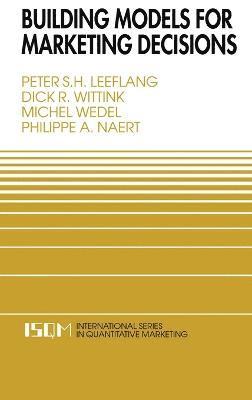
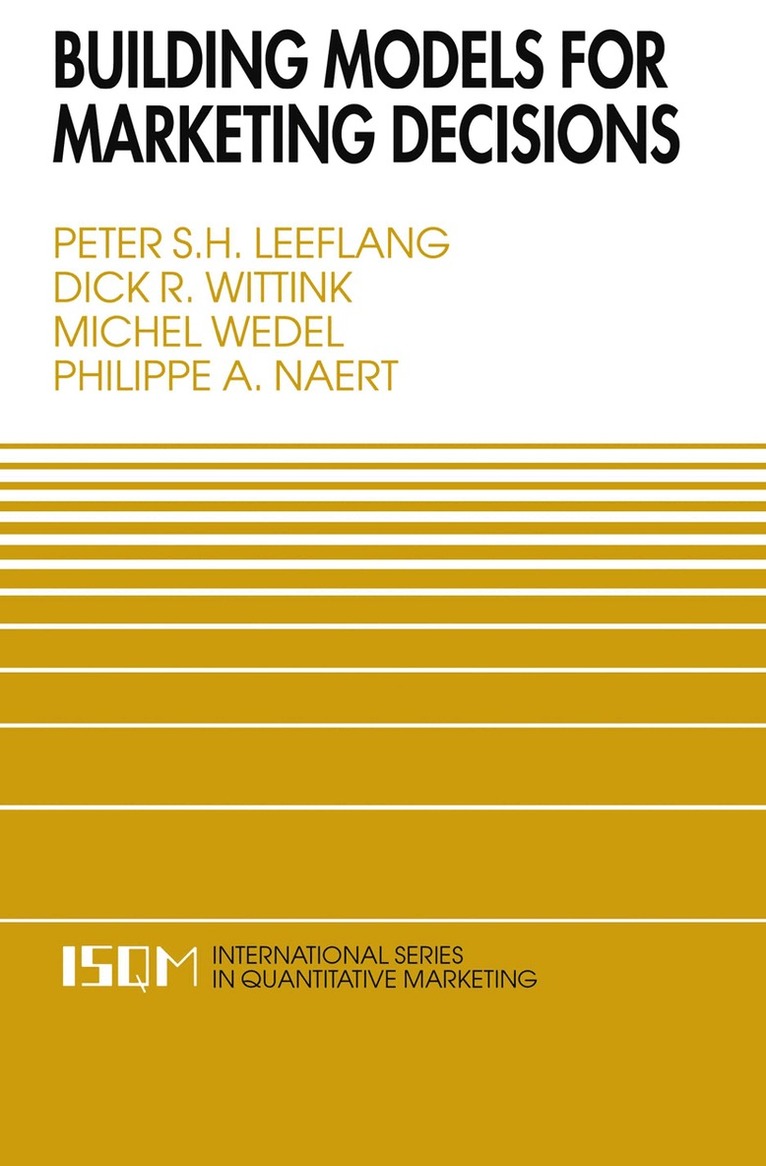
The market environment is changing rapidly. Prior to scanner data, ACNielsen, the major supplier of information on brand performances, said its business was to provide the score but not to explain or predict it. Now, model-based insights are not only demanded by managers, but can also be meaningfully provided. It is common for managers in many countries to receive market feedback frequently, quickly and in great detail due to the use of scanners and computers. With advances in information technology and expertise in modeling, IRI introduced model-based services in the US that explain and predict essential parts of the marketplace. ACNielsen followed, and marketing researchers have been developing increasingly valid, useful and relevant models of marketplace behavior ever since. Models that provide information about the sensitivity of market behavior to marketing activities such as advertising, pricing, promotions and distribution are now routinely used by managers for the identification of changes in marketing programs that can improve brand performances.Building Models for Marketing Decisions describes marketing models that managers can use as an aid in decision making. It has long been known that even simple models outperform judgments in predicting outcomes in a wide variety of contexts. More complex models potentially provide insights about structural relations not available from casual observations. Although marketing models are now widely accepted, the quality of the marketing decisions is critically dependent upon the quality of the models on which those decisions are based. In this book, which is a revision and expansion of Naert and Leeflang's Building Implementable Marketing Models (1978), the authors discuss in detail the model-building process. They distinguish four parts in this process: specification, estimation, validation and use of models. Throughout the book, the authors provide examples and illustrations. This book will be of interest to researchers, analysts, managers and students who want to understand, develop or use models of marketing phenomena.
4 279 kr
Skickas inom 10-15 vardagar
This text describes marketing models that managers can use as an aid in decision making. Even simple models outperform human judgements in predicting outcomes in a wide variety of contexts. More complex models potentially provide insights about structural relations not available from casual observations. Although marketing models are now widely accepted, the quality of the marketing decisions is critically dependent upon the quality of the models on which those decisions are based. In this book, which is a revision and expansion of Naert and Leeflang's "Building Implementable Marketing Models" (1978), the authors discuss in detail the model-building process. They distinguish four parts in this process: specification, estimation, validation and use of models. Throughout the book, the authors provide examples and illustrations.
3 532 kr
Skickas inom 10-15 vardagar
Modern marketing techniques in industrialized countries cannot be implemented without segmentation of the potential market. Goods are no longer produced and sold without a significant consideration of customer needs combined with a recognition that these needs are heterogeneous. Since first emerging in the late 1950s, the concept of segmentation has become a central topic to both the theory and practice of marketing, particularly in the development of finite mixture models to better identify market segments. This second edition updates and extends the integrated examination of segmentation theory and methodology. A chapter on mixture model analysis of paired comparison data has been added, together with a new chapter on the pros and cons of the mixture model. The book starts with a framework for considering the various bases and methods available for conducting segmentation studies. The second section contains a more detailed discussion of the methodology for market segmentation, from traditional clustering algorithms to more recent developments in finite mixtures and latent class models.Three types of finite mixture models are discussed in this second section: simple mixtures, mixtures of regressions and mixtures of unfolding models. The third main section is devoted to special topics in market segmentation such as joint segmentation, segmentation using tailored interviewing and segmentation with structural equation models. The fourth part covers four major approaches to applied market segmentation: geo-demographic, lifestyle, response-based, and conjoint analysis. The final concluding section discusses directions for further research.
1 625 kr
Skickas inom 10-15 vardagar
As in many other sectors, in agribusiness major changes are taking place. On the demand side, consumers are changing lifestyles, eating and shopping habits, and increasingly are demanding more accommodation of these needs in the supermarket. With regard to the supply: the traditional distribution channel dominators - manufacturers of branded consumer products - are trying hard to defend their positions against retailers, who gather and use information about the consumer to streamline their enterprises and strengthen their ties with the consumer. The agricultural producers, meanwhile, face increased regulations with regard to food additives, pesticides, and herbicides. Pressures rise as their business becomes more specialized and capital-intensive than that of their predecessors. Finally, the larger political climate is not so favorable to agriculture, which now has to compete in the global market without significant government support. This volume describes and interprets changes in the domain of agriculture and food.The contributors develop the theme of taking an interdisciplinary approach to coping with these changes, using concepts and methods developed in general marketing, which are adapted so as to apply to the particular characteristics of the food and agriculture sector.
2 150 kr
Skickas inom 10-15 vardagar
This comprehensive volume aims to further research and theory development in visual marketing. By bringing together leading researchers in the field, it strives to contribute to the establishment of visual marketing as a coherent discipline. The chapters represent an array of issues in visual marketing. They address three areas in theory: attention and perception, visual cognition and action and choice. The chapters go beyond what is known, and offer in many cases a more speculative and visionary account of the directions that visual marketing research could and should take.Rather than being confined to advertising only, this new volume shows how visual marketing permeates almost all consumer and marketing activities. It will be of interest to undergraduate and graduate students in marketing, management, industrial design, and consumer and social psychology. Professional practitioners, especially those involved with marketing communications, retail, and in store marketing and market research, will also benefit from the empirically based and innovative ideas put forth in this book.
3 429 kr
Skickas inom 10-15 vardagar
Modern marketing techniques in industrialized countries cannot be implemented without segmentation of the potential market. Goods are no longer produced and sold without a significant consideration of customer needs combined with a recognition that these needs are heterogeneous. Since first emerging in the late 1950s, the concept of segmentation has been one of the most researched topics in the marketing literature. Segmentation has become a central topic to both the theory and practice of marketing, particularly in the recent development of finite mixture models to better identify market segments. This second edition of Market Segmentation updates and extends the integrated examination of segmentation theory and methodology begun in the first edition. A chapter on mixture model analysis of paired comparison data has been added, together with a new chapter on the pros and cons of the mixture model. The book starts with a framework for considering the various bases and methods available for conducting segmentation studies. The second section contains a more detailed discussion of the methodology for market segmentation, from traditional clustering algorithms to more recent developments in finite mixtures and latent class models. Three types of finite mixture models are discussed in this second section: simple mixtures, mixtures of regressions and mixtures of unfolding models. The third main section is devoted to special topics in market segmentation such as joint segmentation, segmentation using tailored interviewing and segmentation with structural equation models. The fourth part covers four major approaches to applied market segmentation: geo-demographic, lifestyle, response-based, and conjoint analysis. The final concluding section discusses directions for further research.
1 578 kr
Skickas inom 10-15 vardagar
As in many other sectors, in agribusiness major changes are taking place. On the demand side, consumers are changing lifestyles, eating and shopping habits, and increasingly are demanding more accommodation of these needs in the supermarket. With regard to the supply: the traditional distribution channel dominators - manufacturers of branded consumer products - are trying hard to defend their positions against retailers, who gather and use information about the consumer to streamline their enterprises and strengthen their ties with the consumer. The agricultural producers, meanwhile, face increased regulations with regard to food additives, pesticides, and herbicides. Pressures rise as their business becomes more specialized and capital-intensive than that of their predecessors. Finally, the larger political climate is not so favorable to agriculture, which now has to compete in the global market without significant government support. This title describes and interprets changes in the domain of agriculture and food. The contributors develop the theme of taking an interdisciplinary approach to coping with these changes, using concepts and methods developed in general marketing, which are adapted so as to apply to the particular characteristics of the food and agriculture sector. This book is published to honor the distinguished career of Professor Mathew T.G. Meulenberg from Wageningen Agricultural University, on the occasion of his retirement in September 1996. As a scientist, teacher, and advisor to the agribusiness and the government, Professor Meulenberg has made an important contribution to the development of marketing, inside and outside the domain of agriculture.